Become a Instructor

Blogs

logotype
Menu
  • Courses
    • Salesforce Admin
    • Salesforce Developer
    • Advance Java Training
    • Buisness Analyst
    • Digital Marketing
    • Oracle DBA
    • QA Testing Course
    • SQL server Training
  • Register
+1-571 989 9489
logotype
  • Courses
    • Salesforce Admin
    • Salesforce Developer
    • Advance Java Training
    • Buisness Analyst
    • Digital Marketing
    • Oracle DBA
    • QA Testing Course
    • SQL server Training
  • Register
  • +1-571 989 9489

Become a Instructor

Blogs

logotype
Menu
  • Courses
    • Salesforce Admin
    • Salesforce Developer
    • Advance Java Training
    • Buisness Analyst
    • Digital Marketing
    • Oracle DBA
    • QA Testing Course
    • SQL server Training
  • Register
+1-571 989 9489
  • Courses
    • Salesforce Admin
    • Salesforce Developer
    • Advance Java Training
    • Buisness Analyst
    • Digital Marketing
    • Oracle DBA
    • QA Testing Course
    • SQL server Training
  • Register
  • +1-571 989 9489
logotype
logotype
  • Courses
    • Salesforce Admin
    • Salesforce Developer
    • Advance Java Training
    • Buisness Analyst
    • Digital Marketing
    • Oracle DBA
    • QA Testing Course
    • SQL server Training
  • Register
  • +1-571 989 9489
Author: Abhinav Kumar
Home Articles Posted by Abhinav Kumar
TECHAvatar of Abhinav KumarAbhinav Kumar0 Comments
Share article:TwitterFacebookLinkedin
1488 Views
64 Likes

Roll-Up Summary Fields in Salesforce for (SUM) Function
Sum -: In Roll -Up Summary we use Sum function to calculate the Summation of the values of a specified field on a child record.

Steps To Create Roll-Up Summary Fields in Salesforce for (SUM) Function

Step 1 Login to your org.

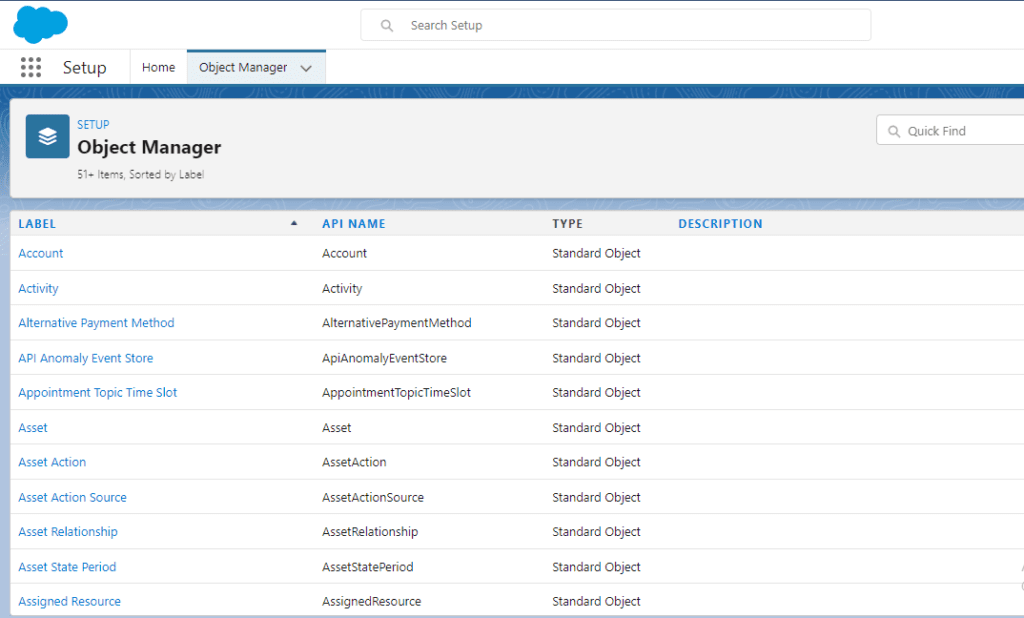
Step 2 Setup > Object Manager.

Capture 1024x618 1

Step 3 Click on Account > field & Relationship > New.

2

Step 4 Select Roll – Up Summary > Next.

3

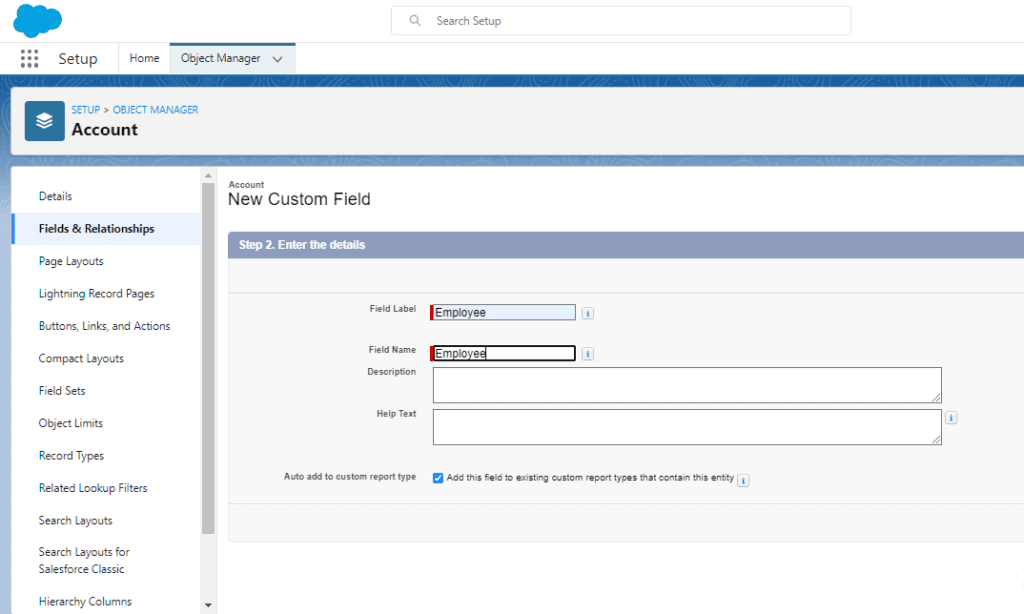
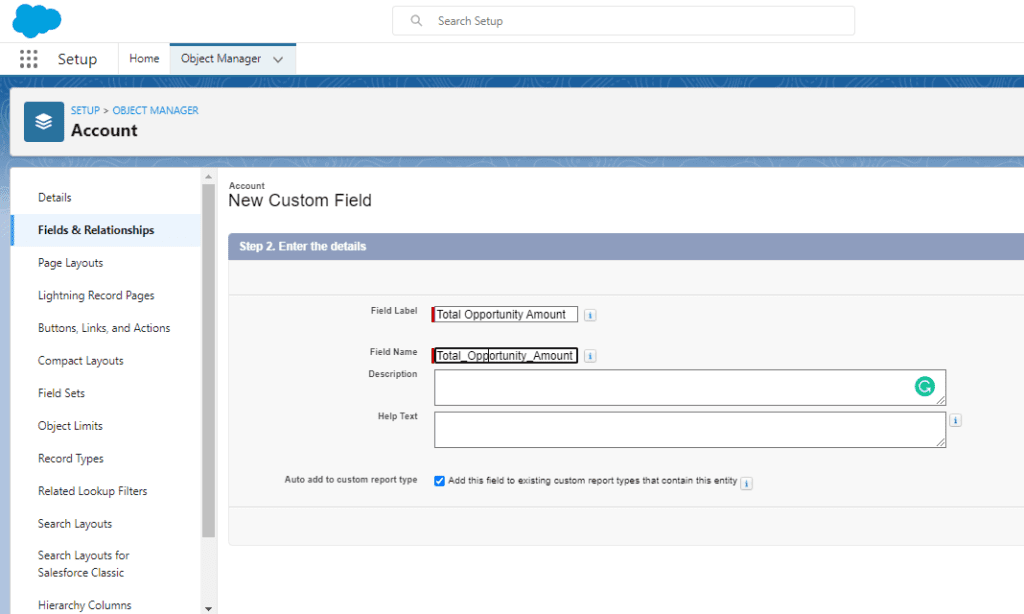
Step 5 Complete all the Steps and fill the details which are required. 

5 1

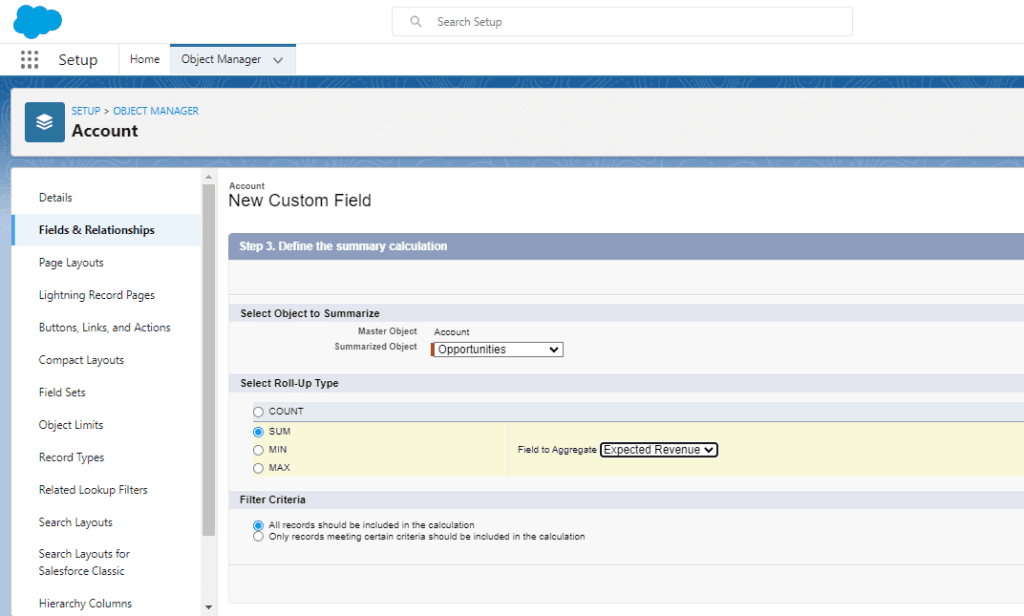
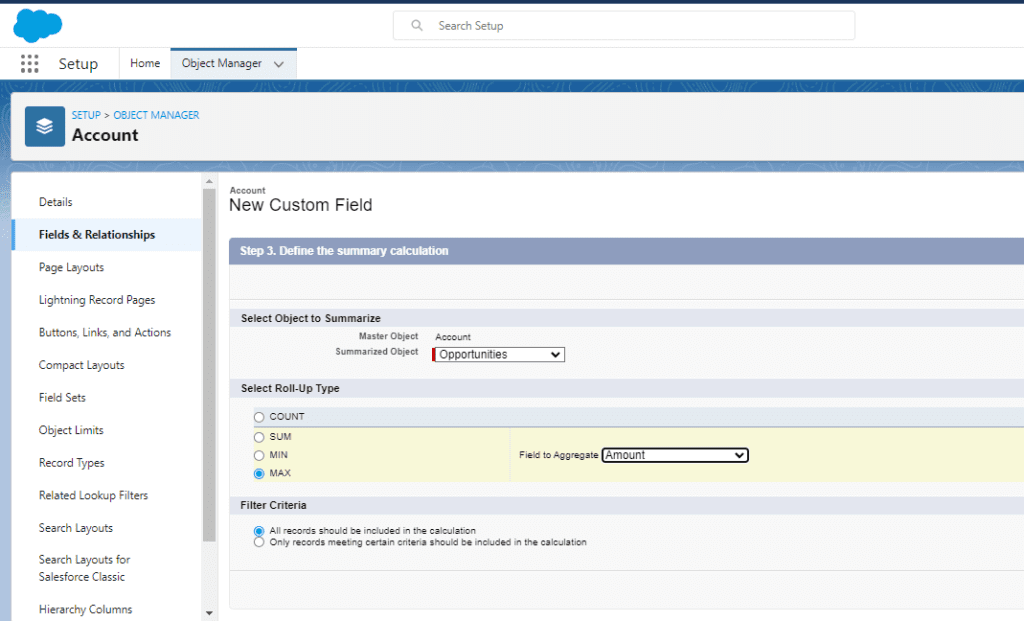
Step 6 Next Steps to Define the Summary and provide the function as shown in figure.

6 1

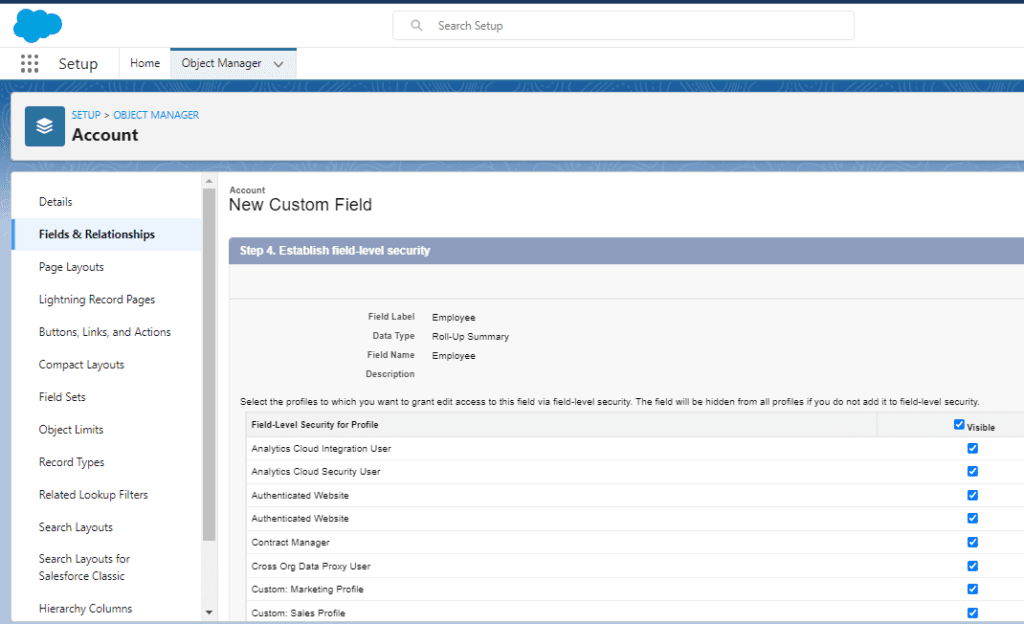
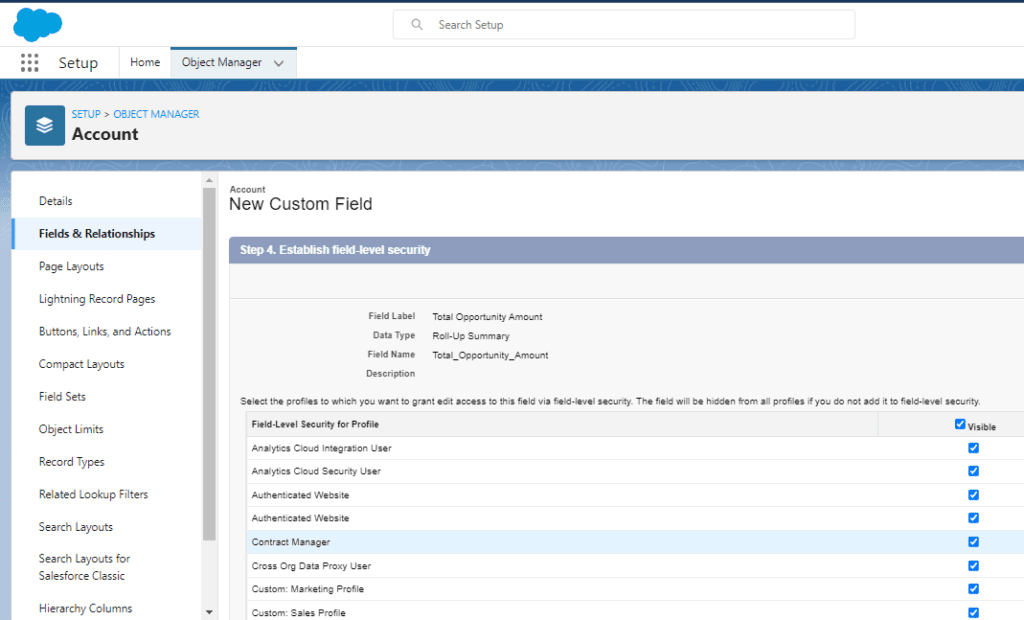
Step 7 Another Steps is to define the Field Security level. Here the permissions are given. 

7 1

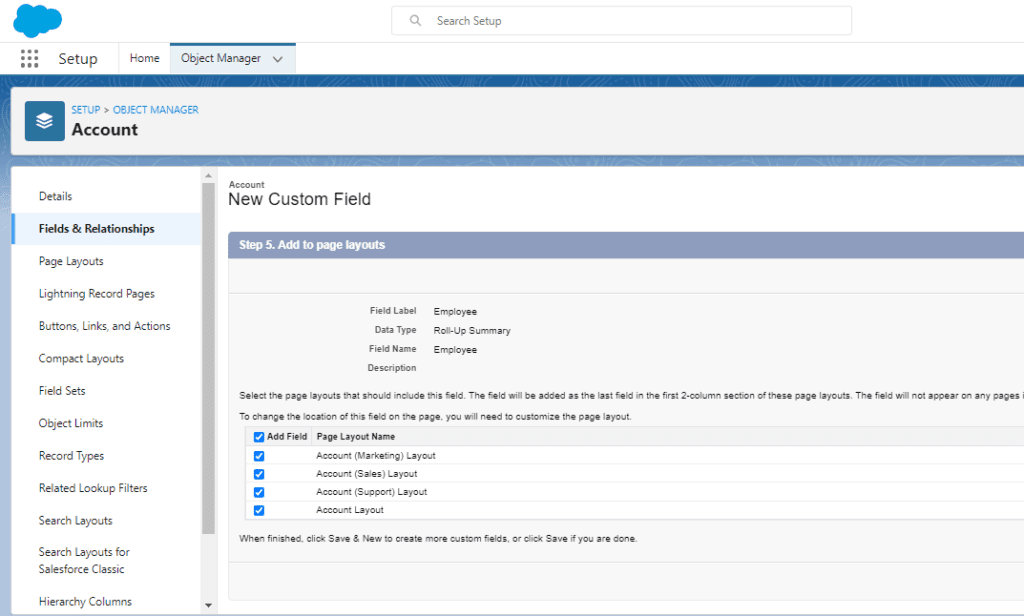
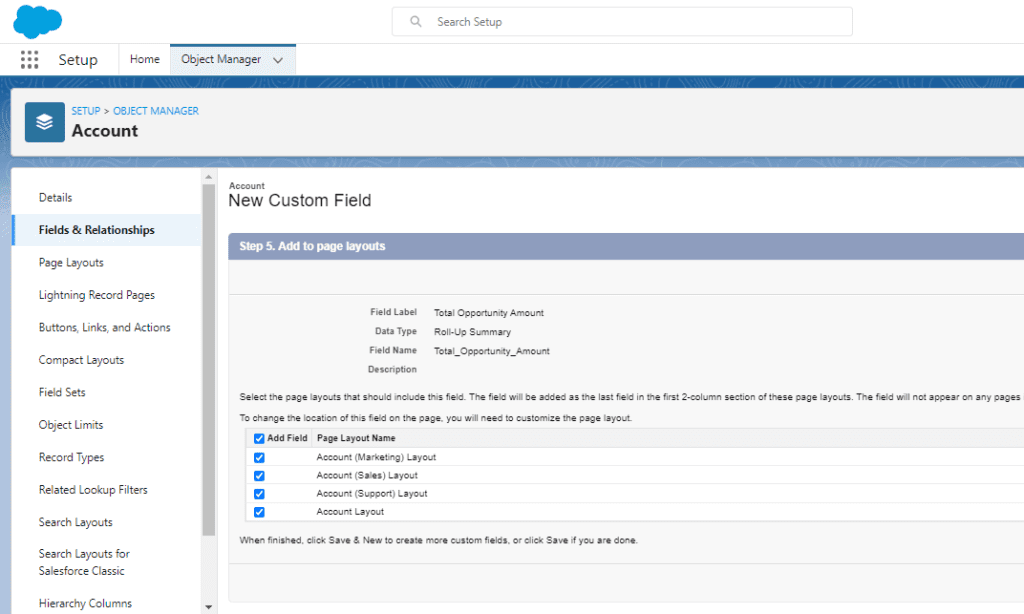
Step 8 Next Steps is to Provide the Page Layout Setting. As where the Output of desired function will be shown.

8

Our Roll-Up Summary Field for the Sum function has been established. Now we can get a total Summation of the value present in the Record.

Happy Learning!

READ MORE
TECHAvatar of Abhinav KumarAbhinav Kumar0 Comments
Share article:TwitterFacebookLinkedin
1512 Views
63 Likes

Roll-Up Summary Fields in Salesforce for (MIN) Function

Min -: In Roll -Up Summary we use Min function to calculate the field’s minimum value in all child records.

Steps To Create Roll-Up Summary Fields in Salesforce for (MIN) Function

Step 1 Login to your org.

Step 2 Setup > Object Manager. 

Capture

Step 3 Click on Account > field & Relationship > New.

2

Step 4 Select Roll – Up Summary > Next.

3

Step 5 Complete all the Steps and fill the details which are required.
12

Step 6 Next Steps to Define the Summary and provide the function as shown in figure.
9

Step 7 Another Steps is to define the Field Security level. Here the permissions are given. 
10

Step 8 Next Steps is to Provide the Page Layout Setting. As where the Output of desired function will be shown.

12 1

Our Roll-Up Summary Field for the Min function has been established. Now we can get a total Minimum of the value present in the Record.

Happy Learning!

READ MORE
TECHAvatar of Abhinav KumarAbhinav Kumar0 Comments
Share article:TwitterFacebookLinkedin
1433 Views
62 Likes

Roll-Up Summary Fields in Salesforce for (COUNT) Function

Count -: In Roll -Up Summary we use Count function for counting the number of child records that exist for the parent record

Steps To Create Roll-Up Summary Fields in Salesforce for (COUNT) Function

Step 1 Login to your org.

Step 2 Setup > Object Manager.

Capture 1024x618 1

Step 3 Click on Account > field & Relationship > New.
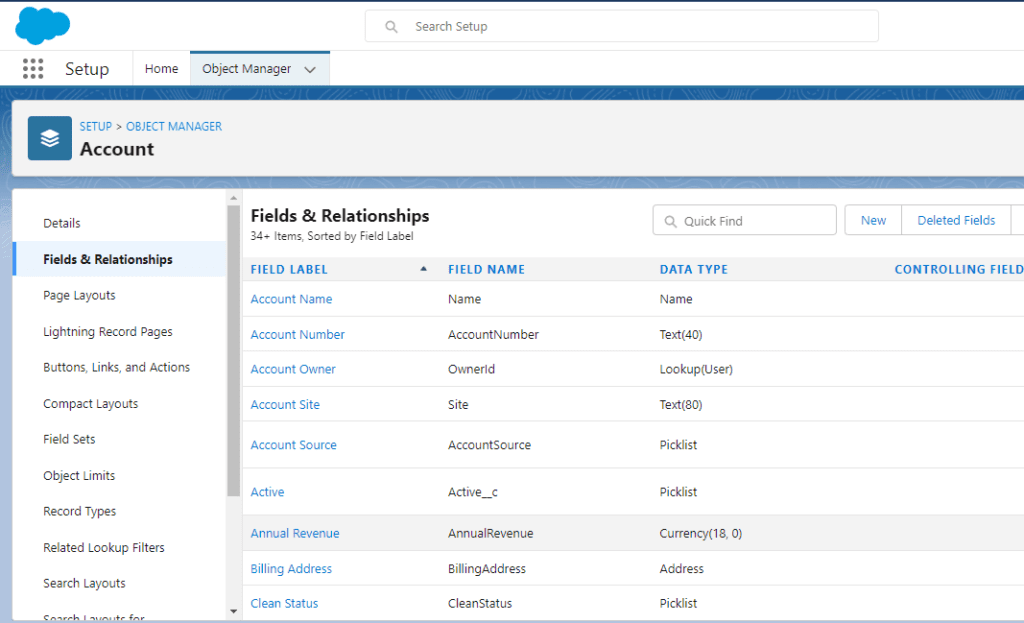
2 1024x623 1

Step 4 Select Roll – Up Summary > Next.
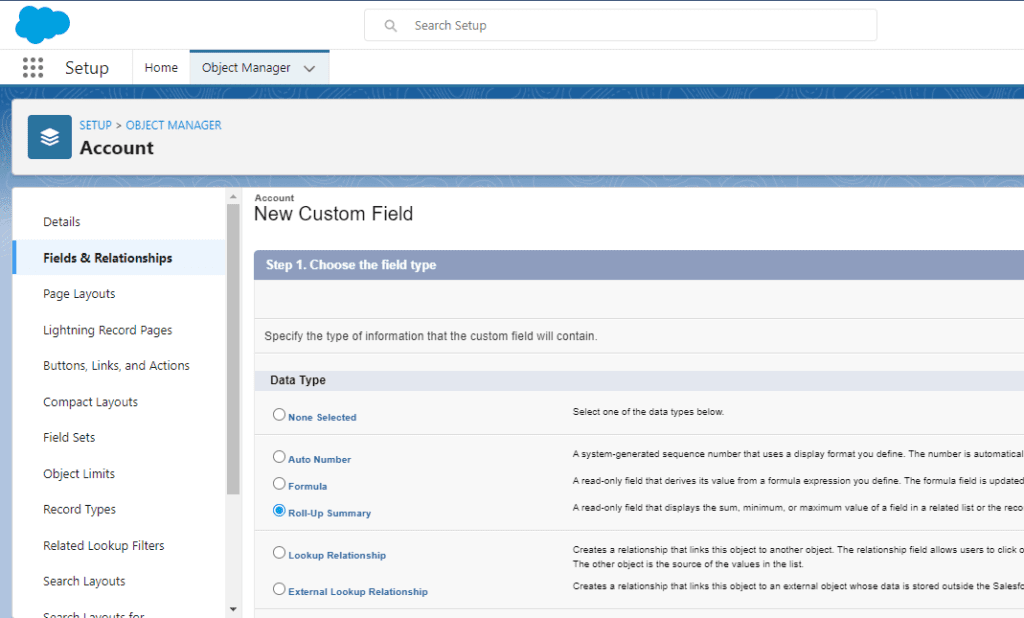
3 1024x618 1

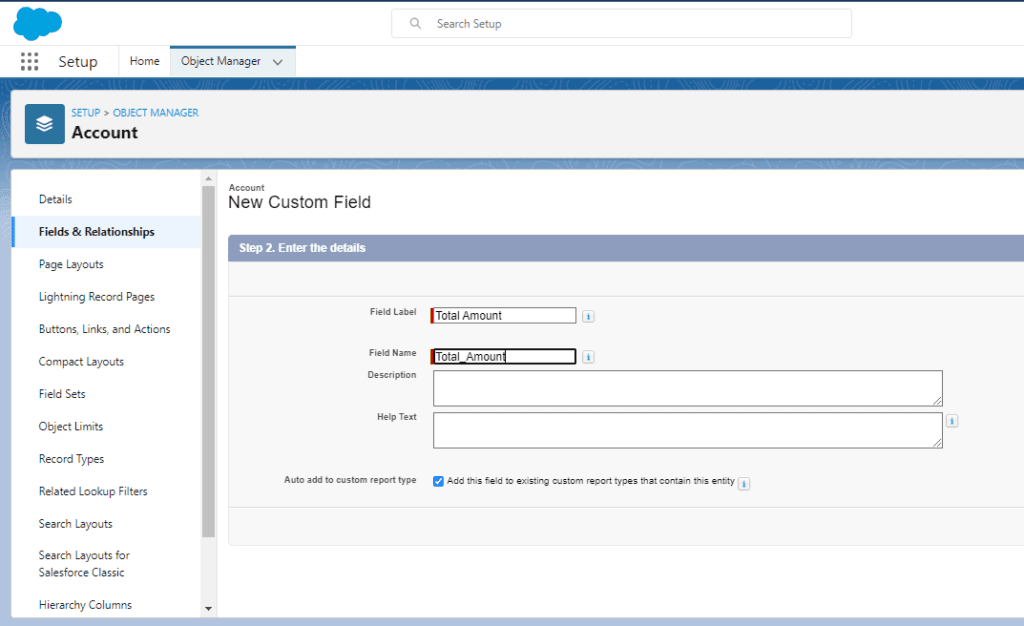
Step 5 Complete All the Steps And fill the details which are required.
Capture 1 1024x626 1

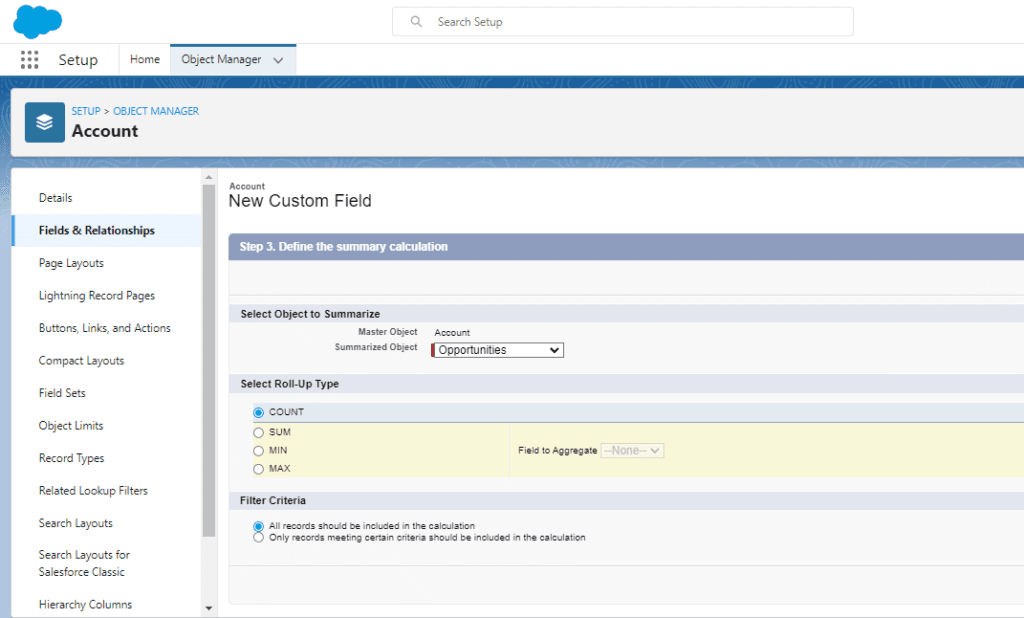
Step 6 Next Steps to Define the Summary And provide the function as shown in figure.
2 1 1024x618 1

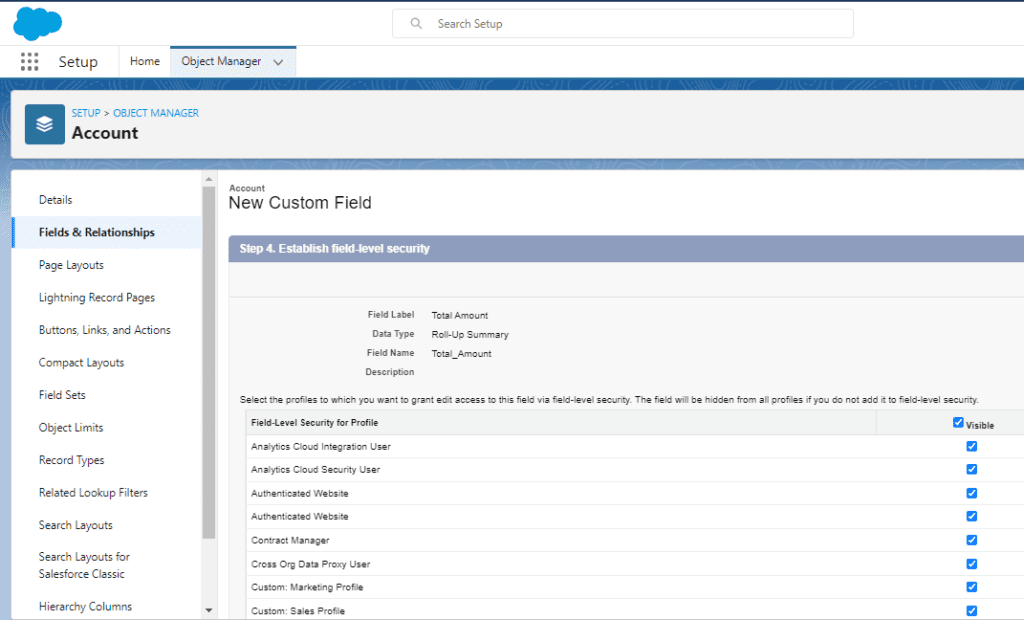
Step 7 Another Steps is to define the Field Security level. Here the permissions are given.
3 1 1024x620 1

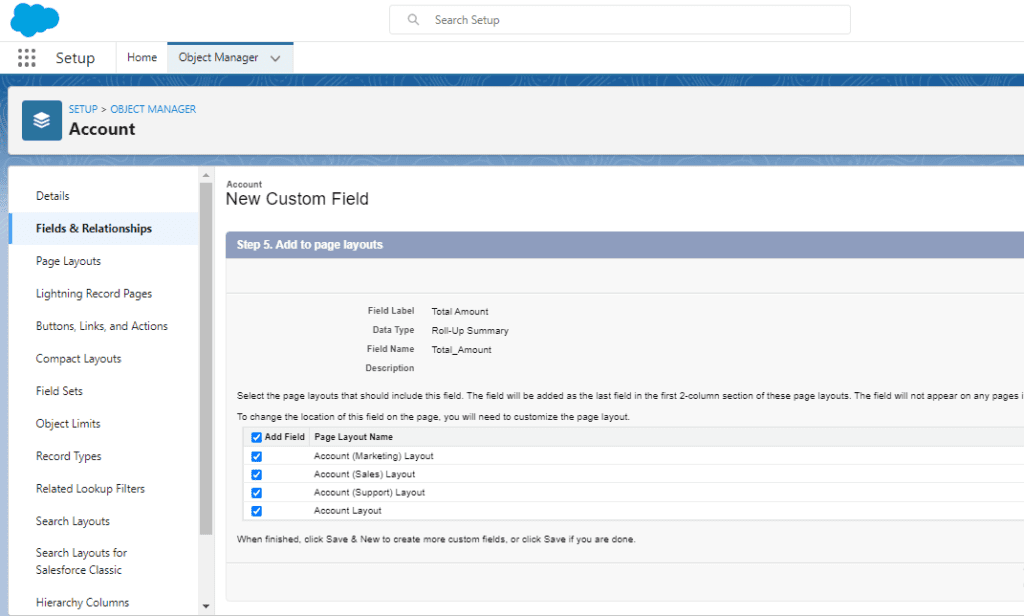
Step 8 Next Steps is to Provide the Page Layout Setting. As where the Output of desired function will be shown.
4 1 1024x616 1

Our Roll-Up Summary Field for the count has been established. Now We can get a count of the value present in the Record.

Happy Learning!

READ MORE
TECHAvatar of Abhinav KumarAbhinav Kumar0 Comments
Share article:TwitterFacebookLinkedin
1400 Views
62 Likes

How to Create Roll-Up Summary Fields in Salesforce

Roll-up summary is a tool in Salesforce that we can use to analyse our data without running summary reports. Roll-up summary fields are used to calculate related record values and to display master records. We can perform different types of calculations with a roll-up summary field such as count, sum, minimum value, or maximum value of a field in the detail records.

The functions which are used in Roll Up Summary -:
1. Count
2. Min
3. Max
4. Sum

Detail Description of each Functions -:
Count -: In Roll -Up Summary we use Count function for counting the number of child records that exist for the parent record.
Min -: In Roll -Up Summary we use Min function to calculate the field’s minimum value in all child records.
Max -: In Roll -Up Summary we use Max function to calculate the field’s maximum value in all child records.
Sum -: In Roll -Up Summary we use Sum function to calculate the Summation of the values of a specified field on a child record.

Steps To Create Roll-Up Summary Fields in Salesforce

Step 1 Login to your org.

Step 2 Setup > Object Manager. 

Capture

Step 3 Click on Account > field & Relationship > New.

2

Step 4 Select Roll – Up Summary > Next.

3

Step 5 Complete All the Steps And fill the details which are required.

4

Step 6 Next Steps to Define the Summary And provide the function as shown in figure.

5

Step 7 Another Steps is to define the Field Security level. Here the permissions are given. 

6

Step 8 Next Steps is to Provide the Page Layout Setting. As where the Output of desired function will be shown.

7

Our Roll-Up Summary Field has been established. Now We can get a maximum value present in the Record.

Happy Learning!


READ MORE
TECHAvatar of Abhinav KumarAbhinav Kumar0 Comments
Share article:TwitterFacebookLinkedin
1565 Views
55 Likes

Master-Detail Relationship

Master-Detail relationship is a type of relationship, one object acts as a master, and the other acts as a detail object. In other words, this relationship acts as a parent-child relationship. We use this type of relationship when we want to bound two objects tightly or closely dependent on each other.

Important Points Regarding Master-Detail relationship (MDR)

  • In Master-Detail Relationship the “child object” or “detail object” must have a parent.
  • Roll-up Summary fields can be established.
  • Records can be re-parented.
  • Standard objects can not be a detailed object
  • Maximum 2 Master-Detail Relationships can be created for an Object.

Steps to create a Master-Detail Relationship(MDR).
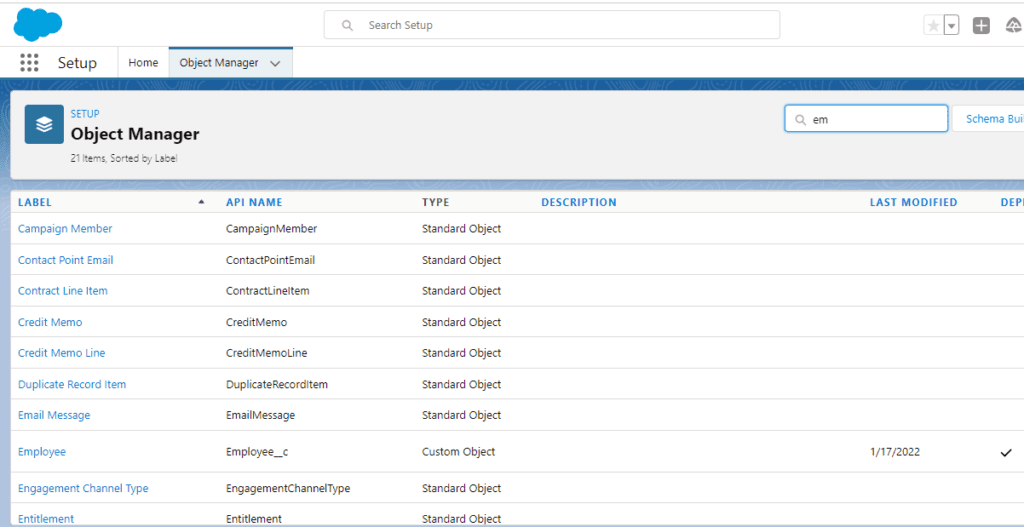
Assuming a situation that any Company is there and we have to create Master-Detail Relationship on the contact of Employee’s who’s working in Company.

Step1-:Login to your org.

Step 2-:Setup > Object Manager > Employee
Screenshot 2022 01 17 220926 1024x527 1

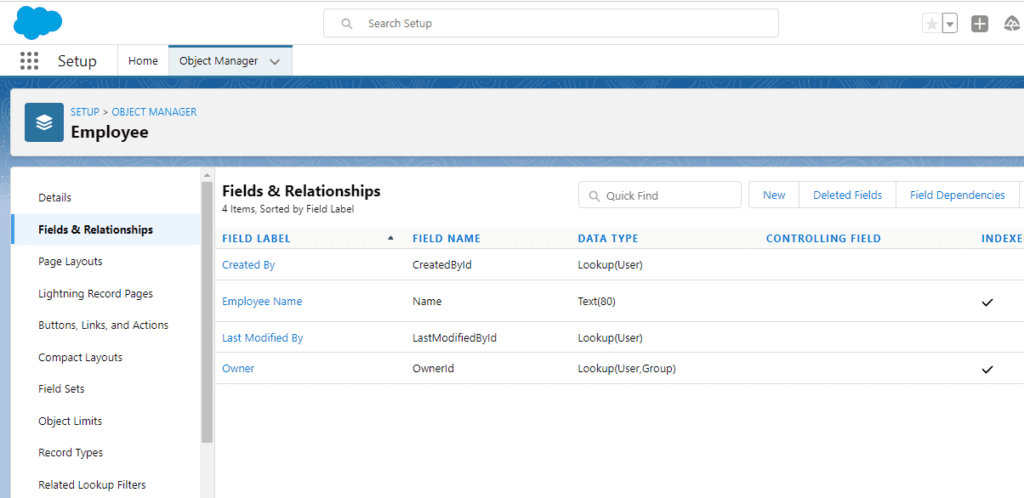
Step3-: Click on field & Relationship > New 
Screenshot 2022 01 17 221338 1024x498 1
Master-Detail Relationship 37

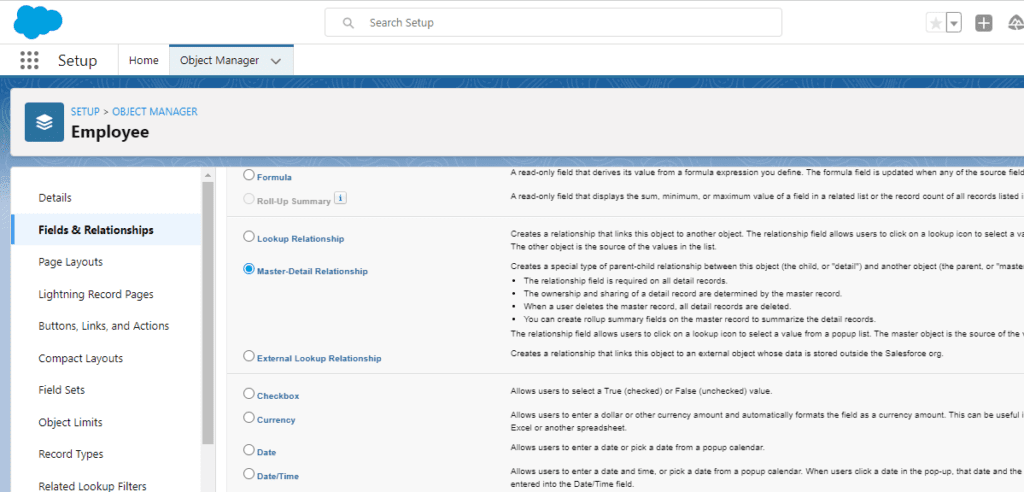
Step 4-: Select Master Detail Relationship >Next.

Screenshot 2022 01 17 221637

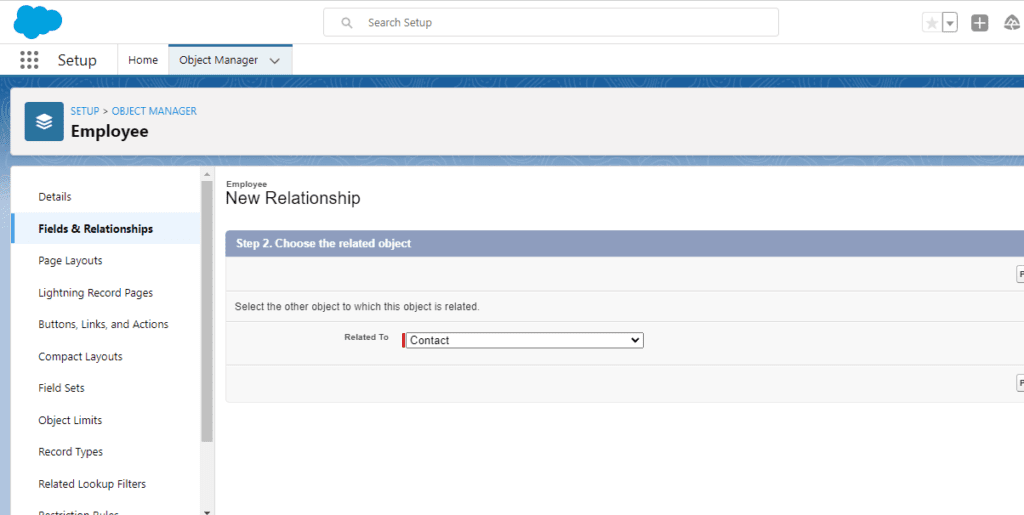
Step 6-: Select Contact from the drop-down > Next.
Screenshot 2022 01 17 221637 1024x492 1

Step 6-: The next page will be containing Child Relationship with a parent.
Screenshot 2022 01 17 223844 1024x515 1

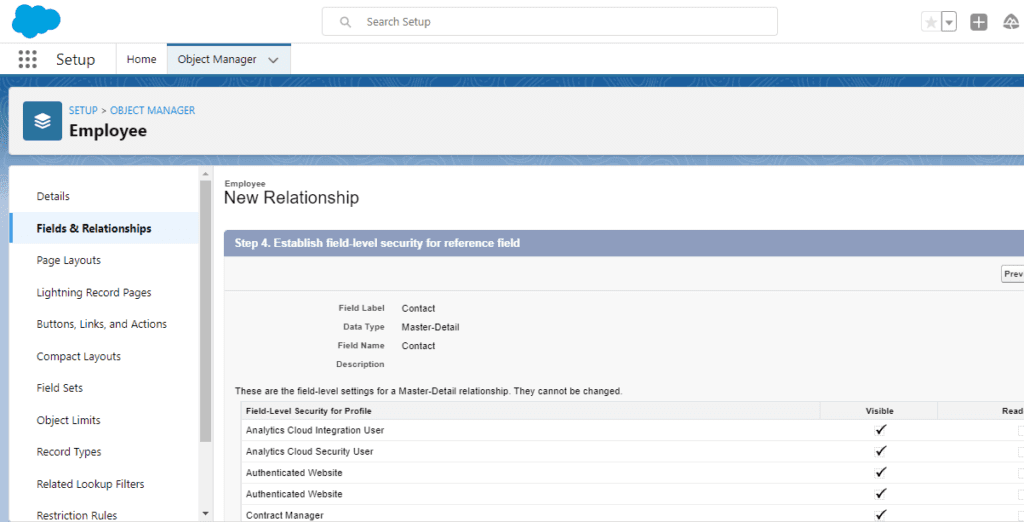
Step 7 -: Next step is Field-level Security.
sd 1024x522 1

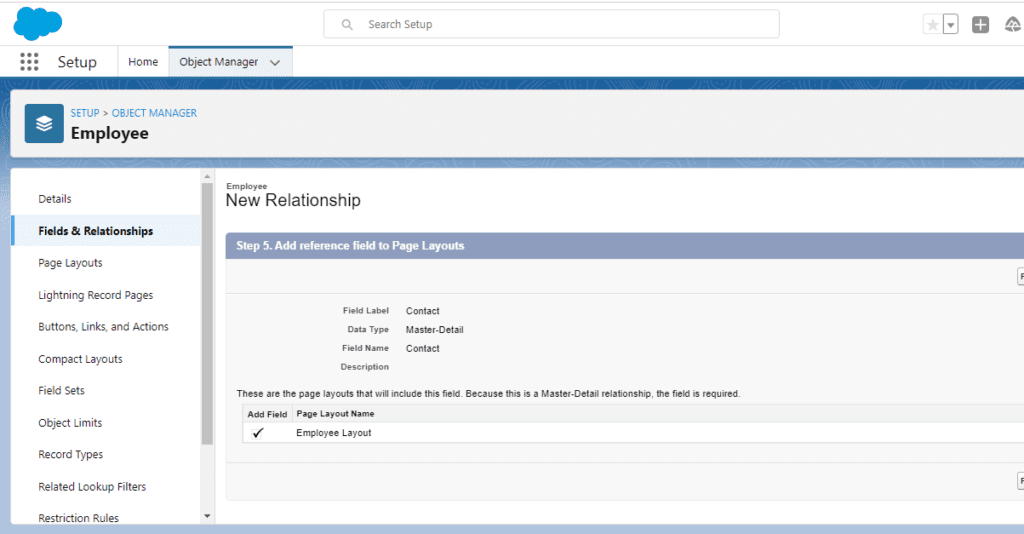
Step 8-: Another Step is for the Page Layout Reference
Screenshot 2022 01 17 224207 1024x534 1

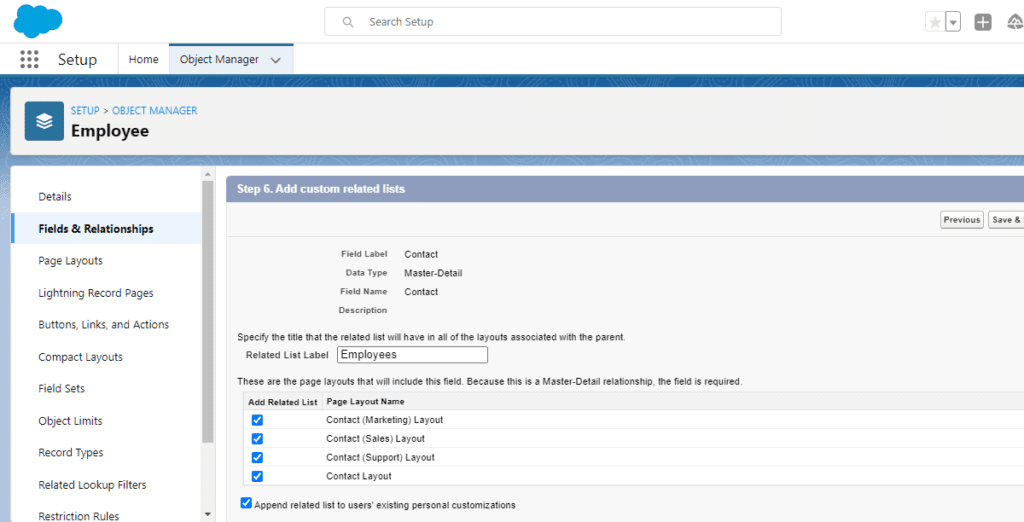
Step 9 -: Last step is the Addition of a Related list and Saving the Master-Detail Relationship.
Screenshot 2022 01 17 224314 1024x522 1

Conclusion: Here we have got a detailed Step by Step understanding of how to create a Master-Detail Relationship.

Happy learning

Written By: Ashutosh Tiwari

READ MORE
TECHAvatar of Abhinav KumarAbhinav Kumar0 Comments
Share article:TwitterFacebookLinkedin
1789 Views
91 Likes

How to register for the Salesforce Developer Certification Exam

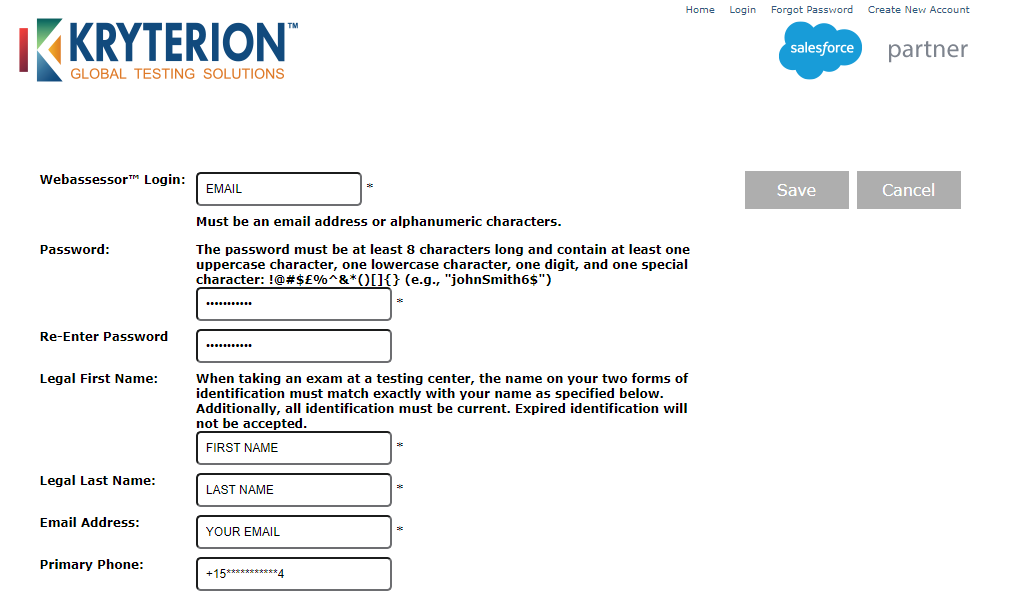
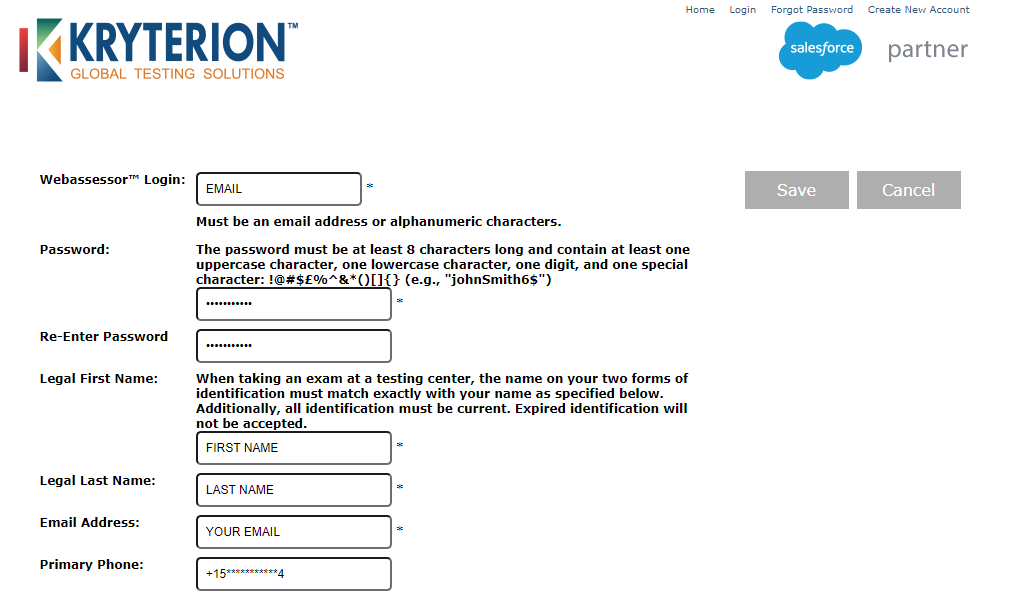
To Register for the salesforce Developer Certification Exam Follow the following steps which are-

Step 1-: Signup and create the account from the link given below and add the required Personal Information.

https://www.webassessor.com/wa.do?page=createAccount&branding=SALESFORCE
5 1
3 2
4


Step 2 -:
Click Save to get a verification email on your registered email address.

Step 3 -: Now Login into the page by giving your credentials.

6

Step 4-: Read the general agreement and then click on the agree button to move to next steps.

7 1

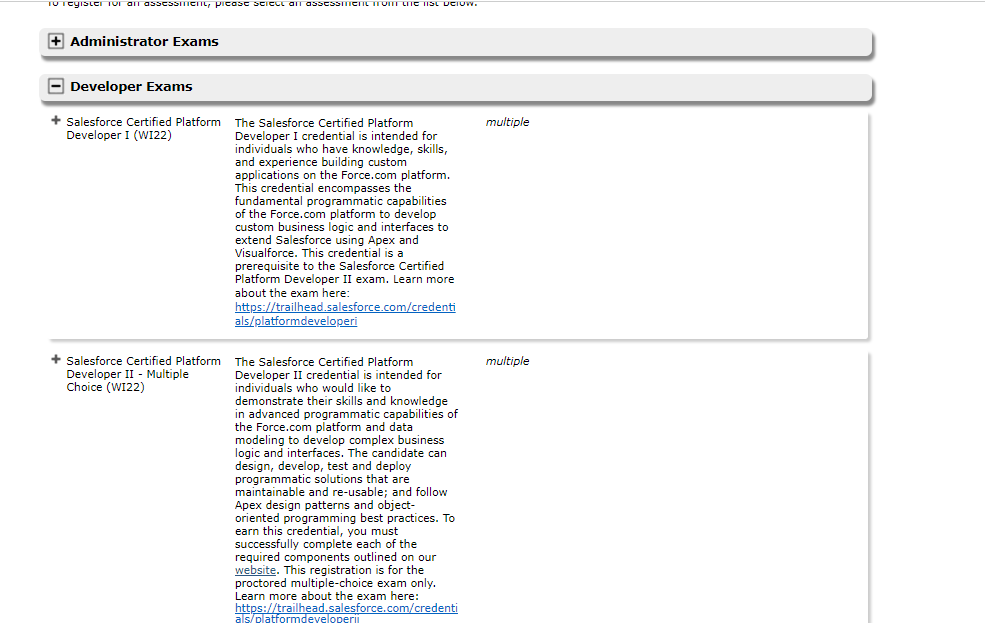
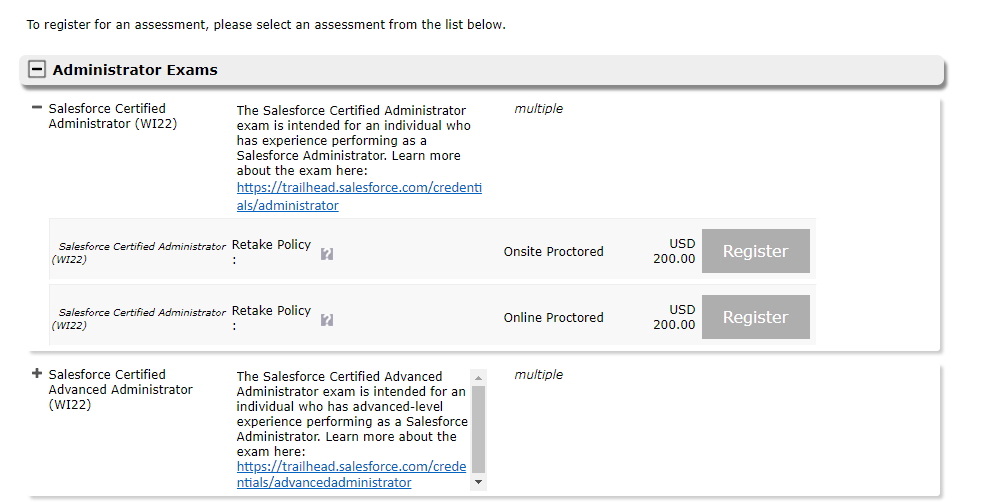
Step 5-: Click on Register for An Exam .You will notice an several option such as Administrator Exam, Developer Exam, Consultant Exam.

8

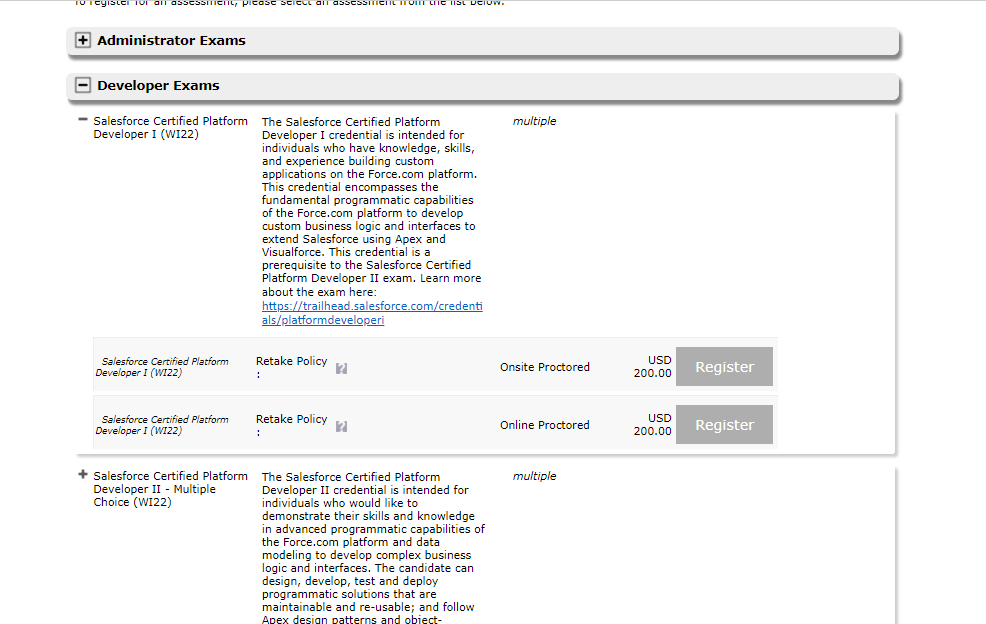
Step 6-: Since we are scheduling the Developer Exam, click on the Developer Exams accordion. Select the Salesforce Certified Platform Developer (WI22) Exam and click on Register.

23
25

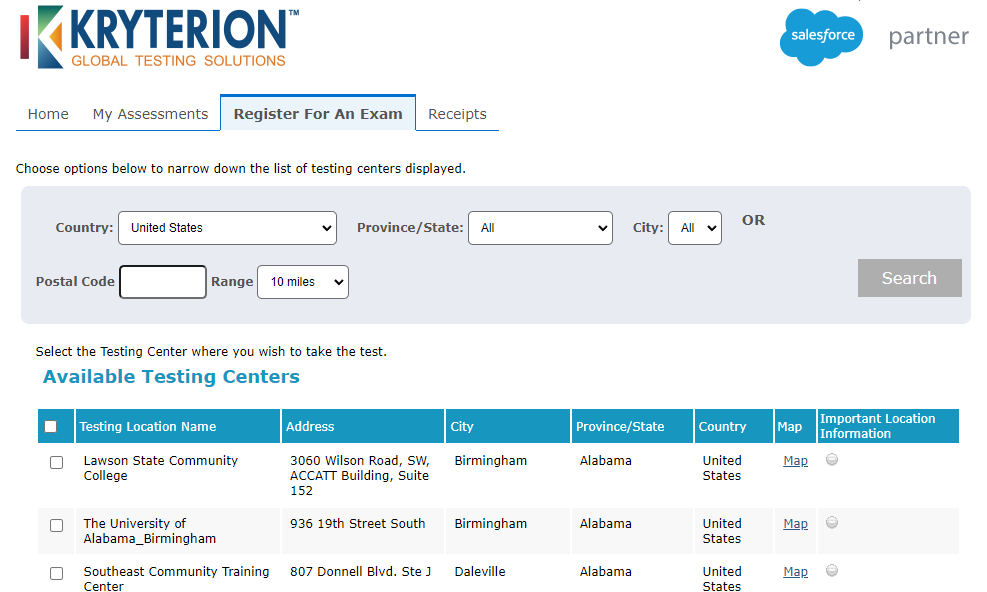
Step 7-: You will be Asked to select the available test Center, Date and Time Then click on Next.

register for exam

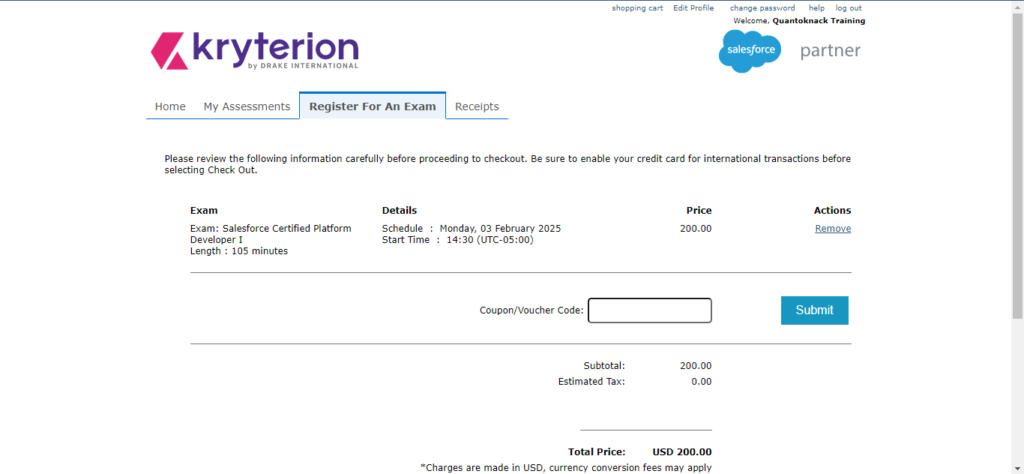
Step 8-: The last step is Checkout process. If you are having any Coupon/Voucher Code please enter it and complete the transection process.

register for dev exam

At last you are done with the registration process. Now you have to give the Exam on the Allotted Date and Time.

All the Best!

READ MORE
TECHAvatar of Abhinav KumarAbhinav Kumar0 Comments
Share article:TwitterFacebookLinkedin
1878 Views
77 Likes

How to register for the Salesforce Administrator Certification Exam

To Register for the salesforce Administrator Certification Exam Follow the following steps which are-

Step 1-: Signup and create the account from the link given below and add the required Personal Information.

https://www.webassessor.com/wa.do?page=createAccount&branding=SALESFORCE
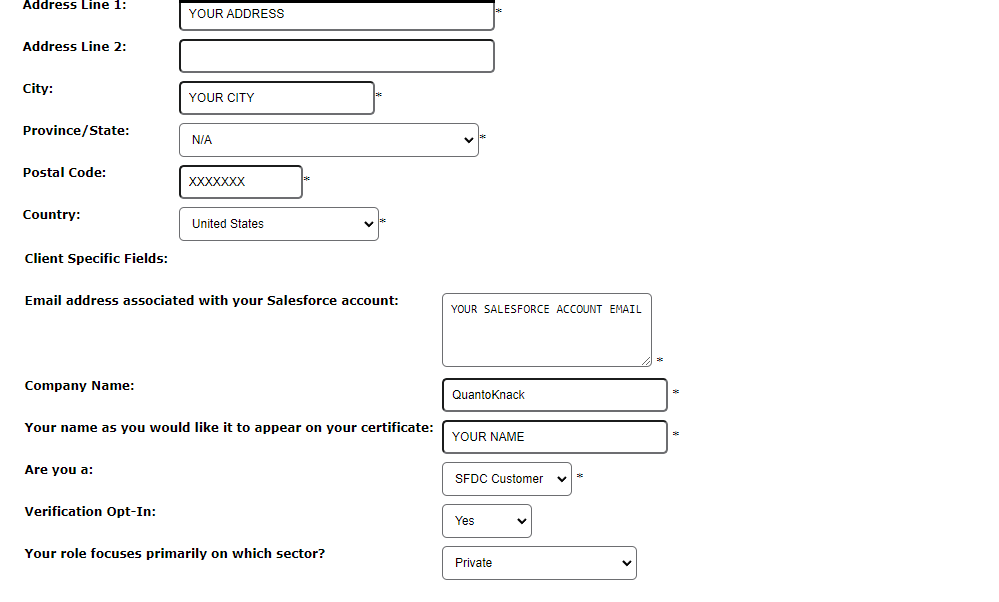
5
3 2
4


Step 2 -:
Click Save to get a verification email on your registered email address.

Step 3 -: Now Login into the page by giving your credentials.
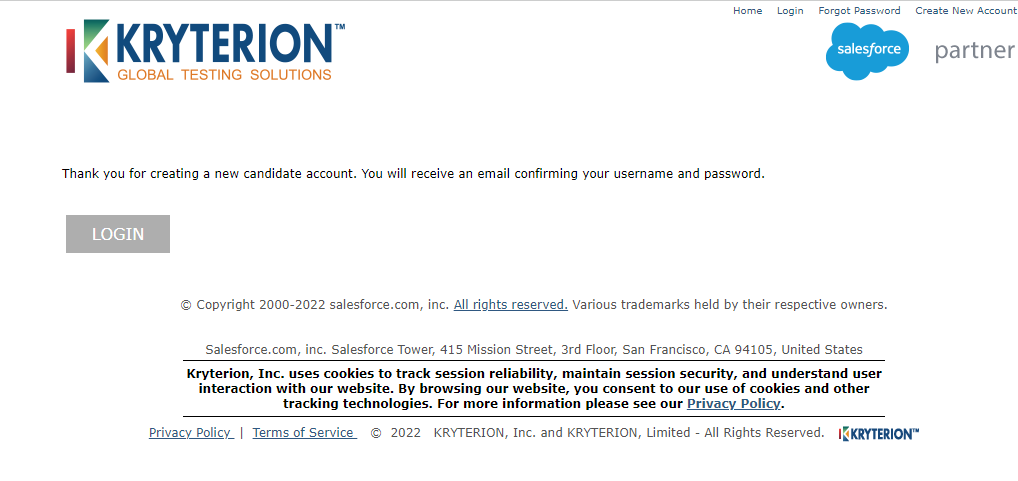
6

Step 4-: Read the general agreement and then click on the agree button to move to next steps.
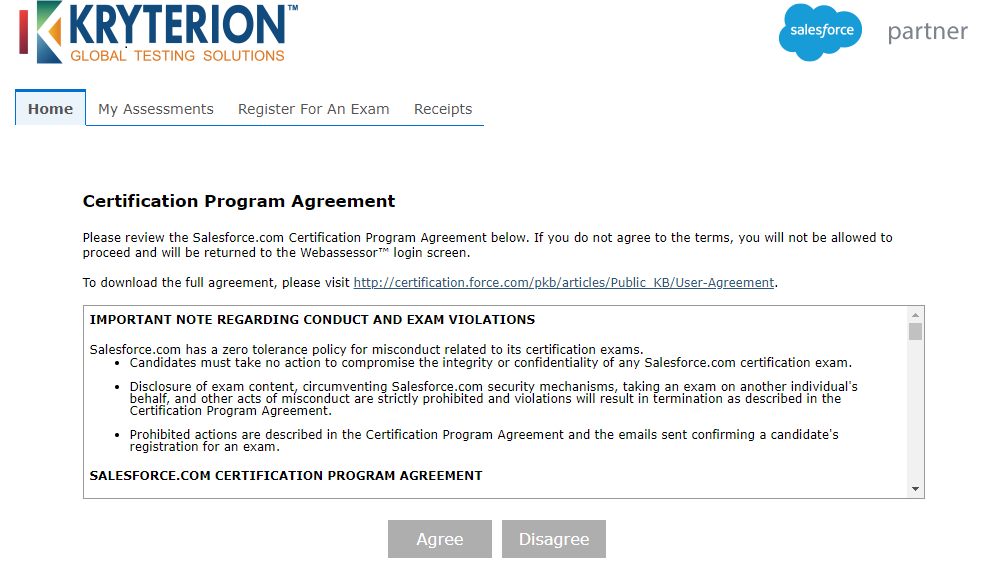
7 1

Step 5-: Click on Register for An Exam .You will notice an several option such as Administrator Exam, Developer Exam, Consultant Exam.
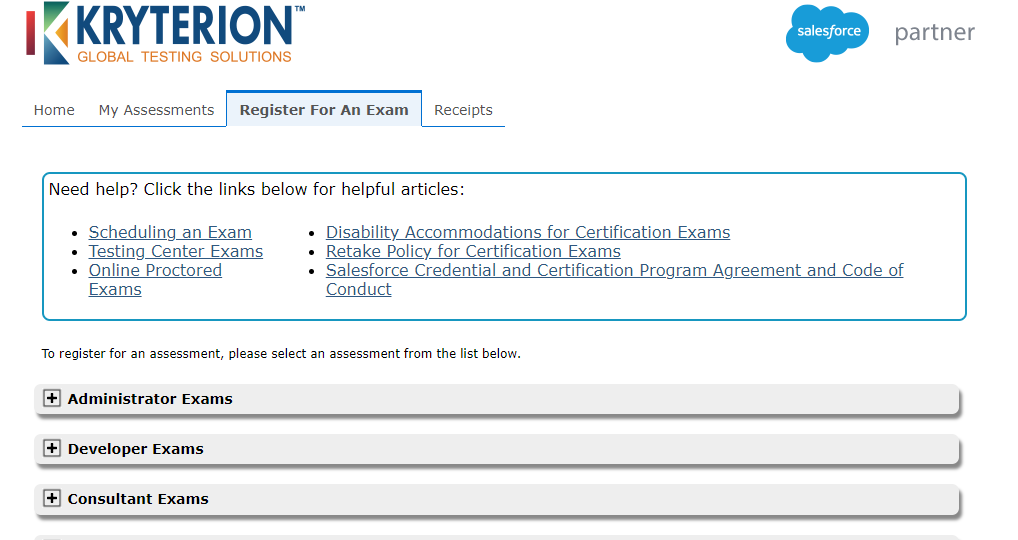
8

Step 6-: Since we are scheduling the Administrator Exam, click on the Administrator Exams accordion. Select the Salesforce Certified Administrator (WI22) Exam and click on Register.

9

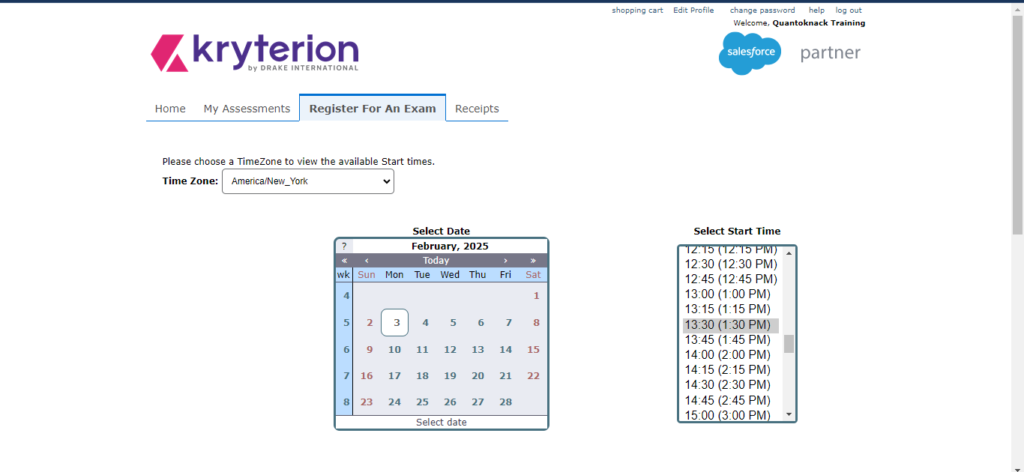
Step 7-: You will be Asked to select the available test Center, Date and Time Then click on Next.
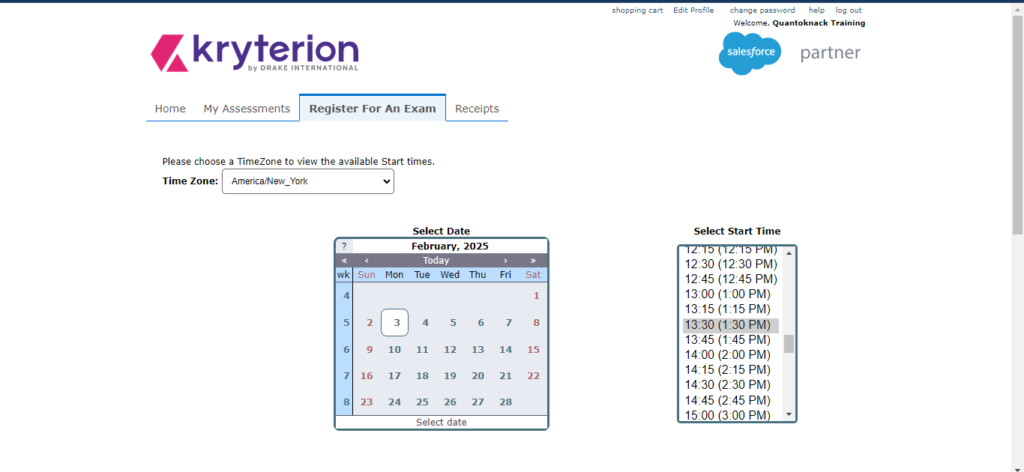
registration

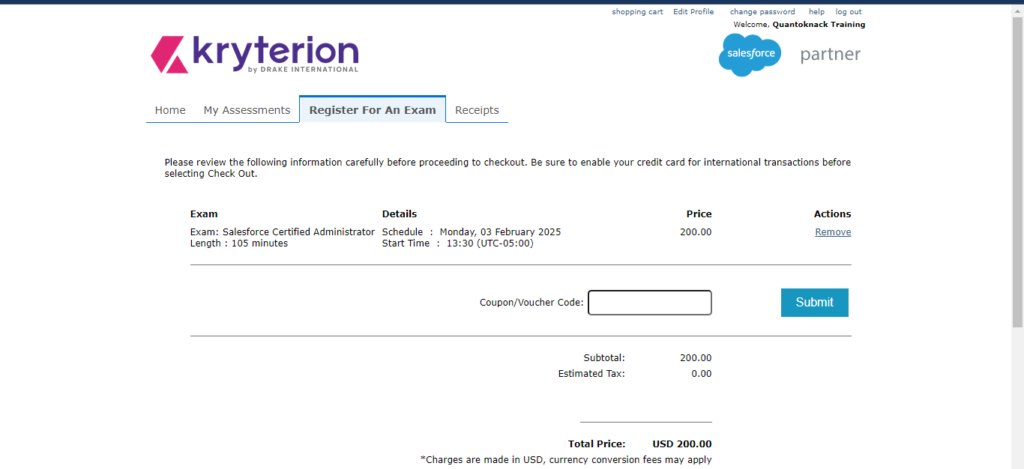
Step 8-: The last step is Checkout process. If you are having any Coupon/Voucher Code please enter it and make a transection process.

register for exam

At last you are done with the registration process. Now you have to give the Exam on the Allotted Date and Time.

All the Best!

READ MORE
TECHAvatar of Abhinav KumarAbhinav Kumar0 Comments
Share article:TwitterFacebookLinkedin
1414 Views
52 Likes

Lookup Relationship

Lookup relationship is a type of relationship in which that if one gets deleted then the related object will not get deleted.

Important Points Regarding look Up Relationship

  • When a parent’s record gets deleted, the child remains in existence.
  • We cannot create a roll-up summary field in a lookup relationship.
  • The relationship is optional.
  • No impact on Security.
Steps to create a Lookup Relationship.
Assuming a situation that any Company is there and they are having Account section Teams They want to have the Account records of Employee’s who’s working in Company.

Step1-:Login to your org

Step 2-:Setup > Object Manager > Employee

Screenshot 2022 01 17 220926

Step3-: Click on field & Relationship > New 

Screenshot 2022 01 17 221338

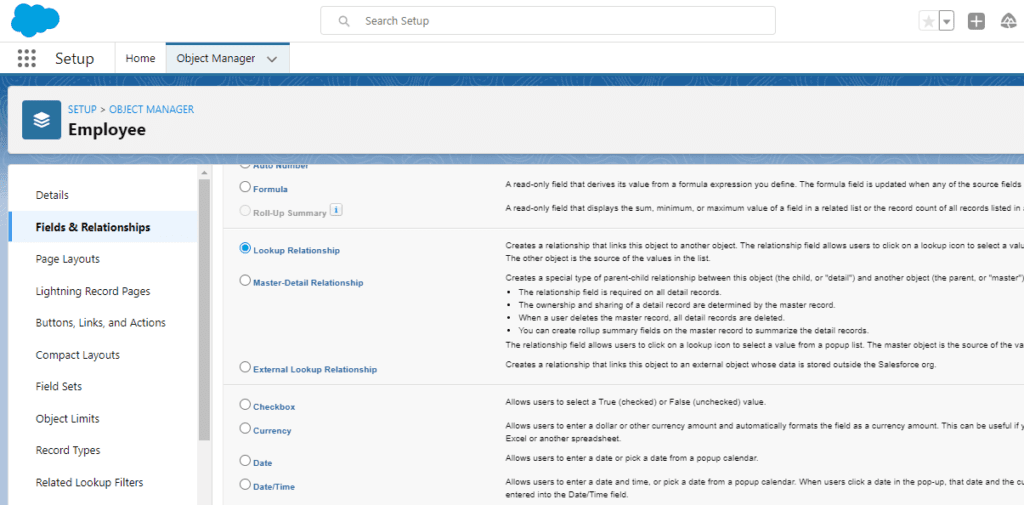
Step 4-: Select Lookup Relationship >Next.

Screenshot 2022 01 17 221502

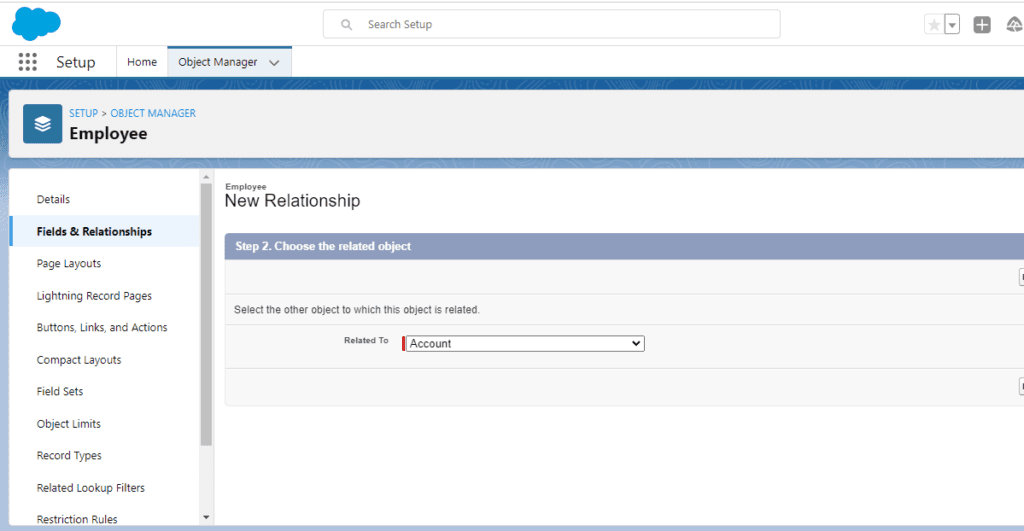
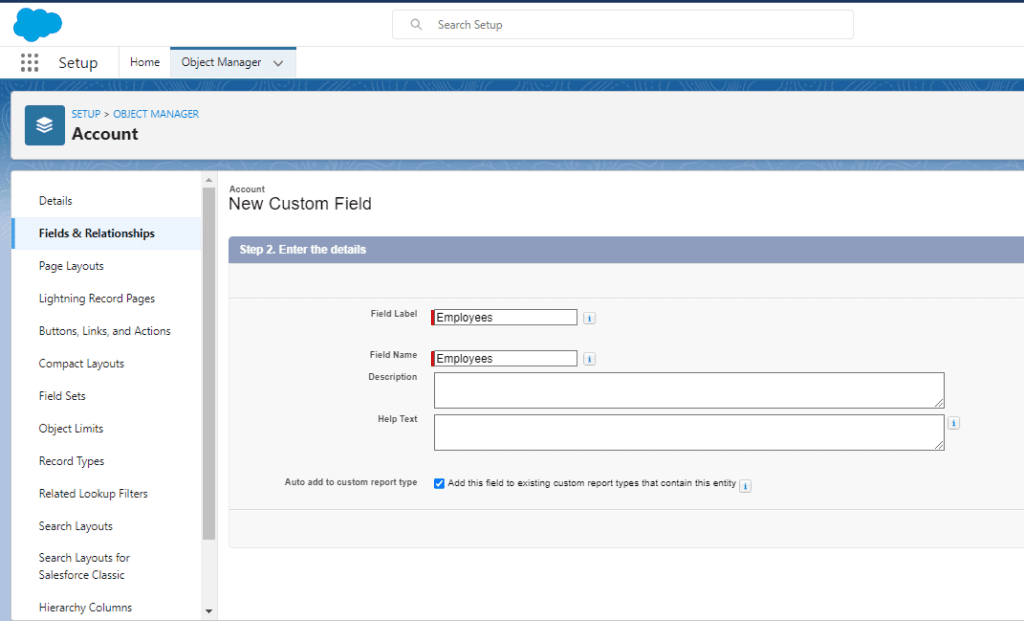
Step 5-: Select Account from the drop-down > Next.

Screenshot 2022 01 17 221738

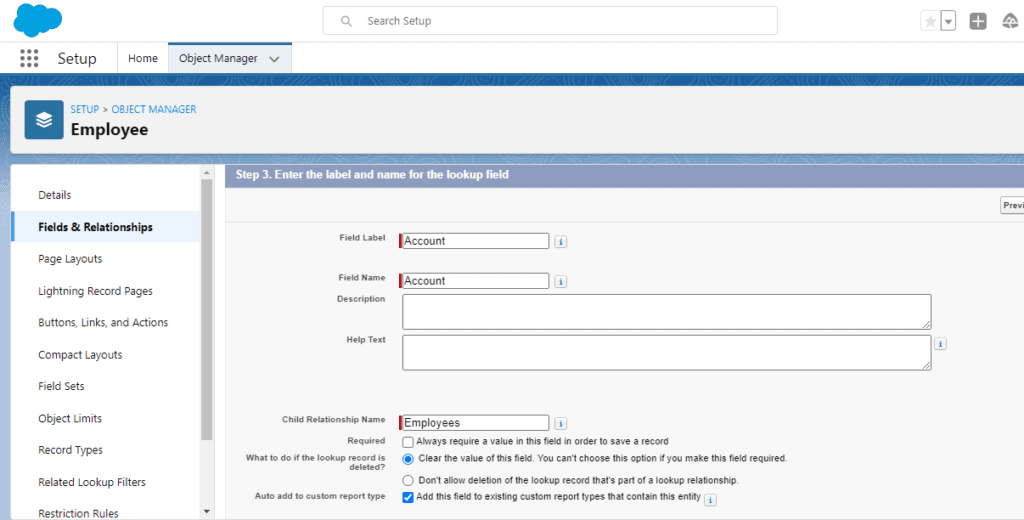
Step 6-: The next page will be containing Child Relationship with a parent.

Screenshot 2022 01 17 221930

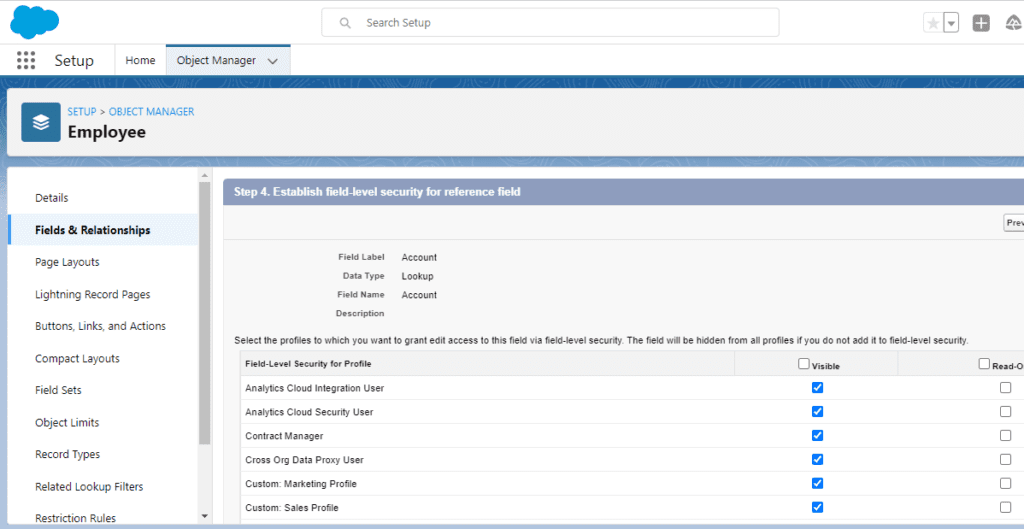
Step 7 -: Next step is Field-level Security.

Screenshot 2022 01 17 222029

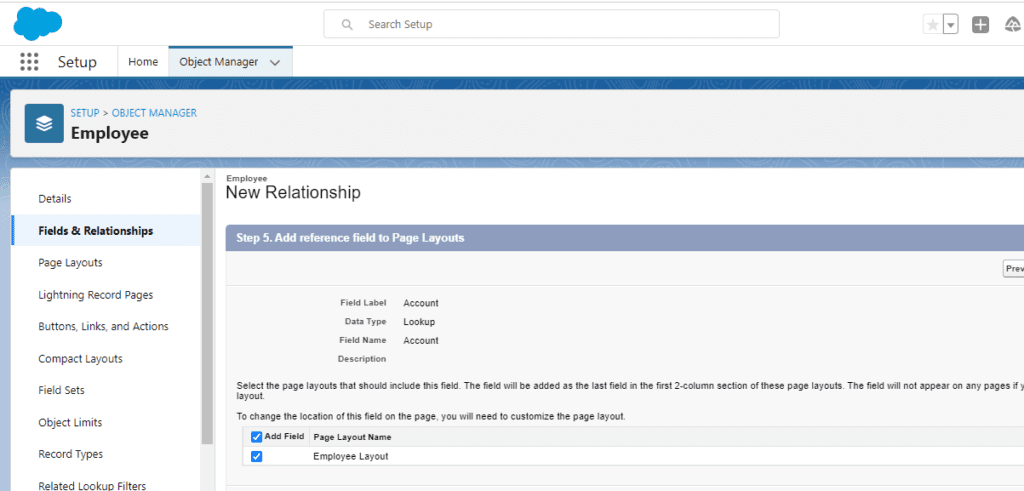
Step 8-: Another Step is for the Page Layout Reference

Screenshot 2022 01 17 222213

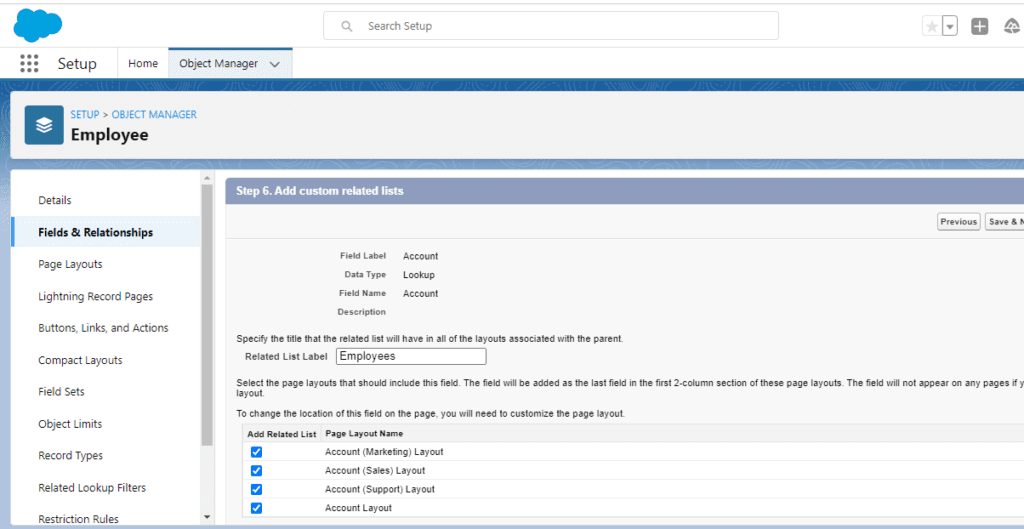
Step 9 -: Last step is the Addition of a Related list and Saving the Lookup Relationship.

Screenshot 2022 01 17 222345

Conclusion: Here we have got a detailed Step by Step understanding of how to create a Lookup Relationship.

Happy learning

Written By: Ashutosh Tiwari

READ MORE
Recent Posts
  • How Salesforce Data Integration Tools Simplify Real-Time Business Connectivity
    In a nutshell, businesses collect operational data to perform...
  • Design, Build, and Optimize Agents with Agentforce 360 Innovations
    In this fast-moving digital world, businesses also want smarter...
  • Salesforce Built-In Payment Processing: How to Handle Everything End-to-End
    In the current digital economy, where online payments have...
  • Explore Top Salesforce Integration Challenges and Ways to Fix Them
    Integrating any system can be a difficult task, as an...
  • Protecting Sensitive Data: A Complete Guide to Encryption in Salesforce
    In the current digital economy, data can easily rank at the top...
logotype

We cater to individuals and corporates and provide IT training and certification programs.

44679 Endicott Drive Suit 300 #1046 Ashburn, VA 20147 United States

Phone: +1-571 989 9489

Email: atul.deo@quantoknack.com

Useful links

About Us

Contact Us

Blog

Courses

  • Live Salesforce Admin Training
  • Business Analyst
  • QA Testing Course
  • Advance JAVA Training
  • SQL Server Training
  • Live Salesforce Developer Training Certification Course
  • Digital Marketing
  • Oracle DBA Training

Subscribe

    Instagram Pinterest Linkedin
    Facebook
    Logo star

     2024 Quantoknack. All Rights Reserved