

Become a Instructor

Blogs

logotype
Menu
  • Courses
    • Salesforce Admin
    • Salesforce Developer
    • Advance Java Training
    • Buisness Analyst
    • Digital Marketing
    • Oracle DBA
    • QA Testing Course
    • SQL server Training
  • Register
+1-571 989 9489
logotype
  • Courses
    • Salesforce Admin
    • Salesforce Developer
    • Advance Java Training
    • Buisness Analyst
    • Digital Marketing
    • Oracle DBA
    • QA Testing Course
    • SQL server Training
  • Register
  • +1-571 989 9489

Become a Instructor

Blogs

logotype
Menu
  • Courses
    • Salesforce Admin
    • Salesforce Developer
    • Advance Java Training
    • Buisness Analyst
    • Digital Marketing
    • Oracle DBA
    • QA Testing Course
    • SQL server Training
  • Register
+1-571 989 9489
  • Courses
    • Salesforce Admin
    • Salesforce Developer
    • Advance Java Training
    • Buisness Analyst
    • Digital Marketing
    • Oracle DBA
    • QA Testing Course
    • SQL server Training
  • Register
  • +1-571 989 9489
logotype
logotype
  • Courses
    • Salesforce Admin
    • Salesforce Developer
    • Advance Java Training
    • Buisness Analyst
    • Digital Marketing
    • Oracle DBA
    • QA Testing Course
    • SQL server Training
  • Register
  • +1-571 989 9489
salesforce developer training and certification Tag
Home Posts Tagged "salesforce developer training and certification"

Tag: salesforce developer training and certification

TECHAvatar of adminadmin0 Comments
Share article:TwitterFacebookLinkedin
114 Views
11 Likes

Salesforce Built-In Payment Processing: How to Handle Everything End-to-End

In the current digital economy, where online payments have become the standard for all, the capability to process payments right within your CRM can be a real game-changer. It simplifies business operations, improves financial analysis, and may increase conversion rates. Salesforce, the world’s most popular CRM solution, has excellent payment processing functionality from the point a customer checks out or is sent an invoice, all the way through to authorization and settlement. For today’s Salesforce experts, particularly those seeking Salesforce developer training or a Salesforce developer course, the know-how to create and control these processes is a must-have.

Now, let’s take a closer look at the subject at hand.

What Is Salesforce’s Built-In Payment Processing?

The built-in payment processing functionality of Salesforce enables businesses to process, capture, and manage payments right from within the CRM. This can be done either through native functionality (Salesforce Payments in some regions and versions of Salesforce) or through the integration of payment solutions and adapters that are part of the Salesforce family. With the built-in functionality, the entire payment process, which is linked to Salesforce data models and processes, can be managed from within the CRM.

From Salesforce documentation, payments within the system are managed through objects and APIs that handle tokenization, authorization, capture, and refunds as part of the commerce flow.

Why End-to-End Payment Handling Matters

A lot of businesses use two departments to complete their online sale transactions-Business to Business (B2B) or traditional eCommerce- and have to create and send invoices through Salesforce’s sales processing department while having the other department complete the payment service through a separate service provider/payment gateway; however, end-to-end has now removed these two separate departments by:

·   Housing all payment info in one central location: invoices, methods of payment and payments made (transactions) are managed through Salesforce; therefore, any company can access one single source for their payment-related activities.

·   Reducing the probability of human error: both authorizing & capturing each payment will now be automated with little to no human involvement; therefore, reducing the probability of future errors due to human interference.

·   Increasing the amount of receivables: using real-time status updates in conjunction with automated reminders will enhance cash flow sooner than traditional ways.

·   Increasing compliance levels: The existing payment service providers/gateways that have previously been integrated with Salesforce are now able to comply with established standards with regards to protecting customer-sensitive payment data within that organization’s CRM.

Examples such as FinDock and ChargeOn provide adequate evidence of how well Salesforce can successfully conduct and manage all transactions through a single source with the appropriate level of visibility and support multiple global payment providers.

Key Components of Salesforce Payment Workflows

To fully handle payments within Salesforce, developers can focus on the following components:

1. Payment Gateway Integration

The payment gateway is the bridge between Salesforce and external payment services (such as Stripe, Square, or Braintree). The Commerce Payment Gateway in Salesforce handles tokenization, authorization, capture, and refund API calls, all of which are necessary for securely processing payments from the customer’s credit card or bank account to your merchant account.

2. Tokenization and Security

Payment details should never be stored in Salesforce. This is where payment gateways come in, issuing tokens that represent customers’ payment details. These tokens facilitate secure authorization and capture of payments without exposing cardholder data.

3. Function for authorization and capture

Authorization is the function that checks if there are enough funds available. On the other hand, capture checks if the funds are successfully transferred from the customer to the merchant’s account. Salesforce payment APIs allow both authorization and capture functions to be performed as part of your payment/billing process implemented on Salesforce. This happens irrespective of whether you are using server-side or client-side programming, based on your requirements for security and performance.

4. Refunds, chargebacks, and reconciliation

An end-to-end solution should address post-processing activities, such as issuing refunds or processing chargebacks. This can also specify how to represent these activities in your Salesforce objects. You can use a product like FinDock to automate the reconciliation process, ensuring that your payment and accounting data remain in synchronized.

How the Salesforce Developer Course Can Help You Leverage This Knowledge

One thing is for sure, the experts who understand payment processing in Salesforce stand out in the market. After acquiring this knowledge, you can develop solutions that enable sales, finance, and technical teams to collaborate effectively. This is exactly what training for a Salesforce developer and Salesforce developer courses aim to achieve – to develop technical expertise and practical problem-solving skills.

If you are thinking of entering this field, learning about payment integration, automation in finance services, Apex programming for custom business processes, and API connectivity will increase your skills.

Conclusion

Payment processing in Salesforce is not just an advantage; it is an edge over the competition. With the entire process integrated into your CRM, businesses can accelerate cash flow, simplify sales cycles, and maintain up-to-date financial information without having to access multiple applications.

If you want to become a Salesforce developer, outstanding developer training is essential to accessing solutions to these payment systems and beyond. Once you gain the skills and knowledge needed to perform as a Salesforce developer, you will then have the expertise to help companies transform their payment processing with reliable, easy, and integrated payment processing into their Salesforce environment.

READ MORE
Artificial Intelligenceinformation technologyTECHAvatar of adminadmin0 Comments
Share article:TwitterFacebookLinkedin
222 Views
13 Likes

Salesforce Unveils Agentforce Vibes — Powerful New Tools for Salesforce Developers

Salesforce Agentforce Vibes is one of the tools launched that can help developers to automate most of the work in 2026. They can simply get help to write code, check code written, deploy, and even test for any error. Students take online Salesforce developer training to learn all these tools and features within the system. It makes it easy for both beginner and professional, and even IT or Non IT students, to work for organizations interested in implementing automation.

Completing a Salesforce developer certification validates the knowledge of students, which helps them land a high pay job in firms. But for that, it is important that you understand various powerful uses of Agentforce Vibes and its benefits in the Salesforce system. So, let’s have a better look at all the powerful new tools.

13 Powerful New Tools for Salesforce Developers to Unveil Agentforce!

  1. Natural language–to–code generation (Apex, LWC, HTML, JS)

Salesforce is a low-code/no-code software that has its own simple language called Apex that makes it easy for the developer to generate code or write a script if required. Most of Salesforce is no-code so most developers just don’t have to worry about it. That’s why in the Salesforce developer training curriculums you will find topics like – Apex, LWC, HTML, a little bit of JS etc. You have to gain basic knowledge of programming languages and complete practice of Apex and LWC kind of Salesforce’s tools. 

  1. Context-aware “Plan Mode” that understands your org’s metadata and schema

Salesforce has its own tool called Vibes that helps and supports developers to create an accurate plan and a step-by-step process to write accurate code. Vibes understands your Salesforce org – objects, fields, flows, triggers, and recommends the right code accordingly.

Plan Mode understands your Salesforce org’s real metadata—objects, fields, validation rules, automations—and then generates an accurate plan before writing any code. This ensures the solution is aligned with your current setup, prevents conflicts, and avoids unnecessary rework. Developers get a clear blueprint of what will be created or changed, making the entire development process smoother, smarter, and more predictable from the very beginning.

  1. Model Context Protocol (MCP) support with 20+ built-in developer tools

Using third-party systems and software can be dangerous for your company’s information security. Hence, Salesforce has developed more than 20 built in developer tools that will guide you for example, file editors, code runners, data explorers, etc. All these tools can be used with AI which results in automatic task performance, helping teams with tasks and workflow maintenance.

  1. Checkpoints to track and roll back changes

Making a small mistake sometimes can get you to a rework and to save you from this issue, you can use the checkpoint and roll back option. This tool helps you to go back to a previous version of your work instantly if you made a mistake. It works like an undo button, supporting you in your entire dev process. So, nothing can stop you from trial and testing any code or syntax that you want to imply and check in the instance.

  1. Agentic rules to enforce coding standards and governance

As a Salesforce agent, you can set rules following the coding standards and governance for example, naming conventions, limits, security standards, etc. You can take help from vibes to make sure all generated code follows them as it helps to set custom rules and guardrails that all AI-generated code must follow. Salesforce developers get consistency across the projects to prevent bad coding habits and violations of organizational policies. A large team can work easily across multiple Salesforce environments, maintaining a clean, standardized codebase and easier collaboration.

  1. Automated test-class and test-case generation

Salesforce Agents can use Vibes to write the necessary test classes and test methods. This way, you can help with the seamless deployment and even save hours of manual effort. You can use Agentforce Vibes to automate the test class creation completely, which can often consume time and is repetitive for developers. It can help you meet the Salesforce deployment rules by writing full test classes, test methods and even set up the required data, validating your code. This way, Salesforce developers are free manually crafting the complex test data and scenarios. Enjoy the automated deployment speeding and improving code coverage and ensuring higher software quality at every development stage.

  1. Integrated code analyzer for security, performance, and best practices

The AI technology of Salesforce Agentforce Vibes helps to review the code and highlight issues, potential bugs, security risks, or ways to optimize performance automatically. This built in code analyzer feature reviews the security vulnerabilities, performance bottlenecks, risk patterns, and best practice violations by just reviewing your code. You can get clear explanations of what’s wrong and improvement suggestions so you can ensure code is efficient, secure, and stable before deployment. You will get immediate feedback beneficial in the continuous improvement of coding practices while avoiding problems that could cause system failures or compliance breaches.

  1. Agentic debugging and bug-resolution assistance

Developers can even utilize the full AI power by just telling what’s not working and it will analyze the problem, explain it, and even fix the bug for you. This makes the process easy as when something breaks or behaves unexpectedly, all you need to do is simply describe the issue to Agentforce Vibes. After the analysis of the problem, it shares the step-by-step procedure that you need to follow and fix the problem right away. If it is a very small issue, the tool can also repair the code automatically. This tool makes troubleshooting far more efficient by eliminating hours of trial and error debugging. Hence, developer can concentrate on developing more features instead of getting stuck or wasting time in hunting for bugs.

  1. Natural-language DevOps for build, deployment, and automation

Developers can now control the complete process from development to deployment and even pipelines using simple text commands with the Agentforce Vibes automation feature. You can just deploy or run developments using simple instructions like “deploy this to UAT,” “Create a deployment plan,” “Generate a release summary,” or “Create a new branch” without touching complex devOps tools. The command will come into action right away. It increases the overall team agility by streamlining the release process, reducing errors, and making deployment accessible even for team members, even if you don’t have deep DevOps experience.

  1. Intelligent inline autocomplete in VS Code and other IDEs

Salesforce agentforce Vibes can even help in suggesting accurate code completions based on organization context and best practices while typing in the IDE. This AI autocomplete in the IDE has the capabilities to understand any companies’ metadata and coding context so that it can provide highly relevant code suggestions as one type. Also, you can use it to predict the next line of code you are typing, complete methods, fill parameters and suggest best practices. This reduces the chance of mistakes and even speeds up the development process significantly. With Salesforce Agentforce Vibes, you can reduce the cognitive load of remembering syntax and get a smoother coding experience, whether you are new or an experienced developer in the field.

  1. Code explanation and refactoring suggestions inside the IDE

Developers can use Salesforce Agentforce Vibes to highlight any part of the code, explain what it does in simple words, and suggest cleaner, more efficient versions. It can help in understanding legacy code, new teammate onboarding, and even reviewing someone else’s work. AI can provide a cleaner, faster, and more maintainable version of the same logic for continuous improvement and manage long-term code quality across the organization.

  1. Web-based Vibes IDE with Git integration, SOQL builder, and CLI

Developers do not need any heavy local setup with Salesforce Vibes as it is a powerful development environment in the browser that includes Git integration, a built-in SOQL query builder, a Salesforce CLI, and an interactive code editor. The org-aware features automate the metadata and configuration understanding. This way, it supports collaboration and simplifies development from any device with a unified, fast and accessible workspace. 

  1. Built-in trust, security, and compliance controls for safe development

Salesforce agentforce Vibes helps companies to follow strict security measures to protect their sensitive data while ensuring compliance. It helps in generating AI code and actions that follow various organizational policies and Salesforce’s trusted guidelines. We can utilize it in creating a more safe system to reduce the chance of exposing user data and even violating governance rules. Teams within the organization can use AI with even more confidence, as it can help in developing and managing the apps without compromising the security or regulatory requirements. 

Final Thoughts

Salesforce developers can utilize the ultimate power they get with Agetenforce Vibes. It automates the complete development and deployment process. Such low-code features make it easy even for the non IT talents to take Salesforce developer training and become an expert. Many companies pay high to get a developer who can work with all the Agentforce power tools to develop and deploy the complete system for various departments. It even makes the testing, problem detection and resolution easy with automation. 

However, it requires a Salesforce developer certification to land the best job with a high pay scale. Hence, most of the students choose Quantoknack training as we offer practical training with mock test and interview preparation guidance and placement assistance with one of our partnered companies. It can be difficult for any student to find such great perks anywhere else. Raise your query today and contact us for online Salesforce training today!

READ MORE
TECHinformation technologyAvatar of adminadmin0 Comments
Share article:TwitterFacebookLinkedin
183 Views
0 Likes

Explore Salesforce Security Checklist for Enterprises and Startups

Data security is no longer optional in today’s digital-first business environments. Protecting customer data, internal records, and business intelligence within Salesforce is key if you are a fast-growing startup or large enterprise. Of course, Salesforce is an impactful CRM, but its security heavily depends on its configuration, monitoring, and maintenance. This, therefore, calls for following a structured Salesforce security checklist that no business can afford to disregard.

Salesforce operates on a shared responsibility model. While the platform manages infrastructure-level security, organisations are responsible for managing user access, data visibility, configurations and compliance. One small misconfiguration can lead to serious data exposure, regulatory penalties, and loss of customer trust.

Speaking of Salesforce for enterprises and startups, let’s explore its importance and key points to be considered. 

Why Salesforce Security Matters to Enterprises and Startups

Large volumes of sensitive data are usually dealt with in enterprises, and this involves complex user hierarchies; thus, security governance is a priority. They also need to be compliant with regulations such as GDPR and industry-specific standards. 

Startups are a lot smaller, although they most often move very fast, and may not have formal security processes in place, which increases the risk of internal errors or unauthorized access.

A well-defined Salesforce security checklist keeps an organization proactive. It embeds security in daily operations and does not make it an afterthought.

Key elements of a Salesforce security checklist for Enterprises and Startups

1. User Authentication and Login Controls

Strong authentication is the first layer of defense. MFA (Multi-Factor Authentication) should be turned on for all end-users, including administrators. Password policies should enforce complexity, expiration, and reuse restrictions. One can also restrict login IP and configure trusted devices so as to reduce the possibility of unauthorized access.

Single Sign-On can also be implemented for central authentication, improving not only the security but also the user experience.

2. Profiles, Roles and Permission Management

The principle of least privilege shall be the basis for access at all times. Base permissions are defined by profiles, and permission sets should be granted in addition to profiles only when required. This helps to minimize overpermissioning and makes access management more scalable and auditable.

3. Data Sharing and Visibility settings

Salesforce also provides flexible controls over data sharing, however, it is very important to configure it mindfully. Other than this, it is necessary to set the Organisation-Wide Defaults (OWD) to the most restrictive level possible. As per the requirements of the business and startups one must use the role hierarchies, sharing rules, and manual sharing along with the borderline access.

Improper sharing settings are among the most common reasons for data disclosure.

4. Field-Level Security and Sensitive Data Protection 

Another essential element of Salesforce security for startups and enterprises is sensitive data protection, which can be achieved by field-level security. One would not want every user to view each of the fields. Field-Level Security ensures that sensitive information, including financial data, personal identifiers, and internal notes, is kept from unauthorized users. Advanced requirements might also rely on encryption and activity tracking utilities when it comes to advanced protection of critical data.

5. Secure Custom Development Practices

The fun part of the custom development for both the startups and the big businesses is it adds flexibility and can also introduces security risks if not handled correctly. All Apex code should enforce object- and field-level permissions. One must secure API integrations using authentication best practices. Along with this, the user inputs should always be validated to prevent vulnerabilities.

Secure development ensures that programmatic access does not bypass the existing security controls.

6. Monitoring, Auditing and Alerts

Detection of unusual behavior normally requires ongoing monitoring. Additionally, one cannot deny the importance of periodic review of login history, audit trails, and configuration changes. Another best thing you can do is set up alerts to notify administrators about suspicious activity, such as repeated failed attempts to log in or unexpected data access.

7. Data Backup and Recovery Planning

Backing the data up and planning the recovery is one of the most critical aspects of Salesforce security. Data losses can occur because of user errors or faulty integrations. Regular backups and tested recovery processes provide business continuity. This is particularly important for start-up businesses that are reliant on Salesforce as their system of record.

You can learn the same by joining the popular Salesforce Admin or Salesforce Developer Training offered by QuantoKnack Trainings and start a rewarding career.

Final Thoughts 

A comprehensive security checklist from Salesforce enables companies to grow without worrying, and provides Startups with a strong foundation, but does not involve risks that are just unnecessary. Security is not something which is completed once and ignored; instead, it is something on which experienced people consistently work and have shown their interest. Understanding what the platform offers and what kind of threats it is actually exposed to is crucial for every business, whether it is small or big. 

READ MORE
information technologyArtificial IntelligenceTECHAvatar of adminadmin0 Comments
Share article:TwitterFacebookLinkedin
187 Views
3 Likes

Why​‍​‌‍​‍‌​‍​‌‍​‍‌ Built-In Payment Processing Makes Salesforce More Powerful

In a world where business operations must be fast, accurate, and seamless, an integrated payment system within a customer relationship platform can have a major impact. Built-in payment processing is a handy and strategic step used by companies that use Salesforce. 

Anyone seeking Salesforce developer training needs to understand how payment integration works in Salesforce. This knowledge shows how modern Salesforce-based systems are built for scalability, efficiency, and strong data integrity, which is also essential for those aiming for Salesforce developer certification.

So hang on, because in this article we will explore all the possibilities of built-in payment processing that makes Salesforce extremely powerful.

Real-time Integration with Reduced Manual Work

Perhaps the most significant advantage of built-in payment processing is that the customer’s payment can be recorded against their invoice or account in Salesforce and that too in real time. This totally eliminates the need for data to be taken out and re-entered from different systems, thus reducing human errors and saving the finance teams a lot of time and effort in the reconciliation process. 

From a developer’s point of view, this situation allows solutions to revolve around a single canonical data source, thus lowering the level of complexity and elevating maintainability.

Streamlined Quote-to-Cash Workflow

Embedding payment processing in Salesforce gives the company the advantage of having the whole sales lifecycle, which includes lead, quote, invoice, and payment, in a single integrated platform. This “quote-to-cash” process gets much more efficient with features like, sales reps can create a quote, email it to the customer, and enable the customer to pay immediately through a secure payment link all without leaving the Salesforce environment.

Stronger Data Accuracy and Unified Records

Data consistency increases when several functions like payments, invoices, customer records, and transaction histories all comes under one roof, Salesforce. This approach also ensures that mismatches won’t occur between external payment systems and CRM records. ‘One data model’ means finance, sales, and support teams all coming from the same source. This further leads to better forecasting and reporting, eventually making processes like renewals and upsells a lot easier. For certified Salesforce developers, that solid foundation of data lets them create powerful dashboards, reports, and analytics.

Automated Subscription and Recurring Billing

The key to most businesses nowadays is a subscription or membership model, making recurring billing the backbone of their operations. Native Salesforce payment solutions support recurring billing, auto-renewals, retries in case of failed payments, and all the related billing logic. Best of all, this is managed within the Salesforce billing platform. This also reduces the risks of missed payments and revenue streams are kept stable.

Built-in Security, Compliance and Lower Maintenance Overhead

Web payment processing deals with sensitive financial information, with regulatory requirements on security standards such as PCI compliance. Payment processing natively in Salesforce includes tokenization, secure data handling, and adherence to payment industry security standards. The entire process becomes a lot easier when you find all these activities within Salesforce, avoiding complex middleware or custom connectors being required. This minimizes efforts from the IT department and also reduces maintenance burdens. Developers who successfully complete their Salesforce developer training know how to apply these built-in security features correctly and safely to avoid compliance risk.

Better Customer Experience and Operational Efficiency

Including a payment link in an invoice or quote that customers can use immediately helps eliminate hassle and delays. Embedded payment processing creates a win-win for the users. It accelerates cash flow, reduces admin work, and prevents delays caused by disjointed payment systems.

The developer to whom it is possible to provide such a smooth, integrated experience thereby gains a competitive advantage, and this is often the case in the real-world scenarios of Salesforce developer certification.

Why This Matters for Salesforce Developers

As companies demand more and more end-to-end digital processes, the need for developers who are capable of creating seamless payment workflows in Salesforce also increases. A developer proficient in Salesforce will recognize that integrating payment-processing features such as real-time posting, secure tokenization, automation of recurring billing, and creating a seamless quote-to-cash cycle. Such professionals are in huge demand. Those who have perfected these integrations and scenarios as part of their Salesforce developer training or Salesforce developer certification are the ones who attract employers the most. 

READ MORE
salesforce developer training
TECHAvatar of adminadmin0 Comments
Share article:TwitterFacebookLinkedin
631 Views
10 Likes

From Learner to Leader: How Salesforce Developer Training Opens Doors to Top Tech Jobs

Many candidates get stuck in the learning journey while working at an organization, which can be difficult. It is crucial to understand the technology that you want to step into and build a career in. That’s why taking online Salesforce developer training in the UK is highly suggested, as it can help attain all the knowledge following a proper curriculum without missing any area. Also, it enables you to get your certification to seek a higher-paying job with more work knowledge and experience. You can become a leader from a learner in 7-9 weeks, depending on your performance and adaptation skills.

How Salesforce Developer Training Helps

  • Diverse Career Paths

A well-structured Salesforce developer training that covers all the topic areas equips individuals with skills applicable to various roles within the Salesforce ecosystem, such as administrator, developer, consultant, and architect.

  • Leadership Opportunities

Crack the increasing demands and opportunities for advancement and leadership roles in the market. Solving various real-life case studies and scenarios while taking online Salesforce developer training can make you an expert in implementation, making your job role skyrocket.

  • High Demand & Lucrative Salaries

With the observed increasing demand in the market, you can aim to earn more without any doubt. Online Salesforce developer training program leads to job security in a career full of growth and endless opportunities.

  • Evolving Skill Set

Every year, Salesforce upgrades its technology, introducing new features or integrations. It opens the doors to staying updated with the latest tech trends, creating opportunities for continuous learning and career growth.

  • Certification

A Salesforce developer training and certification program can help you increase your credibility in the field by earning the right certification. By becoming a reliable certified Salesforce developer, you can open up more opportunities within Salesforce.

  • Practical Experience

Whether you are an IT or non-IT candidate, you can learn the practical application of Salesforce skills. Training can lead to hands-on experience utilizing platforms.

  • Networking

You can drop your queries at the Salesforce communities and forums to get to know more students as well as professionals who can provide solutions for your problems and support throughout your career.

  • Salesforce Developer Placement

The right Salesforce developer training and placement program in the USA can help you attain knowledge and a job right after completing your certification. Globally, well-reputed partners of QuantoKnack training give live projects for these talents’ training and offer jobs as per their requirements.

Aligning Salesforce Training with Current IT Trends

The Salesforce developer training reflects the tech evolution and workplace expectations to help you stay competitive and future-ready.

1. Integration with Emerging Technologies

The latest IT environment has technologies like Artificial Intelligence (AI), Machine Learning (ML), the Internet of Things (IoT), and blockchain. You will learn about features like Einstein AI and easy Salesforce integration with IoT platforms.

Training Impact:

Learn to configure and use Salesforce Einstein for predictive analytics.

Connect Salesforce with third-party AI/ML platforms or IoT devices via APIs and middleware.

2. Emphasis on Data Security and Privacy

Data security is imperative for every system, and even for Salesforce, to save organizational data from increasing regulations (GDPR, CCPA, etc.) and cyber threats.

Training Impact:

Set up data access permissions, field-level security, and secure development practices.

Learn compliance best practices and secure customer data handling within Salesforce.

3. Support for Remote Work Environments

Salesforce is a cloud-based platform with any-time, anywhere access, standardizing the remote and hybrid work models.

Training Impact:

Become proficient with mobile and browser-based Salesforce tools.

Get training on collaboration features, like Chatter, Slack integration, and dashboard settings for distributed teams.

4. Enhancing User Experience and Accessibility

Salesforce gives freedom to create a user-centric design with its fully customizable environment.

Training Impact:

Enhance usability with Lightning component customization

Design accessible pages and reports, following WCAG guidelines.

5. Agile and Continuous Improvement Practices

Sandbox and CI/CD tools support agile methodologies and DevOps for iterative development.

Training Impact:

Learn everything about Agile and its development, application, and configuration.

Work on live projects to experience the tools, like Salesforce DX, GitHub, and deployment automation for continuous delivery.

What Makes QuantoKnack Training a Market Leader:

  • Complete the Salesforce developer training course in 35+ sessions.
  • Job assistance with the reputed partner companies.
  • 24/7 Customer support to resolve all the problems
  • Follow a Certification-Oriented Curriculum to cover all the topics
  • Provide live experience with end-to-end real-time project development
  • Flexible schedule with recorded sessions so you can study anywhere, anytime.
  • Get support from highly experienced and professional Mentors
  • One-on-One Doubt Clearing
  • Real-time Salesforce platform-related use cases
  • Hands-on Practical Assignments
  • Practice mock tests to prepare you for the certification exam and interview.

Certificate

Certified Salesforce Developer Exam

Question Pattern –  60 multiple-option Question

Duration: 90 Minutes to complete all the questions

Passing Score – 65%

Registration fee – $200

Retake fee – $100

Prerequisites – No prerequisites are needed

Certified Platform App Builder Exam

Question Pattern –  60 multiple-option Question

Duration: 90 Minutes to complete all the question

Passing Score – 65%

Registration fee – $200

Retake fee – $100

Prerequisites – No prerequisites are Needed

Certified Platform Developer I Exam

Question Pattern – 60 multiple-option Question

Duration: 105 minutes to complete all the question

Passing Score – 68%

Registration fee – $200

Retake fee – $100

Prerequisites – No prerequisites are Needed

Certified Platform Developer II Exam

Question Pattern –  60 multiple-option Question

Duration: 90 Minutes to complete all the question

Passing Score – 65%

Registration fee – $200

Retake fee – $100

Prerequisites – Salesforce Certified Platform Developer I

READ MORE
TECHAvatar of adminadmin0 Comments
Share article:TwitterFacebookLinkedin
825 Views
32 Likes

Salesforce Platform Developer Certification Guide and Tips

The increasing demand for the Salesforce platform in the market can be your career change and future success. Candidates with an interest in custom app development can get a great career opportunity with online Salesforce developer training and certification. This certified recognition will help you build better opportunities for the future and success in your career path. However, before you step into this path, it is important to get complete information on what, when, where, why, and how these certification and training programs are available. Let’s dive deep to know about Salesforce Platform Developer Certification Guide and Tips.

What is Salesforce Platform Developer Certification?

Salesforce is a well-known CRM platform in the market as many mid- to high-level organizations, like Google and Spotify, utilize it for better management. That’s why many candidates train and prepare for the Salesforce developer job role, as it pays well and has great success in future career growth. Anyone from a non-tech or tech background can start and create a great career in Salesforce as it has its own programming language called Apex, which doesn’t require pre-knowledge of any programming language. Anyone can simply get started with the basics and get the knack of this platform with the right Salesforce developer training and certification. 

Why Should You Get Certified?

A well-recognized candidate with proper Salesforce developer training has a higher chance of getting seen in tons of applications. It not only gives your skills the stamp that you are doing well but also increases your demand in the market compared to non-certified ones. You can get great benefits like below:

  • Career Advancement: Yes, if you want a raise in your pay scale or want to climb a more progressive and growing career path, the Salesforce developer training and certification can help you get both.
  • Competitive Edge: You will shine among all the applicants as a certified Salesforce developer who attains great knowledge with which you passed the exam and attained this certification. High-level companies require proper certification to prove your knowledge and command over what you are doing.
  • Networking: It’s a great way to network among different companies and with different students and experts in the Salesforce environment. You can create your own place above all with your work and connection with professionals in the field, helping you in your career and future growth.

Exam Structure and Key Areas

Before you just jump into something, it is imperative that you understand it completely. That’s why it is very essential to know the complete exam pattern and key points to get yourself prepared better. 

  • This exam includes 60 Multiple-Choice Questions. 
  • You will be allotted 105 minutes for this exam.
  • Everyone’s passing score on the exam is 65%.
  • It will cost you around $200 (plus applicable taxes).
  • You have two options for the exam, either you can give it at the center nearby or you can also choose to give an online exam under the supervision of a proctor.
  • As a prerequisite, you can go through the complete Salesforce Developer course syllabus.

Prerequisites for the Exam

You have to focus on various prerequisites to prepare 100% for your exam and get a better score for a successful career. So, you need to create a list of everything that you want to learn and attain for this Salesforce developer exam.

  • Familiarity with Object-Oriented Programming (OOP).
  • Hands-on experience with Salesforce development, especially on Apex, Visualforce, and the declarative tools.
  • Get a better understanding of basic web technologies like HTML, CSS, and JavaScript, especially for UI components (Lightning Web Components).

Some of the Vital Key Areas Are Highlighted Below:

The exam includes a lot of topics and concepts from the Salesforce development processes. The division of all the key areas is as follows:  

  • Salesforce Fundamentals (7%): Understand the Salesforce data model and architecture.
  • Data Modeling and Management (13%): Concepts related to objects, fields, relationships, and data management.
  • Logic and Process Automation (40%): Core focus on Apex, triggers, batch Apex, and declarative automation tools like flows and workflows.
  • User Interface (23%): Visualforce, Lightning Components, and Lightning Web Components (LWC).
  • Testing, Debugging, and Deployment (17%): Apex testing framework and deployment best practices.

These are the key areas that you need to study and prepare with online Salesforce developer training. But what are these concepts actually, and what should you focus on? Here is a comprehensive list of topics that you need to focus on in order to get ready for your exam.

  1. Apex Programming

As you may already know, Salesforce has its own programming language – Apex. You have to learn the basics of it that includes the data types, collections, control flow, SOQL and SOSL. These processes in Apex help you create various custom functionalities to build an app as per the specific requirement of an organization. 

  1. Visualforce Pages

To give a better visual experience to your users, you need an effective UI/UX builder, which is Visualforce in the Salesforce platform. Hence, it is vital to learn its use in order to build the desired UI for every application.

  1. Lightning Web Components (LWC)

LWC is the framemaker that empowers developers to leverage standard web development technologies like JavaScript, HTML, and CSS to create dynamic web applications without relying on proprietary frameworks. It results in faster and more efficient performance, easily adaptable, reused across applications, and adheres closely to those standards. So, it makes the components reusable and responsive. While LWC and Aura are both component-based frameworks, LWC provides a more modern approach to development.

FeaturesLWCAura
Framework SizeLightweight and optimizedHeavier and slower
Browser StandardsBuilt using modern web standardsProprietary framework
PerformanceFaster due to less overheadSlower due to custom code
Component LifecycleSimplified lifecycle hooksComplex lifecycle hooks
Code ReusabilityHigh reusability with native web componentsReusability but limited by Aura concepts
JavaScript SupportFull ECMAScript 6+ supportLimited support for modern JS
Ease of LearningEasier for web developersSteer learning curve
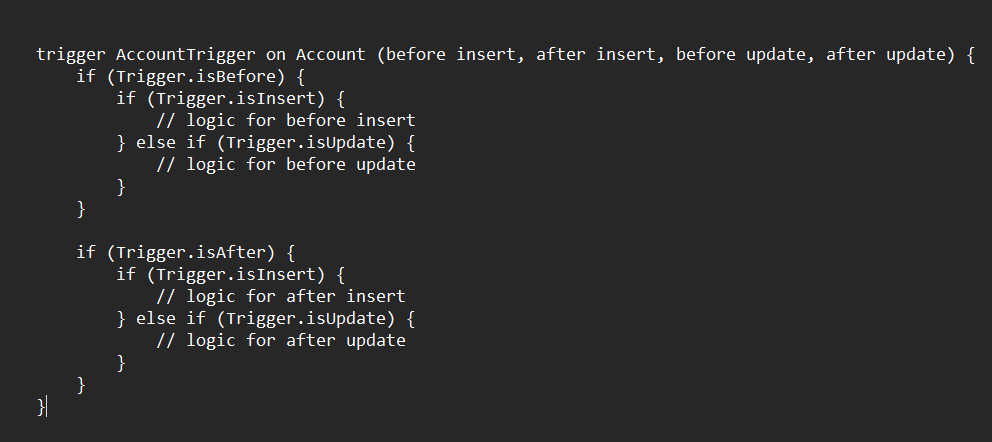
  1. Triggers

With Triggers, you can perform custom actions before and after changes occur in Salesforce records. From inserting and updating to deleting or undeleting data, this Apex code block gives you the power to execute automatically when certain database events occur. Here’s the basic structure of a trigger:
image
  1. SOQL vs. SOSL

SOQL (Salesforce Object Query Language) and SOSL (Salesforce Object Search Language) are both query languages used in Salesforce to retrieve data from the platform, but they serve different purposes and have distinct syntax and use cases. Key Differences Between SOQL and SOSL.

FeatureSOQLSOSL
PurposeQuery specific records from one or more related objectsFull-text search based on keywords
Search typeStructured queries on fields of objectsFull-text search based on keywords
Returns Records from specified objects and fieldsResults from multiple objects
Search scopeSearches within specific fields and objectsSearches across multiple objects in indexed fields
Use caseFetching records with known object structureSearching for keywords across salesforce records
FiltersUse WHERE clause for filteringNo complex filtering (searchers keywords only)
  1. Security and Sharing

Developers utilize the Security and Sharing feature to control data access at various levels. This way, the admin can restrict or give access to various functionalities to authorized users based on their roles, permissions, and sharing rules. Salesforce offers multiple security layers to protect data, from the organization level to individual records.

  1. Test Classes

Developers utilize test classes to check and ensure the quality and reliability of Apex code. This is the easiest way to validate your code and ensure it works as expected. Salesforce has mandated to test at least 75% of Apex code with tests before deploying it to production.

How Do You Prepare for Salesforce Platform Developer Certification and Job?

The next step after knowing everything about a task is to plan and prepare for it. Just like that, you need to get the proper Salesforce developer training online to take the exam and attain your certification without hassle. But the question is HOW? Here are three of the best and most suggested ways to speed up your journey and help you achieve success in the end.

  1. Trailhead

The free online learning platform of Salesforce, Trailhead, is the best place to get started with your online Salesforce developer training. It has fun, specific learning paths, called trails, to build skills and knowledge in various Salesforce-related topics. Each trail includes hands-on challenges, quizzes, and modules, making it an engaging and practical way to learn. These trails align with the exam objectives, offering a comprehensive and structured learning approach.

  1. Salesforce Documentation

If you want to look for more detailed explanations of key concepts, APIs, and development guidelines, Salesforce developer documentation is what you need. It is the official and in-depth resource provided by Salesforce that includes finer details of the Salesforce platform, Apex, Visualforce, Lightning components, and more. You “MUST READ” these documents to deepen your knowledge of Salesforce, as they provide authoritative insights into the functionality, best practices, and implementation techniques required to master the platform and excel in Salesforce developer training and certifications.

  1. Online Salesforce Developer Training Provider

You can also register with the best online Salesforce developer training course in the USA, like QuantoKnack. We have expert mentors who have years of experience in the Salesforce environment and are keen to share their knowledge with the students. From various concepts to practicing time management for your exam, we will guide you all with the help of our practice tests. The live sessions will help you learn with interactions where you can ask your questions and get solutions from the professionals. Also, you can utilize the recorded sessions to revise all the concepts from the classes. This way, you can prepare better for the written exam. 

A lot of students ask, but what about practical knowledge? Yes, we have live projects for you to work on as well. Solve various use cases and become an expert in the Salesforce environment, getting extra skills for better placement assistance with one of our partnered organizations. So, from learning for exams to getting hands-on experience for job placement, our online Salesforce developer training and placement program covers all for you.

Tips for Exam Preparation

Ready for some extra tips from our experts? Here are the 5 major tips that will lead you to the path of success in your Salesforce journey. 

  1. Get Hands-on Experience

Experiencing how things actually work and what actions are required to solve various hurdles in the path of Salesforce development and implementation is very important. Hence, make sure that you work around Salesforce and attain at least some practical knowledge of how things are done. Look for opportunities where you can work with the Salesforce environment, whether through a job or a Salesforce Developer training program.

  1. Set and Follow a Study Schedule Strictly

Whether you are studying for your senior secondary or college or Salesforce developer certification, it is very important to create a proper plan and follow it strictly. Our professionals suggest that the key to success is in your consistency towards the work. If you study a little bit daily, it will definitely give you great results after a while.

  1. Join Online Communities

You can join the Trailhead and other Salesforce online communities. A lot of experts and students like you are already there, some with the questions and some with the solutions. Join them in order to learn about the various use cases that everyone has to face while using the Salesforce platform development and implementation. You can even post your questions as well if you have any, and the experts will share the solution with some resources where you can study it in depth.

  1. Understand the Exam Question Format

You have to learn the exam structure in order to crack it. Above are all the key areas with the percentage of questions they cover in the exam, so focus on them. Also, I solved various practice tests, studied question papers from previous years, and watched some videos related to them. This way, you can understand the pattern of your Salesforce developer certification exam better and get a knack for it.

  1. Focus on Weak Areas

It is very good to know what you are good at, but it is really helpful to know your weaknesses. Hence, you need to focus on the topic areas that you are weak at. Yes, start by making your basics strong and then revise the concepts you are good at, but practice the problems that stop you or take more time. Ask for easy ways to solve those problems with the professionals at online Salesforce developer training or the community people. Guidance can take you to your destination faster than doing it all by yourself.

Conclusion

This blog includes everything that you need to win and complete your Salesforce developer certification. This guide can help you score better in your exam as well as gain some practical knowledge while preparing for it to get started with your job easily. QuantoKnack training can be a good choice if you are interested in learning, training, and getting job assistance with highly reputed organizations in the USA. If you are interested or have any questions, reach out today, and our experts will guide you better.

READ MORE
Recent Posts
  • How Salesforce Data Integration Tools Simplify Real-Time Business Connectivity
    In a nutshell, businesses collect operational data to perform...
  • Design, Build, and Optimize Agents with Agentforce 360 Innovations
    In this fast-moving digital world, businesses also want smarter...
  • Salesforce Built-In Payment Processing: How to Handle Everything End-to-End
    In the current digital economy, where online payments have...
  • Explore Top Salesforce Integration Challenges and Ways to Fix Them
    Integrating any system can be a difficult task, as an...
  • Protecting Sensitive Data: A Complete Guide to Encryption in Salesforce
    In the current digital economy, data can easily rank at the top...
logotype

We cater to individuals and corporates and provide IT training and certification programs.

44679 Endicott Drive Suit 300 #1046 Ashburn, VA 20147 United States

Phone: +1-571 989 9489

Email: atul.deo@quantoknack.com

Useful links

About Us

Contact Us

Blog

Courses

  • Live Salesforce Admin Training
  • Business Analyst
  • QA Testing Course
  • Advance JAVA Training
  • SQL Server Training
  • Live Salesforce Developer Training Certification Course
  • Digital Marketing
  • Oracle DBA Training

Subscribe

    Instagram Pinterest Linkedin
    Facebook
    Logo star

     2024 Quantoknack. All Rights Reserved