
Become a Instructor

Blogs

logotype
Menu
  • Courses
    • Salesforce Admin
    • Salesforce Developer
    • Advance Java Training
    • Buisness Analyst
    • Digital Marketing
    • Oracle DBA
    • QA Testing Course
    • SQL server Training
  • Register
+1-571 989 9489
logotype
  • Courses
    • Salesforce Admin
    • Salesforce Developer
    • Advance Java Training
    • Buisness Analyst
    • Digital Marketing
    • Oracle DBA
    • QA Testing Course
    • SQL server Training
  • Register
  • +1-571 989 9489

Become a Instructor

Blogs

logotype
Menu
  • Courses
    • Salesforce Admin
    • Salesforce Developer
    • Advance Java Training
    • Buisness Analyst
    • Digital Marketing
    • Oracle DBA
    • QA Testing Course
    • SQL server Training
  • Register
+1-571 989 9489
  • Courses
    • Salesforce Admin
    • Salesforce Developer
    • Advance Java Training
    • Buisness Analyst
    • Digital Marketing
    • Oracle DBA
    • QA Testing Course
    • SQL server Training
  • Register
  • +1-571 989 9489
logotype
logotype
  • Courses
    • Salesforce Admin
    • Salesforce Developer
    • Advance Java Training
    • Buisness Analyst
    • Digital Marketing
    • Oracle DBA
    • QA Testing Course
    • SQL server Training
  • Register
  • +1-571 989 9489
Salesforce Developer Certification Tag
Home Posts Tagged "Salesforce Developer Certification"

Tag: Salesforce Developer Certification

TECHArtificial IntelligenceAvatar of adminadmin0 Comments
Share article:TwitterFacebookLinkedin
146 Views
0 Likes

Explore Top Salesforce Integration Challenges and Ways to Fix Them

Integrating any system can be a difficult task, as an organization has to ensure all security measures are in place. That’s why most students take online Salesforce developer training and complete their certification to become experts and help various organizations solve their problems. A certified developer can help you follow all the governance, security, synchronization, risk management, testing, and more.

If an organization doesn’t take the help of an expert who has completed their Salesforce developer course and attained a certification, it will be difficult, and you will have to face a lot of challenges. Let’s go through all the Salesforce integration challenges below and understand the solutions better.

Challenges

Here is the list of challenges that organizations mostly face, and look for a Salesforce developer to solve these for them.

  • Data inconsistency across systems

It can be difficult to maintain data consistency due to some integration errors. Across various systems, it is essential that you maintain the user data because Salesforce and external systems store different versions of the same data. It also leads to mismatched records, outdated information, and unreliable reporting.

  • Duplicate records syncing from multiple sources

Your Salesforce system may get similar data pushed by multiple sources that can obstruct synchronization. It often leads to duplicate leads, contacts, and accounts creation, which makes the data hard to trust.

  • Slow data sync or API limits exceeded

Every API integration has its own data limits that can be exceeded because of large data volumes and sometimes poorly designed integrations. It causes delays, failed syncs, and even incomplete data updates.  

  • Security & compliance risks during data transfer

Integration between systems is a very sensitive connection. If you move sensitive user or business data between systems, ensure proper security and compliance safety. During data transfer, if data leaks, it can expose data breaches or compliance violations.

  • Without direct connectors, complex legacy systems.

Most systems are old and have complex legacy systems that may lack modern APIs or pre-built connectors, resulting in time-consuming and technically challenging Salesforce integration.

  • Lacks integration testing & sandbox environments

Testing all the integration connections is a must. Lacking or skipping integration testing & Sandbox environment increases the risk of broken integrations, data corruption, or unexpected failures after deployment.

  • Poor custom fields and objects mapping

To affect the custom field and objects, you should focus on mapping. It includes dealing with data landing in the wrong fields, values missing, or unusable records inside Salesforce if field mapping is incorrect.

  • Unclear data ownership and sync rules

It is important to write clear rules for ownership and synchronization. Unclear data ownership in the system can cause issues during updates as it overwrites each other and causes frequent data conflicts.

  • Real-time vs batch sync conflicts

It can be difficult to maintain the updates in real-time or even scheduled ones. Updates can get mixed up the older data can replace newer updates if you do not sync properly.

  • Multiple third-party apps are causing system conflicts.

If you connect too many apps to the system, it can cause conflicts like competing for APIs, overwriting data, or slowing down overall system performance.

Fixes / Solutions

Here are the various solutions and fixes that a certified Salesforce developer offers to the organization for various Salesforce integration challenges.

  • Apply data governance & standard naming conventions.

Establishing clearer data governance and standard naming conventions are must. It helps all the systems to follow the same structure, formats, and definitions. Also, it assigns the data stewards for ownership and quality while managing the data lifecycle from creation to deletion.

  • Utilize deduplication tools and matching rules.

With the help of matching rules in Salesforce, you can find duplicate records easily. All you need to do is apply specific metrics to compare the fields in new or edited records with existing records. These rules of diagnosing duplicates and third-party tools can help in detecting and merging duplicate records automatically, resulting in maintained data quality and the detection and merged duplicate data effectively.

  • Apply middleware for faster sync.

Organizations can select the right middleware that fits their requirements, as it helps in bridging gaps between systems. It results in better performance, error control, and complex data flow management. You need a more seamless API to smooth data exchange and synchronization between Salesforce and other systems. Then, you will find out the bidirectional data sync issues that you can solve by following the best practices, such as goal definition for integrations, choosing relevant methods, and cooperation with prebuilt connectors.

  • Encrypt data and apply role-based access & OAuth

You have to work on setting up the encryption policy, test in the sandbox org, and identify the most likely threats to the org. This leads to managing the user access as per their roles and then implementing OAuth that will grant restricted access to a client for the application. To secure the API access, encrypt an external client app, enable OAuth settings, and choose appropriate OAuth scopes to protect sensitive information in Salesforce resources.

  • Use pre-built connectors or custom API development for legacy apps.

You can either choose to build a custom API that supports older systems, lacking modern integration, or use the pre-built connectors that save a lot of your time. Most businesses with unique needs or legacy systems choose to develop custom APIs because of their full control and scalability features. However, this costs them more, takes more time, and even requires constant maintenance. On the other hand, pre-built connectors are faster, more affordable, and easier to set up, which makes them perfect for standard workflows and creating high-converting lead forms. However, there are some legacy system issues and complex feature restrictions.

  • Conduct testing in a full-copy sandbox before go-live.

Start with a thorough testing for the full Sandbox, including end-to-end validation, data accuracy, and system stability. First step is to refresh Sandbox – it will show updated data production & configuration, giving the option to mask sensitive data and verify user access. Next, you must check the API integration connectivity. It helps with data flow validation, error stimulation, bulk data operation running, and even API limit and response time monitoring. These are all the pointers to check before production rolls out.

  • Document field mapping and use the schema builder

Organizations have to identify the source API payload and target to choose the right Match field types. Then only you will be able to determine mapping logic, maintain data transformations, and test sample documents for error and null value validation. This way, you can easily understand how data moves between systems with clear documentation and the Salesforce schema builder.

  • Define sync ownership and CRUD rules clearly.

You have to define sync ownership and CRUD rules in the system. It will help to create, update, or delete data to avoid conflicts and data loss within the system.

  • Use event-based triggers for real-time sync.

Manual synchronization can be difficult. That’s why we use event-based triggers for platform events and change data to ensure updates happen instantly without overloading APIs.

  • Perform periodic integration audits and monitor logs.

It is necessary to monitor the integration from time to time. So, you have to monitor integrations regularly as it will help to detect failures early, improving the performance and maintaining long-term integration health.

Final Thoughts

So, these are various challenges that organizations face while implementing Salesforce integrations. Smart systems like Salesforce require smart solution experts, such as a certified Salesforce developer who has attended a Salesforce developer course and completed the exam. Most organizations seek experts to hire who can implement and manage the Salesforce system as per requirement. To achieve high-end knowledge and a better experience, most candidates enroll in QuantoKnack training. We offer exceptional Salesforce developer training with hands-on experience with integrations and other development areas.

Our online course ensures ease of study anytime from anywhere, following a proper curriculum. Also, our experts create mock and practice tests for students to test their knowledge and prepare them for the Salesforce developer exam. So, you will get complete knowledge + guidance to pass the exam. Even after the completion of your Salesforce developer course, our partnered companies that are well-reputed in the industry offer jobs to the students. So, you don’t have to worry about your training or even the job. We will provide you with complete assistance, from gaining theoretical knowledge to practical experience and even jobs.

READ MORE
TECHinformation technologyAvatar of adminadmin0 Comments
Share article:TwitterFacebookLinkedin
143 Views
0 Likes

Protecting Sensitive Data: A Complete Guide to Encryption in Salesforce

In the current digital economy, data can easily rank at the top of the list of most valuable assets owned by any organization. Customer data, financial data, sensitive medical data, and business data all have to be safeguarded at all costs. This has made the right data security a must-have for companies working on Salesforce. Joining Salesforce developer training and getting Salesforce developer certification can help you master all basics, including the topic of encryption in Salesforce, which will be explained below in detail.

What Is Encryption?

The encryption process involves encoding text into a form that cannot be accessed without the required decryption key. Even if unauthorized users are able to access the encrypted information, this information will not make any sense.

Salesforce allows data to be encrypted both when it is at-rest ((database) form) as well as when it is in transit (from system to system). This is even more important when businesses are involved in personal data or have compliance necessities like GDPR (General Data Protection Regulation) or HIPAA (Health Insurance Portability and Accountability Act). This is because data encryption saves businesses from data breaches and helps businesses in meeting overall legal compliance.

Understanding Salesforce Encryption Options

Salesforce has built various levels of encryption to ensure data is safe without impacting functionality.

1. Standard Platform Encryption

Certain types of data are automatically encrypted by Salesforce at the infrastructure level. These include data storage on the Salesforce server, backups, and replication environments. This type of encryption is enabled by default and runs in the background.

2. Salesforce Shield Platform Encryption

Organizations that need more control have the ability to have advanced encryption using Salesforce Shield. This allows administrators to encrypt fields, files, and even attachments while still having all the functionalities of the core platform. This encryption utilizes tenant-specific keys, providing businesses with the ability to have control over data security.

3. Encrypting in Transit

Salesforce practices safe communications through HTTPS and TLS. The result is the assurance that communications between the browser and the API or systems cannot be intercepted and modified in the middle of the transmissions.

Key Components of Salesforce Encryption

The idea is that, to understand encryption fully, especially from the developer’s perspective, it is important to understand how the underlying components work.

Encryption Keys

Salesforce encrypts and decrypts your data with the use of strong cryptographic keys. With Salesforce Shield, organizations have the chance to rotate their keys routinely in order to reduce the risk of long-term key exposure.

Key Management

Salesforce secures encryption keys in a proper way, but allows administrators to manage key lifecycle actions like rotation and suspension. Such a balance provides very high security with no excessive operational overhead.

Deterministic vs. Probabilistic Encryption

Deterministic encryption provides searching and filtering for some Salesforce encrypted fields, while some others are probabilistic encryption that supports maximum security. Understanding this distinction is central to designing applications in a way that provides security but does not sacrifice functionality.

How Encryption Affects Salesforce Development

Encryption directly affects the development of Salesforce applications. Developers must take into consideration the impact of encryption when working with the Apex code, SOQL, API, and integration.

There may also be some restrictions on search, sorting, or filter capabilities on encrypted fields. Salesforce developers should carefully consider their data models, as this may result in performance degradation or undesired functionality. This is one reason why comprehensive Salesforce developer training is emphasized heavily for secure programming, encryption-friendly architecture, and application scenarios.

In the context of professionals who are preparing for Salesforce developer certification, the topic of encryption has become pragmatic. The challenges of certification exams in the area of data security and compliance-driven software development make encryption a fundamental topic to understand.

Best Practices for Implementing Encryption in Salesforce

In order to get the best out of the encryption features in the Salesforce system, the following best practices should be followed by organisations:

  • Sensitive data needs to be identified as well as categorized before it is encrypted
  • Encrypt only what is needed to achieve the balance between the two factors
  • Regular rotation of encryption keys and access logs
  • Test encrypted fields thoroughly in sandboxes before production deployment.
  • Train developers and administrators to understand the limitations of encryption

A skilled Salesforce developer can easily incorporate all these methods with ease and ensure that everything is secure without any disruption of business activities.

Why Encryption Knowledge Is Essential for Salesforce Professionals

As advanced threats evolve, there is an increasing need for Salesforce talent with more comprehensive knowledge about security as well. Knowledge of encryption also indicates technical intricacy, awareness, and architectural knowledge.

If you are starting out or looking to further develop your career, investing in some top-quality Salesforce developer training will not only give you the skills to build secure, highly scalable solutions, but also further reinforces the skills and expertise to deal with confidential information responsibly.

Final Thoughts

Encryption is more than a technical capability, it is a strategic asset used as a protective mechanism for organizations and their reputation. Salesforce offers strong tools for performing encryption; however, their efficiency is based on their usage and understanding.

By understanding the principles and best practices in encryption, Salesforce developers can establish themselves as professionals with integrity and the expertise to develop secure and complaint systems. For both learners and professionals in the industry, the key to future success in the Salesforce environment lies in gaining practical experience through quality training and certifications.

READ MORE
Artificial Intelligenceinformation technologyTECHAvatar of adminadmin0 Comments
Share article:TwitterFacebookLinkedin
222 Views
13 Likes

Salesforce Unveils Agentforce Vibes — Powerful New Tools for Salesforce Developers

Salesforce Agentforce Vibes is one of the tools launched that can help developers to automate most of the work in 2026. They can simply get help to write code, check code written, deploy, and even test for any error. Students take online Salesforce developer training to learn all these tools and features within the system. It makes it easy for both beginner and professional, and even IT or Non IT students, to work for organizations interested in implementing automation.

Completing a Salesforce developer certification validates the knowledge of students, which helps them land a high pay job in firms. But for that, it is important that you understand various powerful uses of Agentforce Vibes and its benefits in the Salesforce system. So, let’s have a better look at all the powerful new tools.

13 Powerful New Tools for Salesforce Developers to Unveil Agentforce!

  1. Natural language–to–code generation (Apex, LWC, HTML, JS)

Salesforce is a low-code/no-code software that has its own simple language called Apex that makes it easy for the developer to generate code or write a script if required. Most of Salesforce is no-code so most developers just don’t have to worry about it. That’s why in the Salesforce developer training curriculums you will find topics like – Apex, LWC, HTML, a little bit of JS etc. You have to gain basic knowledge of programming languages and complete practice of Apex and LWC kind of Salesforce’s tools. 

  1. Context-aware “Plan Mode” that understands your org’s metadata and schema

Salesforce has its own tool called Vibes that helps and supports developers to create an accurate plan and a step-by-step process to write accurate code. Vibes understands your Salesforce org – objects, fields, flows, triggers, and recommends the right code accordingly.

Plan Mode understands your Salesforce org’s real metadata—objects, fields, validation rules, automations—and then generates an accurate plan before writing any code. This ensures the solution is aligned with your current setup, prevents conflicts, and avoids unnecessary rework. Developers get a clear blueprint of what will be created or changed, making the entire development process smoother, smarter, and more predictable from the very beginning.

  1. Model Context Protocol (MCP) support with 20+ built-in developer tools

Using third-party systems and software can be dangerous for your company’s information security. Hence, Salesforce has developed more than 20 built in developer tools that will guide you for example, file editors, code runners, data explorers, etc. All these tools can be used with AI which results in automatic task performance, helping teams with tasks and workflow maintenance.

  1. Checkpoints to track and roll back changes

Making a small mistake sometimes can get you to a rework and to save you from this issue, you can use the checkpoint and roll back option. This tool helps you to go back to a previous version of your work instantly if you made a mistake. It works like an undo button, supporting you in your entire dev process. So, nothing can stop you from trial and testing any code or syntax that you want to imply and check in the instance.

  1. Agentic rules to enforce coding standards and governance

As a Salesforce agent, you can set rules following the coding standards and governance for example, naming conventions, limits, security standards, etc. You can take help from vibes to make sure all generated code follows them as it helps to set custom rules and guardrails that all AI-generated code must follow. Salesforce developers get consistency across the projects to prevent bad coding habits and violations of organizational policies. A large team can work easily across multiple Salesforce environments, maintaining a clean, standardized codebase and easier collaboration.

  1. Automated test-class and test-case generation

Salesforce Agents can use Vibes to write the necessary test classes and test methods. This way, you can help with the seamless deployment and even save hours of manual effort. You can use Agentforce Vibes to automate the test class creation completely, which can often consume time and is repetitive for developers. It can help you meet the Salesforce deployment rules by writing full test classes, test methods and even set up the required data, validating your code. This way, Salesforce developers are free manually crafting the complex test data and scenarios. Enjoy the automated deployment speeding and improving code coverage and ensuring higher software quality at every development stage.

  1. Integrated code analyzer for security, performance, and best practices

The AI technology of Salesforce Agentforce Vibes helps to review the code and highlight issues, potential bugs, security risks, or ways to optimize performance automatically. This built in code analyzer feature reviews the security vulnerabilities, performance bottlenecks, risk patterns, and best practice violations by just reviewing your code. You can get clear explanations of what’s wrong and improvement suggestions so you can ensure code is efficient, secure, and stable before deployment. You will get immediate feedback beneficial in the continuous improvement of coding practices while avoiding problems that could cause system failures or compliance breaches.

  1. Agentic debugging and bug-resolution assistance

Developers can even utilize the full AI power by just telling what’s not working and it will analyze the problem, explain it, and even fix the bug for you. This makes the process easy as when something breaks or behaves unexpectedly, all you need to do is simply describe the issue to Agentforce Vibes. After the analysis of the problem, it shares the step-by-step procedure that you need to follow and fix the problem right away. If it is a very small issue, the tool can also repair the code automatically. This tool makes troubleshooting far more efficient by eliminating hours of trial and error debugging. Hence, developer can concentrate on developing more features instead of getting stuck or wasting time in hunting for bugs.

  1. Natural-language DevOps for build, deployment, and automation

Developers can now control the complete process from development to deployment and even pipelines using simple text commands with the Agentforce Vibes automation feature. You can just deploy or run developments using simple instructions like “deploy this to UAT,” “Create a deployment plan,” “Generate a release summary,” or “Create a new branch” without touching complex devOps tools. The command will come into action right away. It increases the overall team agility by streamlining the release process, reducing errors, and making deployment accessible even for team members, even if you don’t have deep DevOps experience.

  1. Intelligent inline autocomplete in VS Code and other IDEs

Salesforce agentforce Vibes can even help in suggesting accurate code completions based on organization context and best practices while typing in the IDE. This AI autocomplete in the IDE has the capabilities to understand any companies’ metadata and coding context so that it can provide highly relevant code suggestions as one type. Also, you can use it to predict the next line of code you are typing, complete methods, fill parameters and suggest best practices. This reduces the chance of mistakes and even speeds up the development process significantly. With Salesforce Agentforce Vibes, you can reduce the cognitive load of remembering syntax and get a smoother coding experience, whether you are new or an experienced developer in the field.

  1. Code explanation and refactoring suggestions inside the IDE

Developers can use Salesforce Agentforce Vibes to highlight any part of the code, explain what it does in simple words, and suggest cleaner, more efficient versions. It can help in understanding legacy code, new teammate onboarding, and even reviewing someone else’s work. AI can provide a cleaner, faster, and more maintainable version of the same logic for continuous improvement and manage long-term code quality across the organization.

  1. Web-based Vibes IDE with Git integration, SOQL builder, and CLI

Developers do not need any heavy local setup with Salesforce Vibes as it is a powerful development environment in the browser that includes Git integration, a built-in SOQL query builder, a Salesforce CLI, and an interactive code editor. The org-aware features automate the metadata and configuration understanding. This way, it supports collaboration and simplifies development from any device with a unified, fast and accessible workspace. 

  1. Built-in trust, security, and compliance controls for safe development

Salesforce agentforce Vibes helps companies to follow strict security measures to protect their sensitive data while ensuring compliance. It helps in generating AI code and actions that follow various organizational policies and Salesforce’s trusted guidelines. We can utilize it in creating a more safe system to reduce the chance of exposing user data and even violating governance rules. Teams within the organization can use AI with even more confidence, as it can help in developing and managing the apps without compromising the security or regulatory requirements. 

Final Thoughts

Salesforce developers can utilize the ultimate power they get with Agetenforce Vibes. It automates the complete development and deployment process. Such low-code features make it easy even for the non IT talents to take Salesforce developer training and become an expert. Many companies pay high to get a developer who can work with all the Agentforce power tools to develop and deploy the complete system for various departments. It even makes the testing, problem detection and resolution easy with automation. 

However, it requires a Salesforce developer certification to land the best job with a high pay scale. Hence, most of the students choose Quantoknack training as we offer practical training with mock test and interview preparation guidance and placement assistance with one of our partnered companies. It can be difficult for any student to find such great perks anywhere else. Raise your query today and contact us for online Salesforce training today!

READ MORE
TECHArtificial IntelligenceAvatar of adminadmin0 Comments
Share article:TwitterFacebookLinkedin
160 Views
0 Likes

How​‍​‌‍​‍‌​‍​‌‍​‍‌ Integration Errors Lead to Salesforce Data Loss and Ways to Fix Them

Salesforce is the hub of numerous organizational processes. It connects sales, service, marketing, support, and analytics. As companies continue to rely on automation and system interconnections, integrations become the lifeline. However, these integrations, if wrongly set up, if they are old or if they are not properly monitored, can be the cause of the most serious problems in a Salesforce environment – DATA LOSS. 

Knowing how mistakes happen and how to stop them is not only a must-have skill for teams but also a significant part of the Salesforce developer training and the Salesforce developer certification journey.

Let’s have a quick look at the details here!

How Integration Errors Begin?

In most cases, data loss during the process of integration is not something that happens suddenly. Normally, it starts with small technical gaps that silently exist. One of the frequently encountered problems is reaching the API limits of Salesforce. In situations where these limits are surpassed, the external systems may forcibly reissue the requests or send the incomplete payloads, which update or corrupt the records already stored in the database.

Data mismatch between systems also causes a problem. If the data in Salesforce fields is not structured in the same way as in the external system, then the integration can send the empty values, duplicates can be created without your knowledge, or if the mapping logic is wrong, information can even be deleted. This is particularly dangerous when flows, triggers, or third-party sync tools are used to update the related objects at the same time.

Data loss due to authentication failures is a thing as well. If tokens expire or permissions get changed, there might be some sync attempts that are partial, and as a result, Salesforce will have incomplete records. Sometimes developers make a deployment of integration updates in production without sufficient testing, thus the overwrites happen unexpectedly.

Mistakes made by people worsen the situation. Too many access rights, wrongly set field-level security or unnoticed validation rules are some of the things that create holes in your security through which integrations can unintentionally take advantage of them.

The Real Impact of Data Loss

Data loss in Salesforce is not just about the deteriorating quality of the database. The problem extends to every team that depends on the info being right. The sales teams might lose the history of leads or the updates of opportunities, thus new deals might take longer to close, and the follow-up might not happen on time. As a result, service teams may lose case notes, and thus they will have a hard time understanding and solving customer issues. Marketing becomes weaker because automations fail or send wrong messages.

Even the tiniest loss can result in incorrect numbers showing up on the dashboards and forecasts thus bad decisions being made by the leadership. Since Salesforce is often considered the only source of truth, corrupted or missing data becomes a huge problem for compliance, operational efficiency, and customer satisfaction. The process of restoring the lost relationships or recreating datasets costs time and can cause a financial as well as a reputational loss.

How to Prevent Integration-Related Data Loss

Before companies can really take advantage of Salesforce, they have to put in place strong protection measures that ensure their data is safe during integrations. A lot of data issues originate from the external systems, bad mapping, or from not monitoring and not from Salesforce. By adhering to disciplined practices and implementing proactive checkpoints, teams can almost eliminate the risk of accidental overwrites, mismatched records, and sync failures. That is the reason why knowing the best practices of integration constitutes a vital part of Salesforce developer training. Below are some of the measures by following which you can prevent integration-related data loss.

Strengthening system monitoring: 

  • This involves making use of Salesforce resources such as Event Monitoring, Setup Audit Trail, and Health Check.
  • Keeping a record of API calls, sync failures, and unauthorized access.

Adopt a disciplined development lifecycle: 

  • Every integration should be tested in a sandbox before going live.
  • Employ version control for managing changes in configuration and code.
  • Use defined pipelines and peer reviews for completing the task.

Create strong data mapping rules

  • Every field’s usage should be explicitly defined.
  • Data types should be accurate, validation rules and picklist limitations should be used correctly.
  • Applying field-level security will prevent integrations from changing sensitive data.

Implement detailed logging and alerting

  • Record the mistakes instead of letting the integrations fail quietly.
  • Let the notifications be set for rejected updates, partial syncs, and authentication issues.
  • Study the patterns to be able to fix the same issues before they recur. 

Performing regular system audits

  • Evaluating connected apps and API usage every three months.
  • Inspecting role permissions, workflows that are not being used, and apps that are outdated.
  • Getting rid of the inactive integrations that are risky.

Combining monitoring, organized development, robust mapping, and frequent audits gives organizations a lot more stable and trustworthy integrations. These practices not only safeguard really important data but are also a great support for the teams’ long-term scalability, which is a must-have when going through the Salesforce developer certification journey.

Creating a Culture That Protects Data

Apart from the technical measures, a proper team culture is also very important. It should consist not only of documentation and continuous learning but also of responsible access management. When teams realize the value of accurate data and perform the same procedures, the chance of accidental data loss can be easily eliminated.

This​‍​‌‍​‍‌​‍​‌‍​‍‌ is the moment where proper skill structuring becomes something that can be used. Developers who are part of the Salesforce developer training program stay updated with best practices, integration patterns, and error-handling methods. Besides that, obtaining a Salesforce developer certification empowers a developer to create stable, strong systems that protect the data at every stage.

Final Thoughts

Finally, we can say that integration errors may surely be small at the beginning, but they have the potential to become quite troublesome if no action is taken, as we learned from the information above. Recognizing the causes of integration errors and implementing strong monitoring, testing, and governance, teams act as a shield for their Salesforce environment against these unwanted data losses. When they are accurately added with the right knowledge and training, teams can easily produce more reliable integrations in order to make sure that Salesforce stays a super secure and trustworthy source of ‍​‌‍​‍‌​‍​‌‍​‍‌information.

READ MORE
information technologyTECHAvatar of adminadmin0 Comments
Share article:TwitterFacebookLinkedin
180 Views
3 Likes

A Complete Guide: What Is a Record-Triggered Flow in Salesforce?

Salesforce has brought dramatic changes in how businesses handle automation, efficiency, and customer engagement, and has taken it to the bright side. Among its many intelligent tools, one stands out because of its power and effortless usability, and that is the Record-Triggered Flow. Loaded with these astounding features, everyone’s willing to get hold of it, whether it’s an aspiring professional enrolled in a Salesforce developer course or an experienced administrator refining their automation skills. Understanding how a record-triggered flow works is essential in today’s Salesforce ecosystem.

What is Record-Triggered Flow?

Record-Triggered Flow is one of the most powerful types of automation in Salesforce that a user does not have to manually start as it is always running in the background and reacts to the addition, modification, or deletion of a record in the system by itself. Another way of looking at it is that it is a set of commands that direct Salesforce to execute particular operations only when certain criteria are satisfied. 

For example, if a new Lead is created, Salesforce can instantly assign a new lead to a sales professional, send a welcome email, or update a linked record, and that too without a blink. The system handles all these operations immediately in the background instead of manually, which is time-saving and also ensures that the work is done correctly, consistently, and ​‍​‌‍​‍‌​‍​‌‍​‍‌efficiently.

salesforce developer classess
A Complete Guide: What Is a Record-Triggered Flow in Salesforce? 3

Source: Salesforce blogs

The​‍​‌‍​‍‌​‍​‌‍​‍‌ flow was built via Flow Builder, which is a no-code automation tool of Salesforce that is based on a simple drag-and-drop interface and may be used effectively by developers and administrators for the creation of complex processes. By removing the requirement for traditional Apex coding in numerous business cases, it is accessible even to those with minimal programming ‍​‌‍​‍‌​‍​‌‍​‍‌skills.

salesforce developer cerrification
A Complete Guide: What Is a Record-Triggered Flow in Salesforce? 4

Source: Salesforce blogs 

How Record-Triggered Flow Works?

Changes to a record affect how a record-triggered flow works. The process starts with a trigger event, such as adding and changing a record. Salesforce then checks to see if the record meets certain requirements. If the conditions are met, the flow will do a series of tasks that you have set.

Think about a chance that moves on to the “Closed Won” stage. A record-triggered flow can create a task for the customer success team, update the revenue total, and send an email to the finance department without any human involvement. Making the whole process faster and more accurate without any help from people

Types of Record-Triggered Flow?

Salesforce has two main types of record-triggered flows. It is very important to know when to use each type of flow in order to design efficient automation. One can easily learn these skills in the Salesforce developer training programs. 

In the automation sequence, each of these flows is assigned a particular task: 

  • Before-Save Flows (Fast Field Updates): These flows are initiated before the record is saved in the database, making them perfect for assembling quick changes to the same record. While doing so, it accelerates performance and consumes fewer system resources. 
  • After-Save Flows (Actions and Related Records): These flows are executed after the record is saved and are therefore utilized for actions that require the record to be in the database first, such as sending notifications, creating related records, or updating multiple records.

What is the Importance of Record-Triggered Flow?

Gradually, Salesforce is replacing the old automation tools, such as Process Builder and Workflow Rules, with Flow Builder. This switch means that record-triggered flows are not just another feature; they represent the future of Salesforce automation. 

Here are some of the reasons that show the importance of the Record-Triggered Flow: 

  • Help you with the automation of complex tasks without the need for coding. 
  • With the advent of before-save flows, you can see a great improvement in performance. 
  • It also provides developers and admins with more alternatives for handling logic in one place. 
  • It further guarantees that data is accurate by reducing the number of errors that are made manually. 
  • The best feature of the record-triggered flow is its compatibility with the roadmap of Salesforce.

In case you want to be an automation expert, mastering the use of flows is a crucial step for anyone enrolled in a Salesforce developer ‍​‌‍​‍‌​‍​‌‍​‍‌course.

How to Learn Record-Triggered Flow

If you are a developer in a Salesforce ecosystem and you want to raise your knowledge, you can learn to optimize record-triggered flows. You can get the finest understanding of it by joining the professional Salesforce developer training course. This program will help you understand how to:

  • Create flows with Flow Builder. 
  • Using Apex to connect flows and get more advanced features. 
  • Design triggers and conditions easily and effectively.

Conclusion

I hope the article has helped you understand that Record-Triggered Flow is one of the major upgrading and transformative factors for Salesforce automation processes. By decreasing human intervention and ensuring that all operations run smoothly in the background, they become more efficient. 

So, if you want to boost your knowledge in Salesforce, then you should check out Salesforce developer courses at Quantoknack Training. They offer the best Salesforce developer training programs, which will help you become an automation expert by gaining a deeper understanding of flow design and start a rewarding career. 

READ MORE
TECHArtificial Intelligenceinformation technologyAvatar of adminadmin0 Comments
Share article:TwitterFacebookLinkedin
188 Views
1 Like

Salesforce Relationships Demystified: Latest Trends You Need to Know

Salesforce relationships used to be primarily focused on technical objects, such as Lookup and Master-Detail, but are now shifting towards a more strategic approach through its Customer Data Platform (CDP) and Generative AI. Even the online Salesforce developer training is covering more advanced areas of systems, including AI, Einstein, and more.

These aspects help build more trusted hyper-personalized customer and exceptional employee experiences. Organizations need data-driven, customized interactions across all customer touchpoints in order to achieve growth and solve various challenges. AI is the latest trend, and the Salesforce system has implemented it to make every interaction humanized, integrate Slack for employee collaboration and flexibility, and create a broader Salesforce ecosystem for partners for a better experience.

Let’s explore the various trends of 2025 that will be great in 2026 as well.

Customer and Employee Experience Trends

Customers and employees are the two most important aspects of the system; catering to them can change and add great value to the organization. So, it is crucial to understand the trends that can support you in providing them with the best experience.

  • Hyper-Personalization: Salesforce is using its Customer Data Platform (Salesforce Customer 360) and Marketing Cloud/Commerce Cloud to unify customer data, enabling businesses to create personalized experiences across all channels.
  • AI-Powered Interactions: Salesforce has also integrated generative AI in the system, as it is the need of the hour to humanize interactions and build more relevant customer experience.
  • Employee Experience: Developers using Salesforce to provide flexibility to employees is another trend. Leveraging tools like Slack can enhance communication and collaboration within teams and even between departments. It is important to understand employee needs for a more positive workplace culture.

Platform and Ecosystem Trends

The Salesforce platform offers great trends for a unified customer and employee experience.

  • Unified Data: Organizations that utilize the Salesforce Customer 360 platform continue to evolve & serve as a central, unified view of customer data and create a single source of truth for businesses.
  • Ecosystem Growth: The certified experts, consulting partners, and app vendors play a vital role in delivering solutions and driving customer success across industries, expanding the Salesforce partner ecosystem rapidly.

Technical Relationship Trends: The Core Pillars

The Salesforce platform relies on specific data relationships, as strategic emphasis is on relationships with customers and employees.

  1. Lookup Relationships (The Loose Connection)

Salesforce developers use Lookup relationships to create a connection between a child and parent objects, following the most usual and effortless way, but with a loose one-way association.

How it works: An 18-character Salesforce ID of the related parent record gets stored in the field on the child object.

Key Features:

  • Independent Sharing: The child record does not use parent’s  sharing and security settings. They follow their own independent setting.
  • Optional Parent: The lookup field can be null as it is not mandatory. If you delete the parent record, the child record will not be deleted automatically. However, the Salesforce developer will require an Apex trigger to handle deletion and archiving logic, as deleting the parent record will clear the lookup field.

  1. Many-to-Many Relationships (The Junction Object)

Developers can make the process of linking multiple records of object A to many records of object B easy by using the Junction object. It combines two Master-Detail relationships on a single custom object.

How it works: The Junction Object becomes the “detail” in two separate Master-Detail relationships with the two “master” objects.

Key Features:

  • Two Masters: Although the junction object inherits sharing from both masters, it is crucial to designate one of them as the Master for a better look and feel, and give ownership to one record.
  • Roll-up Flexibility: You can roll up the data from the junction object, getting the freedom to create roll-up summary fields on both master objects.

The Developer Takeaway: Even in the most difficult business scenarios, you can use these standard patterns. It helps link students to multiple courses or projects with multiple team members.

  1. Master-Detail Relationships (The Ownership Bond)

You can use the Master-detail relationship as the most powerful link in the Salesforce environment, as it will help you define a strong parental ownership between two records.

How it works: The master record creates and manages the detailed child record.

Key Features:

  • Cascading Deletion: If you delete the master record, it deletes all associated detail records automatically. Hence, developers can make the most of cascading deletion to maintain data integrity.
  • Inherited Sharing: Detail records receive all the data, including sharing, owner, and security settings through inheritance.
  • Roll-up Summary Fields: It is an excellent feature utilized by Salesforce developers on the master object to count, sum, find the minimum, or find the maximum of fields on detail records.

The Developer Takeaway: You can enforce data integrity where child record is a true component of the parent record. Master-detail relationship is perfect for this as it requires managing financial data, line items, or more with restrictive sharing and conversion rules.

Career Path: Mastering the Modern Relationship

In 2026, Candidates looking for a successful career in Salesforce must attain skills and credentials with online Salesforce training programs.

  1. The Value of Salesforce Developer Training

To get started or level up your skills in Salesforce, both demand targeted Salesforce developer training from a reputable program provider. QuantoKnack training courses are highly recommended and chosen by students, as we have online classes with on-demand recorded sessions. We focus on the practical application of data modeling principles:

  • Live & Recorded Sessions: You can attend live Salesforce developer training classes from anywhere, at any time, and even get a recording of all the classes so that you can watch any of your missed classes later on. Not only this, but you get lifelong access to the resources.
  • Hands-on Practice: You can work on various live projects with the experts. It will increase your knowledge and ability to solve complex case scenarios that will strengthen you even in your future jobs.
  • Curriculum: Experts will guide you about topics such as indexing, selective SOQL, data archiving strategies, Salesforce Connect, Data Cloud, and MuleSoft basics, as these are crucial for Salesforce relationships.
  • Placement: Get a chance to work with highly-reputed organizations partnered with our Salesforce developer training and certification programs.
  1. Earning Your Salesforce Developer Certification

Validate your abilities and skills in developing and implementing complex, scalable solutions with the Salesforce developer certification. Becoming a certified Salesforce developer, highlights your abilities and skills in creating a scalable solution for any industry by creating and implementing complex structure. You have options like Salesforce Certified Platform Developer I and Platform Developer II that place heavy emphasis on data modeling and querying.

You need to learn more than just the difference between various types of Relationships. It requires more to become an expert in the field.

  • Design for Scale: Prevent LDV issues in a master-detail hierarchy
  • Ensure Data Integrity: Enforce business logic by choosing the right relationship type.
  • Optimize for Performance: Avoid governor limits and non-selective errors by efficiently traversing relationships and writing Apex and SOQL languages.

When you take the Salesforce developer certification exam, it proves that your knowledge is more than defining relationships in Salesforce. It takes complete knowledge from creating to implementing the complete system as per the business need.

Conclusion

The Salesforce relationships turn a powerful, single-system CRM into an all-encompassing, enterprise-wide ecosystem. Tools like Data Cloud and Salesforce Connect empower the foundational relationships (Lookup, Master-Detail, Many-to-Many) by augmenting them with sophisticated external models and real-time connectivity.

For students or professionals preparing for Salesforce developer and architect roles, it is crucial to gain the ability to model, optimize, or integrate data relationships of AI and LDV hinges across both the core and external systems.

READ MORE
Streamline Sales with Salesforce Revenue Cloud: A Practical Guide
TECHAvatar of adminadmin0 Comments
Share article:TwitterFacebookLinkedin
764 Views
6 Likes

Streamline Sales with Salesforce Revenue Cloud: A Practical Guide

Every organization wants to unify the key processes and data for the entire revenue lifecycle within a single platform. You can take the Salesforce Revenue Cloud as the one-stop solution! From quoting to billing and collaboration between sales, finance, and partner teams, this integrated approach leads to faster sales cycles and increased efficiency. It eliminates the data silos, workflow automation, and other problems in the way. Students earn a Salesforce developer certification, learning all these types of features implementation for the organization, easing their sales processes, and contributing to higher revenue. Not only this, but Salesforce Revenue Cloud has a comprehensive list of advantages that can help with sales. Let’s go through the details.

Unified Revenue Management

Optimize revenue and profitability with the right strategy, which can integrate all aspects of pricing, forecasting demand, controlling inventory, and distribution across an organization, creating a holistic view of revenue opportunities.

  • Centralized Product and Pricing Catalogs

All the information related to the products and their pricing across business units, regions, and sales channels can be accessed through the one-stop solution – the Catalog of the organization. It works as a source of truth that helps in maintaining quotes consistency and accuracy, reducing errors, and even supporting complex pricing models, like discounts with volume, bundles, or even pricing products based on the subscription.

Example: A rep selling software and hardware can access a unified catalog that includes real-time pricing, availability, and product rules—no need to toggle between systems.

  • Guided Selling

It is crucial to make the sales experience intelligent and seamless for the users so reps choose the right products and configurations based on customer needs. Organizations can utilize Salesforce CPQ (Configure, Price, Quote) with built-in rules and logic that will improve the cross-sales and upsell opportunities with guided selling while reducing training time. 

Example: A new rep can confidently build a tailored quote for a client by answering a few simple questions—Revenue Cloud guides them to the optimal product mix.

  • Contract Management

Businesses need a proper streamlined process to create, negotiate, store, and manage contracts throughout their lifecycle. It is possible for organizations with integrated e-signature tools and real-time visibility to accelerate deal closure, reduce legal risk, and ensure compliance.

Example: Legal and sales teams collaborate in one platform, using pre-approved templates and automated workflows to get contracts signed faster.

  • Order Orchestration

A seamless process that connects front-end sales with back-end fulfillment, billing, and provisioning systems. It ensures that once an order is placed, it is accurately routed and fulfilled across departments, without manual handoffs or delays.

Example: When a customer signs a deal for a software subscription and hardware bundle, Revenue Cloud automatically triggers fulfillment and billing across systems.

Streamlined Sales Processes:

  • Automated Workflows

Organizatons can eliminate repetitive tasks and reduce manual intervention easily by automating the workflows throughout the departments. From quote approvals to contract generation and renewal notifications, Salesforce Revenue Cloud automates key steps in the sales cycle to ensure speed and accuracy.

Example: When a quote exceeds a certain discount threshold, an automatic approval request is triggered and routed to the sales manager—no emails or follow-ups needed.

  • Integration with Sales Cloud

Revenue Cloud works seamlessly with Salesforce Sales Cloud, unifying lead-to-cash processes in one system. This integration provides full visibility from opportunity creation to revenue recognition, empowering sales teams with real-time insights and reducing handoffs between departments.

Example: A sales rep can track a deal from prospecting to contract signature, quote, billing, and renewals—all within a single dashboard, without jumping between systems.

Enhanced Collaboration and Visibility:

  • Data Consistency

With a unified platform, all teams—from sales and finance to operations—work from the same up-to-date data. This reduces errors, prevents duplicate entries, and ensures alignment across the entire revenue lifecycle.

Example: When pricing is updated in the product catalog, that change is instantly reflected across quotes, contracts, and invoices, so everyone uses the same, accurate information.

  • Real-time Visibility

Revenue Cloud provides dashboards and reporting tools that deliver real-time insights into sales performance, pipeline health, customer orders, and revenue forecasts. The organizational leaders get more power with these insights to make faster and smarter decisions like reps.

Example: Sales managers can see exactly which deals are stuck in the approval stage, which quotes are pending signature, and how changes in pricing affect forecasted revenue—all in real time.

  • Partner Relationship Management

Salesforce Revenue Cloud supports channel sales by providing partners with the tools they need to sell efficiently—access to pricing, quote generation, deal registration, and performance tracking—all within a secure partner portal.

Example: A distributor logs into the partner portal, configures a product bundle, submits a quote, and tracks commission—all while Salesforce automatically syncs the data with the internal sales team.

Benefits of Using Revenue Cloud:

  • Faster Sales Cycles

Automated approvals, guided selling, and streamlined quoting tools reduce bottlenecks and manual steps, helping deals close faster.

Example: Sales reps can configure a quote, generate a proposal, and send it for approval in a matter of minutes rather than days.

  • Improved Accuracy

With centralized data, product and pricing rules, and integrated systems, errors in quotes, contracts, and invoices are dramatically reduced.

Example: Built-in pricing validations prevent reps from offering discounts beyond approved thresholds, reducing costly mistakes and rework.

  • Increased Efficiency

Automation reduces administrative burden, allowing teams to focus more on selling and serving customers rather than chasing paperwork or approvals.

Example: Renewal reminders, contract generation, and invoice creation are automatically triggered, saving hours of manual effort each week.

  • Enhanced Customer Experience

A seamless buying process—from quote to cash—makes interactions faster, more consistent, and personalized, helping the customers to get everything they need at the time they need it without any delay or issues.

Example: Customers receive accurate quotes instantly, with transparent pricing and contract terms, enhancing trust and satisfaction.

  • Better Financial Management

Revenue Cloud provides finance teams with real-time visibility into revenue streams, helping improve forecasting, compliance, and reporting accuracy. 

Example: Because billing, invoicing, and revenue recognition are tightly integrated, finance teams can close the books faster and with greater confidence.

Summary

Whether an organization wants to improve the sales workflow within the organization or rep sales for users, the Salesforce revenue cloud is the best solution for them. You can easily get it implemented as per your own specifications by the developers authorized by the Salesforce developer certification online. They have attained a lot of theoretical knowledge and experience throughout their Salesforce developer training, so they can help you create and implement various features of Salesforce revenue cloud, helping you make the most out of it and taking smart decisions. 

READ MORE
salesforce developer training
TECHAvatar of adminadmin0 Comments
Share article:TwitterFacebookLinkedin
631 Views
10 Likes

From Learner to Leader: How Salesforce Developer Training Opens Doors to Top Tech Jobs

Many candidates get stuck in the learning journey while working at an organization, which can be difficult. It is crucial to understand the technology that you want to step into and build a career in. That’s why taking online Salesforce developer training in the UK is highly suggested, as it can help attain all the knowledge following a proper curriculum without missing any area. Also, it enables you to get your certification to seek a higher-paying job with more work knowledge and experience. You can become a leader from a learner in 7-9 weeks, depending on your performance and adaptation skills.

How Salesforce Developer Training Helps

  • Diverse Career Paths

A well-structured Salesforce developer training that covers all the topic areas equips individuals with skills applicable to various roles within the Salesforce ecosystem, such as administrator, developer, consultant, and architect.

  • Leadership Opportunities

Crack the increasing demands and opportunities for advancement and leadership roles in the market. Solving various real-life case studies and scenarios while taking online Salesforce developer training can make you an expert in implementation, making your job role skyrocket.

  • High Demand & Lucrative Salaries

With the observed increasing demand in the market, you can aim to earn more without any doubt. Online Salesforce developer training program leads to job security in a career full of growth and endless opportunities.

  • Evolving Skill Set

Every year, Salesforce upgrades its technology, introducing new features or integrations. It opens the doors to staying updated with the latest tech trends, creating opportunities for continuous learning and career growth.

  • Certification

A Salesforce developer training and certification program can help you increase your credibility in the field by earning the right certification. By becoming a reliable certified Salesforce developer, you can open up more opportunities within Salesforce.

  • Practical Experience

Whether you are an IT or non-IT candidate, you can learn the practical application of Salesforce skills. Training can lead to hands-on experience utilizing platforms.

  • Networking

You can drop your queries at the Salesforce communities and forums to get to know more students as well as professionals who can provide solutions for your problems and support throughout your career.

  • Salesforce Developer Placement

The right Salesforce developer training and placement program in the USA can help you attain knowledge and a job right after completing your certification. Globally, well-reputed partners of QuantoKnack training give live projects for these talents’ training and offer jobs as per their requirements.

Aligning Salesforce Training with Current IT Trends

The Salesforce developer training reflects the tech evolution and workplace expectations to help you stay competitive and future-ready.

1. Integration with Emerging Technologies

The latest IT environment has technologies like Artificial Intelligence (AI), Machine Learning (ML), the Internet of Things (IoT), and blockchain. You will learn about features like Einstein AI and easy Salesforce integration with IoT platforms.

Training Impact:

Learn to configure and use Salesforce Einstein for predictive analytics.

Connect Salesforce with third-party AI/ML platforms or IoT devices via APIs and middleware.

2. Emphasis on Data Security and Privacy

Data security is imperative for every system, and even for Salesforce, to save organizational data from increasing regulations (GDPR, CCPA, etc.) and cyber threats.

Training Impact:

Set up data access permissions, field-level security, and secure development practices.

Learn compliance best practices and secure customer data handling within Salesforce.

3. Support for Remote Work Environments

Salesforce is a cloud-based platform with any-time, anywhere access, standardizing the remote and hybrid work models.

Training Impact:

Become proficient with mobile and browser-based Salesforce tools.

Get training on collaboration features, like Chatter, Slack integration, and dashboard settings for distributed teams.

4. Enhancing User Experience and Accessibility

Salesforce gives freedom to create a user-centric design with its fully customizable environment.

Training Impact:

Enhance usability with Lightning component customization

Design accessible pages and reports, following WCAG guidelines.

5. Agile and Continuous Improvement Practices

Sandbox and CI/CD tools support agile methodologies and DevOps for iterative development.

Training Impact:

Learn everything about Agile and its development, application, and configuration.

Work on live projects to experience the tools, like Salesforce DX, GitHub, and deployment automation for continuous delivery.

What Makes QuantoKnack Training a Market Leader:

  • Complete the Salesforce developer training course in 35+ sessions.
  • Job assistance with the reputed partner companies.
  • 24/7 Customer support to resolve all the problems
  • Follow a Certification-Oriented Curriculum to cover all the topics
  • Provide live experience with end-to-end real-time project development
  • Flexible schedule with recorded sessions so you can study anywhere, anytime.
  • Get support from highly experienced and professional Mentors
  • One-on-One Doubt Clearing
  • Real-time Salesforce platform-related use cases
  • Hands-on Practical Assignments
  • Practice mock tests to prepare you for the certification exam and interview.

Certificate

Certified Salesforce Developer Exam

Question Pattern –  60 multiple-option Question

Duration: 90 Minutes to complete all the questions

Passing Score – 65%

Registration fee – $200

Retake fee – $100

Prerequisites – No prerequisites are needed

Certified Platform App Builder Exam

Question Pattern –  60 multiple-option Question

Duration: 90 Minutes to complete all the question

Passing Score – 65%

Registration fee – $200

Retake fee – $100

Prerequisites – No prerequisites are Needed

Certified Platform Developer I Exam

Question Pattern – 60 multiple-option Question

Duration: 105 minutes to complete all the question

Passing Score – 68%

Registration fee – $200

Retake fee – $100

Prerequisites – No prerequisites are Needed

Certified Platform Developer II Exam

Question Pattern –  60 multiple-option Question

Duration: 90 Minutes to complete all the question

Passing Score – 65%

Registration fee – $200

Retake fee – $100

Prerequisites – Salesforce Certified Platform Developer I

READ MORE
Salesforce Developer Training!
TECHAvatar of adminadmin0 Comments
Share article:TwitterFacebookLinkedin
657 Views
10 Likes

Become a Certified Salesforce Developer with Expert-Led Online Training

The IT sector is booming because of all the technologies that have changed the ways of working, making it easier and more convenient. Just like that, Salesforce is a CRM platform that most companies globally like and recommend. It has created a pool of jobs for developers with low-coding, high-paying jobs. From non-IT to IT talents, seek Salesforce developer online training to learn and get effective jobs in the field. The QuantoKnack training offers lectures from experts, live project experience, mock and practice tests for certificate and interview preparation, and even placements at well-reputed companies partnered with us.

A certified Salesforce developer can get loads of jobs all around the world at a higher pay scale than a non-certified one. Hence, most students in the UK seek expert-led Salesforce developer training online. If you are also seeking a better understanding of the Salesforce developer training course and certification, this blog is for you!

Who is a Salesforce Developer?

A Salesforce developer helps organizations design and build the Salesforce platform, following customized business needs. To create such solutions, the Salesforce developer online training provides complete knowledge of Apex, Visualforce, Lightning Web Components (LWC), and SOQL

Key Responsibilities:

  • Translate business requirements into functional and scalable solutions.
  • Retrieve and manipulate data.
  • Rigorous testing and debugging.
  • Collaborate with business analysts, project managers, and other stakeholders.
  • Documentation for maintainability and knowledge sharing
  • Other systems and applications integration.

Technologies:

  • Apex: A powerful, object-oriented programming language used for building custom logic and business processes within Salesforce. 
  • Visualforce: A framework for creating custom user interfaces within Salesforce. 
  • Lightning Web Components (LWC): A modern, declarative component framework for building user interfaces. 
  • SOQL (Salesforce Object Query Language): A language for querying data in Salesforce. 
  • HTML, CSS, JavaScript: Front-end technologies used for building user interfaces and enhancing the user experience. 
  • Salesforce Platform Knowledge: Understanding of the Salesforce platform, its features, and best practices. 
  • Problem-solving and Analytical Skills: Ability to identify and resolve technical issues and translate business needs into technical solutions. 
  • Communication Skills: Ability to effectively communicate technical information to both technical and non-technical audiences.

Why Get Certified as a Salesforce Developer?

There are a lot of benefits to becoming a certified Salesforce developer in the UK. Here’s a more detailed breakdown of the benefits:

Career Growth and Advancement:

  • Global Recognition
  • Demand for certified developers is high, leading to more job opportunities.
  • Command higher salaries and benefits compared to their non-certified counterparts.
  • Transition into specialized roles like Salesforce Architect or Consultant, or even lead to management positions. 
  • Skills and knowledge validation with a certificate
  • Demonstrates your dedication to your career and continuous learning
  • Remote, full-time, flexible, and the ability to work from anywhere.

Enhanced Skills and Knowledge:

  • You gain In-Depth Knowledge of the Salesforce platform, its functionalities, and best practices. 
  • Salesforce developer online training and certification involve hands-on experience through projects and case studies, preparing you for real-world challenges. 
  • Stay Ahead of the Curve with the latest features and technologies.
  • Improved Problem-Solving skills
  • Data Management Skills

How to Choose the Right Salesforce Developer Training Course?

Online vs. Offline Training: Pros & Cons
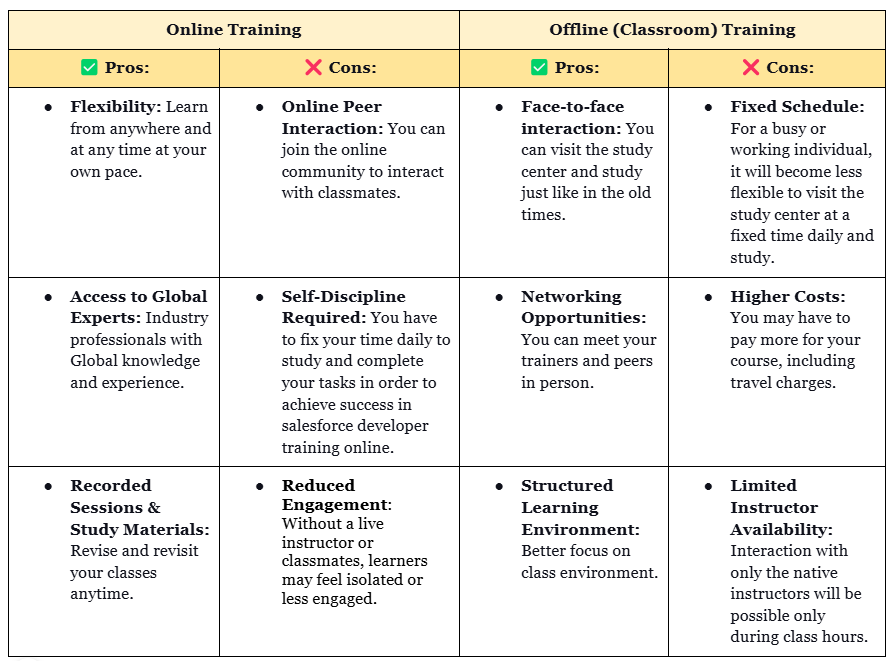
online vs offline training 5 1

Final Thoughts: Start Your Journey Today

It is very important to study and become an expert in your field to increase your chances of earning more with better organizations. Hence, you must complete a Salesforce developer online training and certification to open all the doors for professional and financial growth in the field. With QuantoKnack training, you can get everything, like getting training from experts, anytime and anywhere classes, real-time experience with live project completion during your training, passing certificate exam, and getting placement assistance with one of the partnered, reputed organizations. In the UK, we have always helped candidates grow and make a better future, and we will always do. Enroll today!

READ MORE
Recent Posts
  • How Salesforce Data Integration Tools Simplify Real-Time Business Connectivity
    In a nutshell, businesses collect operational data to perform...
  • Design, Build, and Optimize Agents with Agentforce 360 Innovations
    In this fast-moving digital world, businesses also want smarter...
  • Salesforce Built-In Payment Processing: How to Handle Everything End-to-End
    In the current digital economy, where online payments have...
  • Explore Top Salesforce Integration Challenges and Ways to Fix Them
    Integrating any system can be a difficult task, as an...
  • Protecting Sensitive Data: A Complete Guide to Encryption in Salesforce
    In the current digital economy, data can easily rank at the top...
logotype

We cater to individuals and corporates and provide IT training and certification programs.

44679 Endicott Drive Suit 300 #1046 Ashburn, VA 20147 United States

Phone: +1-571 989 9489

Email: atul.deo@quantoknack.com

Useful links

About Us

Contact Us

Blog

Courses

  • Live Salesforce Admin Training
  • Business Analyst
  • QA Testing Course
  • Advance JAVA Training
  • SQL Server Training
  • Live Salesforce Developer Training Certification Course
  • Digital Marketing
  • Oracle DBA Training

Subscribe

    Instagram Pinterest Linkedin
    Facebook
    Logo star

     2024 Quantoknack. All Rights Reserved