Become a Instructor

Blogs

logotype
Menu
  • Courses
    • Salesforce Admin
    • Salesforce Developer
    • Salesforce Business Analyst
    • Advance Java Training
    • Buisness Analyst
    • Digital Marketing
    • Oracle DBA
    • QA Testing Course
    • SQL server Training
  • Register
+1-571 989 9489
logotype
  • Courses
    • Salesforce Admin
    • Salesforce Developer
    • Advance Java Training
    • Buisness Analyst
    • Digital Marketing
    • Oracle DBA
    • QA Testing Course
    • SQL server Training
  • Register
  • +1-571 989 9489

Become a Instructor

Blogs

logotype
Menu
  • Courses
    • Salesforce Admin
    • Salesforce Developer
    • Salesforce Business Analyst
    • Advance Java Training
    • Buisness Analyst
    • Digital Marketing
    • Oracle DBA
    • QA Testing Course
    • SQL server Training
  • Register
+1-571 989 9489
  • Courses
    • Salesforce Admin
    • Salesforce Developer
    • Advance Java Training
    • Buisness Analyst
    • Digital Marketing
    • Oracle DBA
    • QA Testing Course
    • SQL server Training
  • Register
  • +1-571 989 9489
logotype
logotype
  • Courses
    • Salesforce Admin
    • Salesforce Developer
    • Advance Java Training
    • Buisness Analyst
    • Digital Marketing
    • Oracle DBA
    • QA Testing Course
    • SQL server Training
  • Register
  • +1-571 989 9489
TECH
Home TECH Page 8

Category: TECH

TECHAvatar of adminadmin0 Comments
Share article:TwitterFacebookLinkedin
1363 Views
155 Likes

How To Become A Salesforce Expert?

As Salesforce continues on its incredible growth path, the demand for talent grows.  And like all professionals in the Salesforce ecosystem, Salesforce experts are in high demand. In order to stand out from your peers and boost your success, it’s helpful to know some differentiators that can help you be a great Salesforce expert.

To assist you, we’ve compiled a list of some things you can do to stand out from the crowd, become even more successful in your job, and emerge as a Salesforce expert.

Communication is Key 

While there’s no doubting that Salesforce expertise is essential for your work, there’s also a lot more to think about. Everything revolves around effective communication at its heart.

Effective communication is a must-have ability when it comes to a tech profession. You’ll need to learn about your employer’s present systems and demonstrate how alternative Salesforce techniques will assist them in the long run. 

Hires will also need to attentively listen to their bosses’ concerns and search for methods to successfully “pitch” any changes that may need to be implemented in the organization.

After all, the age of digital transformation has arrived, and Salesforce experts may be leading the march toward more contemporary, agile ways of working.

Relationship Development

Relationship building is a valuable skill that many successful Salesforce experts share. It combines networking and stakeholder management. The capacity of an expert to establish connections will be seen in how successfully they can work with new customers and maintain great relationships with those with whom they are presently working. More frequently than not, a professional’s next assignment will come from someone they previously worked with.

Take the Time to Understand Your Clients

As with any profession, it’s critical to get to know your co-workers personally and professionally. You may be involved for more than a year take s, depending on the length of the project;some time to get to know the folks you will be working with! Understanding your client and the teams you’ll be working with as a Salesforce expert will help you make better decisions about how to approach a project.

It’s also a good idea to grasp the project’s political context — who is funding it? Who is more concerned about the firm’s success? What role does your team play? For example, if the team you’re mostly dealing with is under a lot of stress, finding methods to simplify procedures and reduce burden might help you earn some brownie points.

This level of depth and understanding of your customer and “what is vital to them” is what actually distinguishes the successful Salesforce expert from the typical ones.

Active Listening

A Salesforce expert should be able to listen to the concerns and issues of their clients and stakeholders. There is, however, a distinction between hearing and actively listening. The latter includes empathy, or the capacity to put yourself in someone else’s position to comprehend their feelings better. 

Being more sensitive to your client’s issues can help you focus on activities that affect your client’s demands, whether on a day-to-day activity level or in terms of the overall project. When you can appropriately handle such points, it means you have worked on things that are important to your customer, which will increase your productivity.

Industry Knowledge

It is highly common and equally vital to have an area of expertise and understanding of how to work with Salesforce and interact with your clients. While selected Salesforce pros appear to know everything about everything, not everyone will fall into that group.

If you are the latter, it is strongly advised that you choose an industry or a subset of the industry to study and specialize in. For example, if you choose to concentrate on financial services, you may focus on insurance or general banking compliance. While you do not need to know everything about that industry, you should know enough to provide value to a project. The bulk of Salesforce professionals uses a similar strategy. It is typical to discover experts that truly specialize.

The Right Certifications

Salesforce certifications are industry-recognized. Salesforce certifications are classified according to each job role’s criteria and skill sets. Taking more than one can help you advance in your Salesforce career.

Salesforce certifications are classified into eight types:

  • Salesforce Certifications for Marketers
  • Administrator – Administrator, Advanced Administrator 
  • Developer – Commerce Cloud, Platform Developer I, Platform Developer II
  • Technical Architect
  • App Builder
  • Certifications for Implementation Experts or Consultants
  • CPQ Specialist Certification
  • Pardot Expert – Consultant, Specialist

These certificates are stand-alone qualifications based on the employment position in question. Each of them provides you with competence in the relevant field. If you want to be the ultimate Salesforce expert, you may take several tier examinations and pursue higher tier certifications. It’s an excellent way to reach the top of Salesforce specialty in the industry. It may appear daunting, but it is achievable, especially if you combine certifications to save money on Salesforce certification.

Conclusion

The path to becoming a successful Salesforce expert will be difficult. There is so much to learn that it might be challenging to know where to begin. Still, as long as you are ready to learn and improve as a professional, you will have a competitive advantage over others who aren’t as eager to learn.

Get one or more Salesforce certifications if you want to obtain a new job with an arsenal of sought-after skill sets or shift laterally to a well-paying Salesforce position for enhanced career chances. QuantoKnack makes obtaining these certifications easy by providing Salesforce training that allows you to delve deeply into Salesforce concepts. 

QuantoKnack’s Salesforce developer training and Salesforce admin course transform your ability to understand, build and deliver cutting-edge business applications using the Salesforce platform. Our instructor-led, live training and real-world projects will help you overcome any challenges.
Register yourself today!

READ MORE
TECHAvatar of adminadmin0 Comments
Share article:TwitterFacebookLinkedin
1447 Views
177 Likes

How to become a salesforce business analyst

When it comes to efficiently managing customer datasets, Salesforce has long been the most sought-after platform.

Through its various features, tools, and platforms, the Salesforce platform offers a wide range of services. When you implement the software in your business, your sales associates will breathe a sigh of relief since it significantly saves the time and work that goes into various critical business activities.

In addition to being an effective CRM platform, Salesforce has assisted countless candidates in obtaining prominent employment in the field of data science. As new and difficult technology breakthroughs occur on a regular basis and clients expect more tailored services, there have been more vacancies for Salesforce professionals in all types of enterprises. 

Whether you want to be a Salesforce Consultant, a Salesforce Developer, or a Salesforce Administrator in Dallas, you may get a position in a decent company if you excel in all relevant abilities.

Do you want to make a career out of Salesforce?

But what if you don’t want to be a part of Salesforce careers or possibilities that are too technical for you? Don’t worry. We have a fantastic title for you that is techno-functional and does not necessitate hard and fast technological aptitude or background to pursue: Salesforce Business Analyst.

Let’s begin.

What exactly are business analysts?

Business Analysts (BAs) serve as the intermediary between the customer and the implementation partner. Business Analysts must be well familiar with the project. 

They are critical at every step of the SDLC (Software Development Life Cycle), regardless of methodology. Business Analysts identify the requirements that determine the project scope and identify gaps during the Planning & Analysis stage.

Business Analysts collaborate with Solution Architects and Developers to solve requirements throughout the Design stage. During the Development stage, Business Analysts check to see whether the Developers are on the correct track and assist them with requirement clarification if necessary, as well as showcase the product to the client.

Business Analysts assist QAs and customers in testing the system during the testing stage. BAs provide the customer with training and post-implementation support during the Go-Live stage.

Business Analysts may also demo the product at the presales stage in some firms. Business Analysts unquestionably wear several hats during the project life cycle.

What does a Salesforce Business Analyst do?

Here’s a typical job description of a salesforce Business Analyst:

  1. Consult with stakeholders about various parts of the project.
  2. Save research documentation based on stakeholder learnings.
  3. Analyze and review needs before implementing solutions
  4. Evaluate the proposed solutions

Salesforce Business Analysts connect with personnel from various departments and clients to pass on necessary information. They collect critical input from stakeholders and use it to improve company operations. They guarantee that business automation and data management run smoothly and efficiently.

Salesforce Business Analyst Salary

COUNTRYEXPERIENCEPERMANENTFREELANCE
USAJunior$105,100$80 per hour
USAMid$120,900$105 per hour
USASenior$137,000$130 per hour

Why should you become a Salesforce business analyst?

You are in a unique position as a Salesforce business analyst. Within each area, you may have an impact on a company’s technical and operational progress. Knowing all of your options might help you make an educated selection when you begin your career.

Several career entry points

If you have prior expertise in a variety of areas, you may be able to move to become a Salesforce business analyst quickly. For example, you may already have strong IT experience and wish to work in business administration.

Alternatively, you may be a business analyst who wants to learn more about Salesforce technology. Other areas of competence might help you become a business analyst specializing in Salesforce CRM. 

These include, among other things, sales management, company management, organizational leadership, and commerce. Salesforce business analyst training provides us with several professional opportunities.

Utilize cutting-edge technologies

Salesforce business analysts use cutting-edge technology and tools to evaluate processes, provide reports, and create solutions that are tailored to a company’s operations. You will most likely work with Microsoft PowerPoint, Google Analytics, Tableau, and SQL in addition to learning about Salesforce CRM systems. You can also update existing outdated network systems to the most recent technologies throughout a company’s departments.

Job security

Companies frequently check their existing ranks for a potential internal candidate, someone who is eager to become a business analyst and learn about Salesforce technology. This is an excellent chance for people who desire to progress their careers while remaining with the same firm.

If you decide to change jobs, you should be aware that business and management analysts are in great demand across a wide range of sectors. As per the US Bureau of Labor Statistics, job growth will be 11 percent from 2019 to 2029, typically faster than the average for all occupations (BLS). Furthermore, many businesses offer continual on-the-job training through boot camps and other continuing education forms to help their employees improve their present abilities.

Team collaboration

Business analysts are employed at all levels of a business. They can be found in a variety of divisions within the organization, including sales, accounting, information technology, and operations. 

Salesforce business analysts may operate as part of a team on a single major project or numerous smaller projects to accomplish the necessary modifications. They will also interact with various stakeholders about the company’s current capabilities and discussed about the application the customer wants to build in order to improve their customer interactions.

Top 5 Skills Required for Success as a Salesforce Business Analyst

If you love addressing issues with practical solutions, using data as a foundation for generating insights, and thriving on logic, then learning how to become a Salesforce Business Analyst for the world’s #1 CRM is for you! Stick to the following skillset to jumpstart your profession with impulsive growth.

Ability to Document

As a Salesforce Business Analyst, you must be able to manage functional and technical documents effectively. You will very probably have to deal with simple to extremely complicated data in enormous amounts. Here is the list of documents needed to be prepared by Business Analysts.

  • Business analysis plan
  • Business requirement document
  • Project vision document
  • System requirement specification (SRS)
  • Functional requirement specification (FRS)
  • Wireframes 
  • Mock-ups
  • Change request document

Understanding of Business Processes

As a Business Analyst, you will be responsible for a wide range of responsibilities in a number of industries, each with its unique set of business procedures. You must understand the client’s process, problem areas, and goals. 

Ascertain that you provide solutions that the customer values and that are long-lasting. You must comprehend each phase of the business process, from obtaining project requirements/resources to assessing and confirming the final result. This is one of the most critical abilities for working successfully as a Salesforce Business Analyst.

Analytical Capabilities

In this role, you must think rationally about the customer’s wants and properly investigate them. So, to begin your Salesforce position and advance your career in this sector, you must have excellent analytical skills and the capacity to translate them into meaningful development.

Soft Skills

  • Active Listening: You must be able to pay close attention to every detail. If you can pay attention to every detail, you can quickly identify the source of the problem. You can bargain well if you grasp the issues and think strategically.
  • Collaboration skills: They are required for Salesforce efforts. It is critical to be able to collaborate with others and plan activities with the entire team. Communication Skills: You must be able to work well with others and communicate well with teams and stakeholders. You must also be able to interact and persuade stakeholders in any situation. As a result, you will be able to maintain strong and effective working connections with stakeholders.
  • Problem Solving Skills: This role demands great problem-solving abilities since it allows you to address all of your concerns swiftly. Problem-solving talents entail quickly identifying the underlying issue and implementing a solution.
  • Time management: It refers to your capacity to manage your time properly, be productive, and fulfill all of your daily tasks. To stay in this industry, you must prioritize duties, take the initiative, be self-directed to meet deadlines, be self-motivated, and work confidently.

How to Become a Salesforce Business Analyst?

You can begin your Salesforce Business Analyst career in just five easy steps:

  • Conduct thorough research on the Salesforce Business Analyst career path regarding how to proceed, future scope, comparison with other work possibilities, practicability, compensation package, degree of interest, and other factors.
  • Attend the Salesforce career counseling session. Discuss with an expert family member or a friend to help you navigate this profile. If you don’t have someone with this level of expertise, come to QuantoKnack, where our specialists can assist you in navigating the Salesforce Business Analyst Career path and upskilling yourself with our Salesforce developer training and Salesforce admin course.
  • Attend QuantoKnack’s comprehensive Master Salesforce Training, which is guided by real-life Salesforce specialists who educate you about Salesforce CRM end-to-end through real-case studies and tasks.
  • Win the Salesforce Certification wars. Because there is no specific Salesforce Business Analyst certification, you may complete the course and then go on to pass and retain your Salesforce Admin course and Salesforce Consultant certifications.
  • Connect with Salesforce Communities and Business Analysis Associations, connect with actual Salesforce specialists on Linkedin, and begin your career path with internships, employment, or industry projects.

Make new career steps that are in line with your ambitions.

Business analyst careers for Salesforce-trained persons are expanding quickly across the world. Companies are looking for new methods to provide better services to their consumers while also offering software and hardware solutions that allow their personnel to retain high productivity levels as technology and big data become more extensively employed. Salesforce Business Analyst is one of the best bargains you can get because Salesforce leads the CMS industry with a 20% share and expects to create 4.2 million jobs inside its ecosystem by 2024. 

Because there are so many methods to become a Salesforce business analyst, you may choose a learning opportunity that allows you to choose the career path that best matches your lifestyle.

We at QuantoKnack assist you in launching an excellent career in the cloud. We’re here to help you gain the skills and information you need to pursue your career goals.

Join QuantoKnack’s Salesforce Business Analyst training and benefit from our expert training course. Once you’ve completed training, you’ll become a certified Salesforce Business Analyst, ready to begin your new career with one of our esteemed clients.

Register yourself today and start forging your path to a higher salary and better career opportunities!

READ MORE
TECHAvatar of adminadmin0 Comments
Share article:TwitterFacebookLinkedin
1679 Views
172 Likes

How to Become A Salesforce Developer In 2024

Salesforce.com, Inc. became popular as a CRM market leader for the sixth straight year in 2019. Salesforce CRM is already used by over 150,000 enterprises globally, including well-known brands like Sony, Financial Times, Toyota, and others. As the use of Salesforce CRM increases, Salesforce expects to create over 3.3 million job opportunities, including roles for developers, by 2024.

According to the reports, the average yearly package of Salesforce developers is approximately 0.5 million, while working with top recruiters can result in an annual package of 1 million. 

If you want to be a successful Salesforce developer, this article will help you identify the best path to success. You will be given a brief overview of the field, the necessary skills, and best practices to identify the opportunities.

Who is a Salesforce Developer?

Salesforce Developers, also known as SDFC Developers, strive to revolutionize every project they work on with their professional development expertise. Salesforce engineers are required to have certain built-in abilities, and they can further their education through various certifications.

The task force is in great demand in a variety of industrial categories, including healthcare, financial services, hospitals, information technology, and others. These programmers work on large projects like Salesforce customization, designing bespoke Salesforce apps, and configuration. They constantly work on the Salesforce platform, and they have a variety of jobs and responsibilities.

Job duties of Salesforce developers

Salesforce functionality may be tailored to specific business requirements in two ways: configuration and customization. Salesforce customization is primarily the responsibility of developers, although they may also handle configuration.

CRM functionality is customized via the user interface during the Salesforce setting, with no code required. This allows you to construct tables, objects, and fields and form relationships between them, and specify rules for automating linear work processes. Businesses often use a Salesforce administrator for configuration.

Salesforce customization is required when the built-in point-and-click features in Salesforce are insufficient to automate certain business processes. Examples of Salesforce customization include: 

  • Automating complicated non-linear business processes.
  • Connecting Salesforce to other systems (ERP, company website, social media, etc.).
  • Designing unique reports and dashboards.
  • Integrating Einstein AI capabilities with CRM, etc.

Salesforce developers in Dallas create bespoke apps for Salesforce in addition to customization and configuration (IT product businesses can upload such applications to Salesforce’s AppExchange marketplace).

Salesforce Developer Requirements

Salesforce Developer job descriptions are now looking for talents found in the same areas where developers and administrators have shown their proficiency. First and foremost, Salesforce Developer soft skills are necessary for candidates to enter the Salesforce field. If you want to compete, you must demonstrate proficiency in the following soft skills:

  • Problem-solving: Because a developer is responsible for overseeing all stages of software development, they must be well-versed in problem-solving techniques.
  • Communication: You must be able to help your clients and team members understand what you are trying to say.
  • Analytical mindset: You must continually evaluate and comprehend the client’s brief to build software that meets their requirements.
  • Solution-focused: Your primary goal must be to solve all of the client’s and your team’s concerns.
  • Project management: You must manage projects and ensure that they are completed on schedule. This includes quality assurance and client feedback.

These experts should be knowledgeable and experienced in the following technological skills:

  • Web services: A Salesforce Developer must be able to design web services using technologies such as Apex.
  • End-to-end Salesforce ideas: A Salesforce Developer must be well-versed in all Salesforce concepts.
  • SOQL/SQL: Salesforce Developers must be well-versed in Salesforce Object Query Language (SOQL) and Structured Query Language (SQL) (SQL).
  • JQuery: Salesforce Developers must have a basic grasp of jQuery in order to navigate tools like visualforce and the Salesforce Lightning component.
  • JavaScript: Salesforce Developers rely heavily on JavaScript.

Reasons why you could like Salesforce development 

The Lightning Platform has several ready-made development components, which dramatically simplify a developer’s task.

  • You like delving into a customer’s problems.
    • Salesforce development necessitates investigating a customer’s business operations. 
    • Furthermore, knowing a customer’s business will be part of your work responsibilities and affect your career advancement.
  • You are interested in both back-end and front-end development.
    • Salesforce app developers provide user interfaces as well as work on the server-side.

Salesforce Developer Salary and Job Outlook

Salesforce developers often have a background in software engineering. According to the US Bureau of Labor Statistics, the median compensation for entry-level software engineers, quality assurance analysts, and testers in 2020 will be $110,140. Between 2020 and 2030, the field is predicted to create 409,500 jobs, representing a 22% increase.

The average yearly income for Salesforce developers, according to ZipRecruiter, is $115,403. According to ZipRecruiter, the three most profitable places for Salesforce developer jobs are New York City, Boston, and Silicon Valley.

Top 4 Reasons to Become a Salesforce Developer in 2024

Salesforce engineers get high incomes due to their great demand.

There are various reasons why working as a Salesforce developer is a great choice, and we’ve included our favourites below:

  • You get to work with a creative platform. Salesforce is a very engaging system. Optimizing user interfaces to improve user experience may be both enjoyable and demanding.
  • You have a direct impact on economic progress. You enable business and promote economic activity in your country by producing enterprise software solutions.
  • It is the most profitable occupation. Salesforce engineers make high pay because cloud specialists are in high demand in the employment market.
  • You will be exposed to cutting-edge technologies. The Salesforce system is continually being improved, as is the technology needed to sustain it.

Types of Salesforce Developer Careers

Salesforce professionals can choose from a variety of career paths. Aside from Salesforce development, you can pursue any of the other vocations listed below.

Salesforce Architect

These individuals analyze and manage various design elements of Salesforce apps. They create Salesforce systems and ensure that features scale smoothly. They are also in charge of Salesforce cloud systems and servers.

Salesforce Administrator 

Salesforce Administrators educate users on Salesforce basics and produce reports. One of their responsibilities is to automate complex company procedures.

Salesforce Consultant

Salesforce consultants collaborate with clients to ensure that their needs are satisfied. In addition, the Salesforce consultant helps the operations teams on how to improve the customer experience and address defects.

Benefits of Becoming a Salesforce Developer in the Digital World 

  • Maintain Contact with the Technical World
    • We live in a digital world dominated by developing IoT, AI, and machine learning technologies. As a Salesforce developer, you will work with a variety of programming languages that are utilized in various technologies. This allows you to introduce yourself to the technological world and, as a result, implement sophisticated solutions in the projects you work on.
  • High-end Packages
    • Salesforce developers are among the most in-demand experts in the world and among the highest-paid IT professionals. The faster you expand, the better your pay scale and annual revenue.
  • Multiple Career Paths
    • Salesforce developers can pursue a variety of career paths. They can work as a freelancer in addition to their full-time employment. They can also work as a full-time freelancer. When you have extensive knowledge in this field, you may even become a salesforce development trainer.
  • Good Recognition 
    • Along with benefits, most people desire positive social recognition. A job as a Salesforce developer will help you achieve it. As a result, 80 percent of people nowadays aspire to work as a salesforce developer.
  • Rapid Growth
    • Not every corporate position can promise rapid advancement. Many corporate employees are locked in the same organization without advancement, yet this is not the case for many salesforce developers. As a result, those individuals are looking for a job as a salesforce developers in order to keep up with the latest technology. They mostly prefer online classes to learn it.

How to become a Salesforce Developer 

From Salesforce Developers to Administrators, there are various career options accessible to ambitious IT employees who want to be in demand and, more crucially, who want to be compensated for their hard-to-find skills. But, suppose you want to learn how to become a Salesforce Developer; how do you acquire such knowledge from such a constrained starting point?

Let’s take a look at how to become a Salesforce developer in 2024.

Be an Effective Salesforce Administrator

Consolidate your Salesforce Admin knowledge! Devote three months to studying for and passing the five certifications listed below.

  • Salesforce Certified Administrator 
  • Salesforce Certified App Builder 
  • Sales Cloud Consultant
  • Salesforce Certified Advanced Administrator 

You may find a plethora of materials and testimonies on YouTube and Google.

Make Salesforce Personal → Run Your life on Salesforce

Navigating and configuring your Salesforce org should become as natural and simple as navigating and modifying the settings on your iPhone. Use Salesforce for your personal requirements to become acquainted with it. Is there anything unique you can do with Salesforce?

First, you should be familiar with Salesforce’s programming languages, Apex and JavaForce, before moving to UI scripting languages VisualForce and CSS. After that, businesses seeking someone to occupy a desk without worrying about settling in time would always prefer someone with platform experience.

Join Your Local Salesforce Developer Community & Join QuantoKnack’s Training Programs

You could do it alone by utilizing Salesforce’s fantastic training tool, Trailhead, to earn badges and invest in industry-recognized certifications, which are becoming a must for everyone working on the stack. Alternatively, you may self-learn by utilizing various online resources and seeking a job from an employer who will ignore your lack of qualifications and experience.

One way is to enroll in QuantoKnack’s Salesforce developer training, which will take you from Salesforce newbie to fully qualified with all the certifications, skills, and real-world Salesforce experience you need to become a really appealing candidate. Our industry experts will work with you one-on-one to ensure you are properly prepared for your certification tests.

Pass the Platform Developer (PDI) Certification

Passing the Platform Developer Certification is critical because it will help you make up for any gaps in your Salesforce Development expertise. Although part of the test content is out of date (since it mostly concentrates on Visualforce), you should still pass this Certification – additionally, it will indicate your eagerness to learn.

Pass the Scrum Master Certification

When you start a project, you should be familiar with terms like backlog, sprint, and stand-up meetings. Scrum.org certification may be obtained in as little as two days of study. In addition, the test is an open book. This qualification should look well on your CV.

Apply to Jobs & Track your Mistakes

Many individuals may be depressed after repeatedly failing to ace salesforce interviews. The goal is to learn from your mistakes and glean useful information before moving on to your next interview. The goal is to discover the gaps and then maximize your interview performance. 

If you’ve already created a Salesforce track record for your job hunt, you may utilize it to track your performance, top interview questions, and other useful information.

Unlike other types of interviews, coding interviews are objective, allowing you to discover specific areas for development and utilize Google, Trailhead, or other relevant platforms to build strengths and enhance your performance in the next interview.

What’s The Future of Salesforce?

According to research, 1.9 million new jobs will be generated in the Salesforce ecosystem by 2020. Such forecasts predicted exciting developments, such as increased Salesforce adoption by smaller firms, increased influence on field service and the IoT, and simplifying the app to attract a larger range of users.

If such optimistic forecasts are correct, it is reasonable to infer that Salesforce’s popularity will rise and extend into expanded SMB markets. With more demand comes an increased need for developers; this looks to be a viable career route to choose.

FAQs

Is it Possible to Work as a Salesforce Developer Without a Degree?

You certainly can. You can start a career in technology if you have high school graduation and are willing to take certification examinations. Salesforce programming is a contemporary and in-demand job that may be learned without a college diploma.

Can a Salesforce Development Certification Help Me Get a Good Job?

You absolutely can. According to ZipRecruiter statistics, the average income for entry-level Salesforce developers is $85,069. This attractive remuneration is only one of the benefits of obtaining a Salesforce developer certification. It’s never been easier to achieve your job goals.

Is It Difficult to Become a Salesforce Developer?

No, it isn’t. The learning process is quite enjoyable. The training atmosphere is incredibly dynamic, so learning the technical skills essential for success does not feel overwhelming. You will work with other software development students to design custom cloud-based applications.

What types of programming languages will you use as a Salesforce Developer?

Apex, similar to Java, is a particular Salesforce programming language that can be used to program the platform and VisualForce, like HTML. VisualForce is a markup language for customizing Salesforce pages.

Lightning web components are contemporary user interface components that are modular and developed using HTML, CSS, and JavaScript. They are a functional substitute for VisualForce. Although VisualForce is still used in many older Salesforce deployments.

Conclusion

The Salesforce Development & Customization Services taskforce is very important in the world of Salesforce Development & Customization Services. There is an increasing rush of newcomers to acquire the expertise that Salesforce developers should possess, demonstrating its popularity and need. The sky is the ultimate limit for Salesforce CRM, and the task force is the driving force behind its support.

If you want to become a certified Salesforce Developer, register yourself today for QuantoKnack’s Salesforce developer training and Salesforce admin course. 

Let QuantoKnack Training help you polish your development skills to get your first job soon as a Salesforce Developer! 

READ MORE
TECHAvatar of adminadmin3 Comments
Share article:TwitterFacebookLinkedin
2123 Views
199 Likes

How to Become a Salesforce Consultant

“By 2024, Salesforce and its ecosystem will generate 4.2 million new employment globally.”

This is a significant number, and it is equivalent to the combined GDP of Belgium and Thailand or the population of New Zealand. Salesforce has a greater global influence than technology.

Salesforce has built up its platform and updated and enhanced its products and services over the last few years. This surely contributes to its rapid expansion. More and more businesses are turning to solutions like Salesforce to help them manage customer relationships more efficiently. However, not all business owners are tech-savvy. That’s where the Salesforce consultant comes in.

Did you know that Salesforce consultants earn more than 50$ per hour on average?

A Salesforce Consultant is a trusted adviser who uses technological solutions to solve complicated business challenges and offers the best of the Salesforce platform to the customer.

When you think of starting a career in Salesforce, it brings a lot of questions, fears, and doubts. Especially in a job profile such as Salesforce Consultant since it’s quite new but is here to stay. 

Do you want to learn how to become a salesforce consultant? In this blog, we will help you understand everything about the Salesforce Consultant role and guide you on how to start your journey. 

Who is a Salesforce Consultant?

A Salesforce consultant is an expert who designs, maintains, and implements databases and connects commercial organizations with their respective clientele. They are in charge of improving and sustaining business-client relations. 

The person achieves this through strategic Salesforce Implementation and efficient management of various functions that influence work productivity and customer relations.

What does a Salesforce Consultant do?

A Salesforce Consultant typically wears multiple hats. The following are some of the responsibilities of a Salesforce Consultant:

  • Managing the Client Relationship
  • Mapping out Business Processes
  • Creating and Managing Project Plans
  • Configuring and customizing the app on the force.com platform.
  • Gathering Functional (Business) Requirements 
  • Brainstorming Technical Requirements
  • Technical Product Configuration
  • Unit Testing and Training

Salesforce consultants assist organizations in making the most of their Salesforce platform. Knowledge of both the platform and business processes and exceptional communication skills make them a significant addition to any organization, which is why they are highly compensated with a competitive wage.

Why choose to be a Salesforce Consultant?

  • Ample Job Opportunities:
    • Nearly 37,000 new jobs are posted on average. 
  • In-demand skill:
    • More than 150,000+ customers, ranging from small businesses to Fortune 500 companies, are using the Salesforce platform to expand their business.
  • Lucrative Salary:
    • Earn an annual average ranging from $80,000 to $150,000+
  • Always on the Move:
    • Salesforce continues incorporating changes and also evolving so that you are never locked with a single subject or one monotonous work/task.

Who can Become a Salesforce Consultant? 

If you’re interested in applying for the Salesforce Consultant examination, you need to know about various Salesforce concepts and how the platform functions. 

An ideal Salesforce admin training and Salesforce developer training provider efficiently offer all this knowledge to the candidates preparing for this Salesforce examination. It helps the candidate in formally preparing for and taking the certification exam. 

The skills required differ depending on the duties and functions you are willing to take on. 

In general, clients prefer to hire Salesforce Consultants that have a rich history in the functional and technical knowledge of the salesforce platform. If you wish to become a Salesforce Consultant or take Salesforce Admin Training in Dallas, the first thing you should think about is the credentials and experience necessary.

One of the most valuable qualities here might be extensive business expertise.

The second most significant requirement is understanding the Salesforce platform along with the relevant certifications like Salesforce Admin, Salesforce Developer etc. Additionally, you should add a Salesforce Consultant certification to your CV or resume. The more experience you have with Salesforce, the more likely you are to get hired for higher-paying positions. 

Top Salesforce Consultant Skills Recruiters Actively Looking for

Certain skills set you apart from the crowd, and they are the ones that recruiters are actively looking for while hiring a Salesforce Consultant. 

The following are the technical and soft skills for a Salesforce Consultant to get a better salary package and to climb high in your career:

Technical skills that indeed make your CV stand out:

  • Salesforce platform knowledge
  • Sales, Service, or Marketing cloud certifications
  • Technical Solutions 
  • Apex Programming, Trigger, LWC, Knowledge 
  • Technical Support

Brush up on these soft skills and watch your career skyrocket like never before:

  • Communication
  • Teamwork/Collaboration
  • Presentation Skills
  • Writing
  • Problem Solving

5 Best Strategies for Becoming a Salesforce Consultant

The following are the five best strategies to help you become Salesforce Consultant:

Get a Rich Experience

To flourish in their profession, every technology star should have an in-depth understanding of their field. Salesforce consultants must have extensive knowledge of customer relationship management solutions.

To land a job as a Salesforce consultant, you should be able to demonstrate to your prospective employer that you understand how to use cutting-edge technology to their benefit. Salesforce offers many features and tools, and a consultant must be able to manage them all, from the Service Cloud to the Marketing Cloud, in order to support/achieve company goals.  

Outstanding Salesforce consultants also have project management experience. They understand what it takes to unite a team behind the same purpose and expedite the adoption of innovative technologies. 

Make sure you have experience in: 

  • Every Salesforce Platform (Marketing, Service, and Sales)  
  • Integration and configuration of CRM tools
  • Leading diverse teams within a business 

Obtain Your Salesforce Consulting Certifications

Salesforce’s breadth as a CRM platform merely means that consultants have more than one path to take. Salesforce has six distinct certifications that consultants may use to demonstrate their expertise in customer relationship management. The following are the possible certifications: 

  • Salesforce Certified Marketing Cloud Consultant
    • This certification helps you demonstrate your ability to implement and configure comprehensive cloud-based marketing tools for email and other campaigns.  
  • Salesforce Certified Sales Cloud Consultant
    • This certification provides you with the knowledge and skills required to develop and deploy cloud solutions, including interface and application design. You will also learn how to handle statistics for tracking Salesforce performance.
  • Salesforce Certified Service Cloud Consultant
    • This certification is designed for cloud contact center support professionals and provides an overview of metric and analytics tracking.
  • Salesforce Certified Pardot Consultant
    • This certification is intended for consultants who deal with the Pardot suite of solutions that are linked to the Salesforce CRM. You will learn how to implement and design Pardot solutions.  
  • Salesforce Experience Cloud Consultant
    • You may demonstrate to employers that you can install Salesforce Communities apps and handle difficulties for teams by earning this certification.  
  • Salesforce Certified Field Service Lightning Consultant
    • This certification showcases your ability to design and manage apps/solutions for customers.  

QuantoKnack offers a live, instructor-led Salesforce admin course and Salesforce developer training program, which can give wings to your Salesforce career. 

Improve Your Analytical and Listening Skills

Salesforce consultants should be well-adapted in listening and analytics. The knowledge acquired from workshops and meetings is used to inform the results of your work as a consultant. This implies that consultants must be able to absorb concepts as well as read between the lines.

While embarking on your journey of how to become a Salesforce consultant, focus on looking for opportunities to build your analytical and judgment skills. Demonstrating problem-solving expertise will help you both in the everyday business environment and any competency-based interviews. 

Exceptional listening will help you become a valuable part of any business team. Furthermore, understanding how to respond to the demands and expectations of others inside a business guarantees that the group will completely embrace any solutions you implement. 

You must have an excellent: 

  • Listening & communication skills
  • Problem-solving and Analytical abilities
  • Ability to design complex business solutions that properly leverage the Salesforce platform.  

Keep Learning

As the Salesforce ecosystem evolves, a Salesforce consultant should aim for constant learning.  

Salesforce certifications are available in a broad category, including consulting. The more training you receive, the easier it will be to satisfy the demands of a wide range of clients and enterprises.  

A solid commitment to continuous learning additionally includes networking with other industry experts within the Salesforce Ohana community. There are countless forums and events designed to help professionals on the path to a new Salesforce career.  

Improve/Enhance Your Communication Intelligence

A Salesforce consultant must have a high level of education and experience. However, it is also necessary to have the necessary soft skills. 

Salesforce consultants must be able to analyze the needs of the business carefully, then recommend the teams that everyone can understand. As a Salesforce consultant, you must be able to convert a CRM system’s sophisticated jargon into something that workers and departments can immediately understand.  

Make sure you know how to: 

  • Feel comfortable being a part of a team and also leading teams towards stronger Salesforce implementations.
  • Address and lead complex business solution-related discussions with technical architects.  
  • Share functional and technical expertise with other teams.  

Conclusion

Salesforce consultant is an extremely rewarding profession that promises healthy career growth, stability, and an excellent pay scale. Holding a primary role in any organization, a Salesforce consultant enjoys a leadership reputation, helping him build a social reputation and lifestyle perks.

If you’re looking for a reliable and trusted Salesforce Certification training institute, you have come to the right place. 

Enroll in the live, Instructor-led training program by QuantoKnack Training and learn the Salesforce platform–from the basic concepts to solving and building complex business solutions. We offer online training so that you can choose what suits you best. 
Register yourself today!
READ MORE
TECHAvatar of adminadmin0 Comments
Share article:TwitterFacebookLinkedin
1901 Views
163 Likes

How to Become a Salesforce Partner

Salesforce was launched in 2000 with a unique concept of Software-as-a-service. It had also established itself as an innovator way back when the business became synonymous with the ‘No Software’ logo.

Today Salesforce revenues are $20 billion annually, and it has been growing about 30% every year. In 2018, Salesforce acquired Mulesoft for roughly $7 billion, and in 2019 Tableau for $16 billion.

Instead of a classic resell model, Salesforce has embraced an ‘ecosystem’ approach. This means that Salesforce has consistently developed an ecosystem of relationships with companies. 

Salesforce partner program includes four major categories:

  • Consulting partners (System Integrators) & Agencies:
    • Offering strategic business consulting, solution integration, system design, and product implementation. 
    • Build software applications and integrate them into Salesforce, Offer Salesforce services.
    • Contribute to business growth and boost efficiency by leveraging their experiences, leading personalized practices, and using innovative tools.
  • AppExchange partners:
    • ISV (Independent Software Vendors) who design and market software solutions built on or integrated with the Salesforce Platform.
  • Resellers Partners:
    • Sell Salesforce licenses, however, are not necessarily involved in the implementation.
  • Managed Services Provider (MSP)
    • Offers ongoing, recurring, and post-implementation services. Only consulting partners can apply for this category.

Are you interested in learning how to become a Salesforce partner? If yes, then you are at the right place. In this article, we will cover everything you need to know to become a Salesforce partner. 

What is a Salesforce Partner?

A Salesforce partner is a consulting business that Salesforce authorizes for building custom solutions, project implementations, and integrations services. 

It comprises industry-leading professionals trained to provide expert advice, guidance, actionable solutions, and unique expertise for all sorts of Salesforce products, industries, and system integrations.

Why should you become a Salesforce Partner?

Salesforce is sought after by millions of businesses, making it the world’s most popular CRM enterprise. There are more than 1843 Salesforce Consulting Companies worldwide, and the Salesforce platform is used by over 150,000 organizations.

Salesforce also reported its highest-ever revenue of $21.25 billion, indicating that demand for its secure, scalable cloud platform has skyrocketed. Salesforce even said that their partners lead 70% of customer implementations and that 86 percent of their customers use the latter’s apps and solutions.

How much does it actually cost to become a Salesforce Partner?

Consulting firms are required to pay an annual consulting partner program fee. The sum is determined by the previous year’s final tier evaluation. Typically, the consulting partner program year extends from March 1 through February 28 of the following year.

How much do Salesforce Partners Earn?

It is said that opting for a Salesforce career is pretty lucrative. You can start your own business. 

As per Cloud Mastery, the following is what a Salesforce partner earns and charges per hour:

  • Salesforce Training – $ 1K – $ 1.5K per day
  • Salesforce Consulting – $ 125 – $ 200 per hour
  • Salesforce Development – $200 – $ 250 per hour
  • Salesforce Data Management – $200 – $250 per hour
  • Salesforce Integrations – $ 125 – $ 150 per hour

Indeed, the amount you charge will still depend on your expertise level and how comprehensive your services are.

How to become a Salesforce consulting partner?

To become a Salesforce consulting partner, applicants must undergo a rigorous vetting procedure. This demands a significant effort in terms of investment, training, certifications, etc. To be accepted as certified partners, they must satisfy all standards and give all relevant information.

Follow these steps:

Step: 1 Agree and accept the policies of the SPPA (Salesforce partner community).

Step 2: Apply to become a member of the Salesforce Partner Community

Step 3: SF sends a welcome email outlining the preliminary prerequisites for joining the program.

Step 4: Prove compliance with the minimum requirements within a maximum period of 30 days after receiving the welcome email

Step 5: Salesforce evaluates the application and, if it is correct, grants the entity the status of “provisional partner and sends an additional email outlining the requirements for its inclusion in the program on a non-provisional basis (certifications, fee payments, etc.) 

Step 6: Present proof of compliance with the inclusion requirements.

Step 7: If the Provisional Partner complies with what is established, it is officially accepted to the program and assigned the “Base” level. 

What are the levels that Salesforce partners can achieve?

The Salesforce Consulting Partner Program has four basic levels, and partners are rated based on these levels based on points as follows: 

  • BASE Partners (up to 249 points), 
  • CREST Partners (More than 250 points), 
  • RIDGE Partners (More than 500 points), 
  • SUMMIT Partners (750 points). 

A partner should have at least two Certified Salesforce Consultants and pay a program fee of around $1000 for the Base level to join this partner program.

Partner program points are earned depending upon the following three categories:

CUSTOMER SUCCESS

In this category, you may earn up to 350 points. The points are awarded depending on the partner’s NAVIGATOR level and Customer Satisfaction Scores. The Navigator level of the partner corresponds to their topic expertise: Expert, Level 1, or Level 2.

INNOVATION

In this category, you can earn upto 350 points. The points are awarded depending upon the number of Certified Salesforce developers,  Salesforce Consultants, and Salesforce Architects that the partner has.

ENGAGEMENT

A maximum of 300 points are available in this category. The points are awarded based on the partner’s Annual Contract Value (ACV). This measure is known as COSELL ACV. Revenue might come from new clients or new projects with existing ones.

Salesforce is steadily increasing the weight of program points accessible from Customer Success criteria (CSAT and Navigator) while decreasing the weight of program points available from Cosell ACV. This basically indicates that they are focusing more on customer experience and less on revenue from partners.

Salesforce provides a thorough partner enablement plan as well as a large content repository called Trailhead.

What are the advantages offered by Salesforce Partner Program?

Salesforce delivers all of the resources, training, and tools needed for partners to gain expertise in certain business operations, product areas, and sectors in order to serve their customers better and improve their practices.

The consulting partner program provides the following advantages:

  • Design and development:
    • Access to forums where you can get an opportunity to interact with partners from all over the world and share your valuable experiences.
    • Marketing Cloud trial partners to design and analyze the tool’s capabilities.
    • Subscription to the consultancy Partner Insights Newsletter
    • Licenses for Lightning CRM Enterprise Edition and the myTrailhead site.
    • The Pardot Plus Edition
  • Sell ​​and market.
    • Participation in the AppExchange Marketing Program (AMP).
    • Partners will get a referral bonus when a recommended lead is provided through the partner community.
  • Service and support.
    • 24-hour technical support, thanks to the Partner Premier Success.
    • Credentials vouchers to cover the cost of Trailhead-listed certification exams.

Start Your Salesforce Consulting Partner Company with these Six Tips

Starting your Salesforce Consulting company is not an easy task. However, there are a few things that you can do to ensure your company is on the right track:

  • Find Your Own Niche In The Market
    • Salesforce provides a variety of solutions such as Marketing Cloud, Sales Cloud, Service Cloud, and Commerce Cloud. You may choose the market you wish to serve with their wide selection of cloud-based products. Once you’ve determined your target audience, plan your strategy and interact with them. This will aid you in clearly defining your future services/activities/efforts and allow you to provide greater value to your clients.
  • Streamline All Your Business Processes
    • Streamline all your processes and ensure everything is in harmony. You can hire the top professionals to handle all the services you offer to your customers.
  • Maintain Healthy Relationships
    • Constantly engage and maintain healthy relationships with your clients and employees. Your clients will stay with you in the long run and may even suggest you to someone they know. 
    • Another element that can help you stand out from other Salesforce Partners is business empathy or the ability to deliver solutions that suit the client’s vision and concepts.
  • Have Flexibility In Structure
    • Create a flexible business structure that allows for future growth. The nature of the Salesforce Partner company is constantly changing, and you will need to take extra steps to adapt to all the Salesforce’s technological advancements.
  • Be Inventive and Adaptive
    • There will always be competition, so make sure you stand out from the crowd. Because clients’ demands vary quickly, you must be more creative in your approach and consider out-of-the-box business solutions by leveraging technology to meet their needs. Creating fresh approaches will assist you in attracting more consumers.
  • Build a Team of Salesforce Professionals
    • Hiring the right Salesforce professionals who can contribute to your business goals is crucial and challenging. This would aid in determining who will work and which Salesforce solution would be prioritized. 

Who is the professional you need to hire for your Salesforce Consulting Partner Company?

The following is the list of professionals/experts that are mandatory for a Salesforce Partner:

  • Salesforce Administrator
    • This individual will manage specific Salesforce requirements of your clients. Register for QuantoKnack’s Salesforce admin course and learn everything about Salesforce admin roles & responsibilities. 
  • Salesforce Developer
    • The Salesforce developer will develop customized and improved applications for your clients. Check out the live, instructor-led Salesforce developer training program and hone your abilities in Salesforce development.  
  • Salesforce Business Analyst
    • This individual will help your clients with Salesforce platform or tool deployment challenges.
  • Salesforce Architect
    • This individual will be your reliable digital advisor and team leader. They always imagine the bigger picture and design systems to address the business challenges.

Conclusion

Opportunities in the Salesforce ecosystem are rapidly expanding. If you want to support millions of businesses that use Salesforce efficiently, now is the right time to take the leap and become a Salesforce Partner.

If you become a Salesforce partner, Salesforce will welcome you to a community. 

Get the hands-on Salesforce training offered by QuantoKnack Training. We offer live, instructor-led Salesforce admin training and Salesforce developer training program to upskill everyone who wants to fulfill their dream of working in the Salesforce ecosystem. 

Register yourself today!
READ MORE
TECHAvatar of adminadmin0 Comments
Share article:TwitterFacebookLinkedin
1538 Views
150 Likes

How To Call A Method In Java

LinkedIn Banner IT Consultant 2
How To Call A Method In Java 2

Java is an object-oriented language and hence requires its methods to be defined in a class. Once a method is defined in a class, it can be called in the main or other methods. There are additionally some built-in methods defined in Java libraries. Call any built-in or self-defined methods utilizing the syntax described in this article.

In this article, we will help you understand how to call a method in Java.

What is a Method?

In Java, a method is like a block of code that performs a particular function and runs only when it is explicitly called. Methods are further commonly known as functions. Each method has its own name. One can pass data into a method using parameters. Moreover, a method has a return type defining the type of data it returns.

According to the convention, the method’s name must be written in lowerCamelCase, where the first letter will always be small. Further, a method needs to have a proper name, specially a verb referring to what it does for example, printContactList(),  add(), updateInfo() etc. Every time a program gets a method call, the program execution branches out to the method’s body.

The body’s code runs, and the method returns to the previous code from which it was called and followed by the next line. A method will return to the code that invoked it at the time when:

  • It finished all the code in the method and reached its end.
  • It throws an exception.
  • It reaches a return statement.

Why are Methods used?

Methods are utilized as they allow code to be reused without rewriting it repeatedly. Methods are timesavers and help you keep the code in an organized and readable manner. It makes the code more understandable to multiple coders. It also helps in modularizing the program.

Just in case methods are not used, the program can become extremely lengthy and difficult to test, debug or maintain the code.

Actually, modular fashion allows many programmers to work independently on separate concepts, which can be collected later to create the entire project. The utilization of methods will be our first step in the direction of modular programming.

How to call a method in Java

This section includes everything you want to know about calling a method in java. Opting for instructor-led Java certified training course offered by QuantoKnack can also help you learn everything about Java in the most efficient manner.

Understanding what a method is.

A method is like a series of statements that create a particular function. Once a method is defined, it can be called at different parts of the code to execute the function. This is a useful way to reuse the same code repeatedly. The below-listed is an example of a simple method.

  public static void methodName() {

  System.out.println(“This is a method”);

}

Declare the class access for the method.

When you define a method in Java, you will have to declare what classes can access that method.

In the above-listed example, the access is defined as “Public.” There are basically three access modifiers you can declare a method:

  • Public: Defining the access modifier as “public” before the method name enables the method to be called from any part of your code.
  • Protected: The “protected” access modifier only permits the method to be called within its class and subclasses.
  • Private: Once a method is declared as private, then the method can only be called inside the class. Only those classes placed in the same package can call the method. This is known as the default or package-private.

Public class MyClass {

  Static void myMethod () {

       // code to be executed

  }

}

Declare the class to which the method belongs.

In our above example, the second keyword, “static,” means that the method belongs to the class and not an instance of the class (object). Static methods should be called utilizing the class name: “ExampleClass.methodExample()”.

If the keyword “static” was not utilized, then the method can be invoked only through an object. For example, if the class was named “ExampleObject” and it had a constructor for making objects, then we can try making another object such as “ExampleObject obj = new ExampleObject();,” and call the method using the below: “obj.methodExample();”.

Package com.test.testing;

Class ExampleClass{

     Static int j = 0;

     Static void methodExample() {

           J++;

           System.out.printIn(“The value of static variable/object j is ” +  j);

   }

}

Class TestStatic{

        Public static void main(String[] args) {

                ExampleClass.methodExample();

      }

}

How to declare the return value

The return value is the name of the value returned by the method. In the above example, the word “void” simply means that the method does not return anything.

If you like a method to return some value, then only replace the word “void<” with the object’s data type. Primitive types consist of int, double, float, and many more. Then you need to add “return” + an object of that type nearly at the end of the method’s code.

When you call a method that returns something, you can use what it returns. For instance, if a method called “someMethod()” returns an integer, then you can use an integer to what it returns using the code:

“int a = someMethod();”

Public class MyClass {

    Static void myMethod() {

      //code to be executed

  }

}

Declare the method name

Once you’ve declared the classes that can access that method, the return value, and the class it belongs to, you should give the method a name so that it can be called. Just type the method name followed by an open and closed parenthesis to give the method a name.

The above examples include, “methodName()” and “someMethod()”. Then, you need to input all the method statements inside opened and closed curly brackets “{}.”

Public class className {

   Public static void methodName() {

   System.out.printIn (“This is a metho”);

}

 Public static void main(String[] args)  {

      methodName();

  }

}

How to Call the method

In order to call a method, you need to type the method name accompanied by open and closed parentheses on the line you want to implement the method. Ensure you just call a method within a class that has access to it. Below is an example of a method that is declared and then called within the class:

public class className {

  public static void methodName(){

  System.out.println(“This is a method”);

}

 public static void main(String[] args) {

    methodName();

  }

}

Add a parameter to a method (if required).

Many methods need a parameter such as an integer (a number) or a reference type such as the name of an object. A method that demands an integer parameter of an integer will look like “someMethod(int a)” or similar.

A method that uses a reference type would look like “someMethod(Object obj)” or similar. If a method requires a parameter, you simply type the parameter between the open and closed parenthesis after the method name.

Public Class MyClass  {

  Static void myMethod(String fname) {

     System.out.printIn (fname + “Good Student”);

 }

Calling a method with a parameter

When calling a method that demands a parameter, you will need to add the parameter in the parentheses just after the method name. For instance: “someMethod(n)” or “someMethod(5)” where “n” is an integer.

Just in case the method requires a reference object, simply enter the object’s name in the open and closed parenthesis. For example, “someMethod(4, thing)”.

Public Class MyClass  {

  Static void myMethod(String fname) {

     System.out.printIn (fname + “Good Student”);

 }

Public static void main(String[] args)  {

   myMethod(“Jane”);

   myMethod(“Amy”);

   myMethod(“Sanjay”);

}

}

How to Add multiple parameters to a method

Methods can additionally have multiple parameters, ideally separated by commas. In the below-listed example, a method is created to add two integers together and return the sum as the return method.

At the time when the method is called, the two integers are given as parameters that will be added together. When the program is running, you will get an output that states, “The sum of A & B is 50”.:

public class myClass {

            public static void sum(int a, int b){

                          int C = a + b;

                          system.out.println(“The sum of A & B is “+ C);

            }

             public static void main(String[] args) {

          sum(20, 30);

             }

}

Conclusion

By now, you must be familiar with methods in Java and how to call them. You can try calling different user-defined, static, or abstract methods with different parameters and return types as a challenge. It will further help you polish your knowledge of methods in Java.

To gain more confidence in your learning, you can register for QuantoKnack’s Java online training course.  

Good luck and happy learning!

READ MORE
TECHAvatar of adminadmin0 Comments
Share article:TwitterFacebookLinkedin
1924 Views
221 Likes

How To Export Salesforce Report To Excel

Salesforce admin course
How To Export Salesforce Report To Excel 8

Do you want to share your built-in Salesforce report with external stakeholders? Or do you simply want to visualize your Salesforce data using some external tools, such as Tableau? 

There are several reasons why you might want to learn how to export Salesforce reports to Excel, but the options are pretty limited. 

Keep reading to find out which Salesforce report exporting solution works best for you.

Methods Of Exporting Salesforce Report To Excel 

  • Manually exporting Salesforce report to Excel or CSV
    • This is probably the native functionality that allows you to manually download Salesforce reports to Excel. You can export the raw data as Excel and CSV files or formatted reports as Excel files.
  • Schedule Salesforce data export to build custom reports in a spreadsheet 
    • This is used for custom reporting. You can automate exporting of specific data entities to Excel or Google Sheets. Based on this valuable data, you can create a custom report or dashboard, which will update automatically with every data refresh.
  • Export Salesforce reports via the Salesforce API
    • This is probably a more advanced approach, demanding exceptional coding skills to extract data using the Salesforce API. On the other hand, you can also use the JSON to Excel connector. This will help you avoid any coding; however, you’ll need to map the exported data in Excel.

Opting for Salesforce developer training and Salesforce admin courses will help you learn all of these methods and tricks to master the Salesforce platform and give wings to your career. Register for QuantoKnack’s live, real-world project-based training and certifications.  

Learn How To Export Salesforce Reports To Excel In Lightning Experience

In this section, you will learn how to export Salesforce reports to Export. Follow the simple steps:

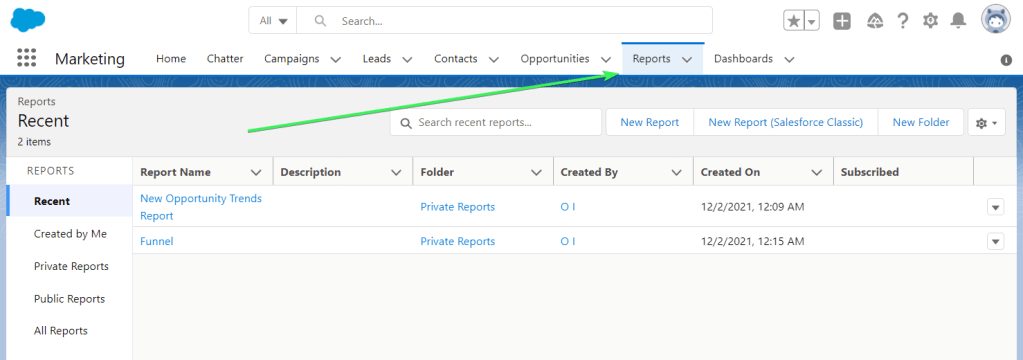
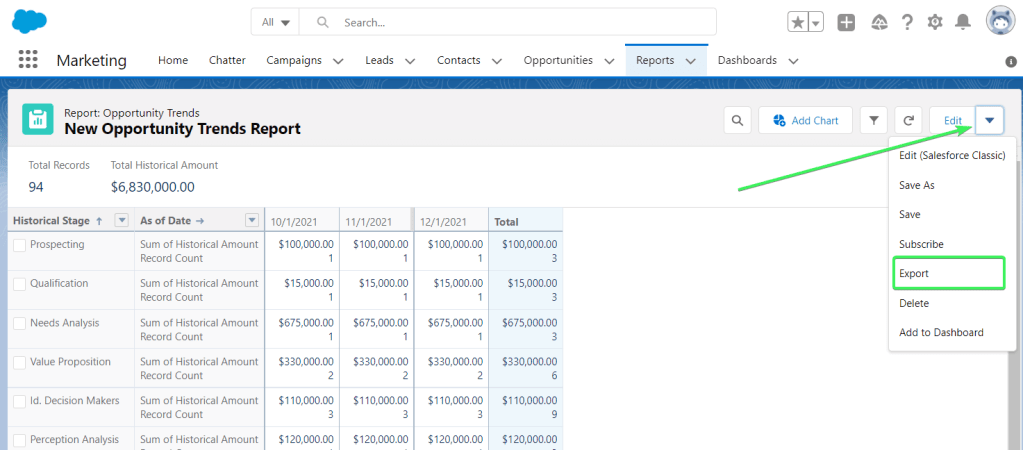
Start with opening a report that needs to be exported to Excel in Salesforce Lightning. Explore the arrow menu on the top right corner of the report, next to the edit option.

1 reports tab

Go to the Edit drop-down menu on the right side of your Salesforce report and choose Export.

2 export

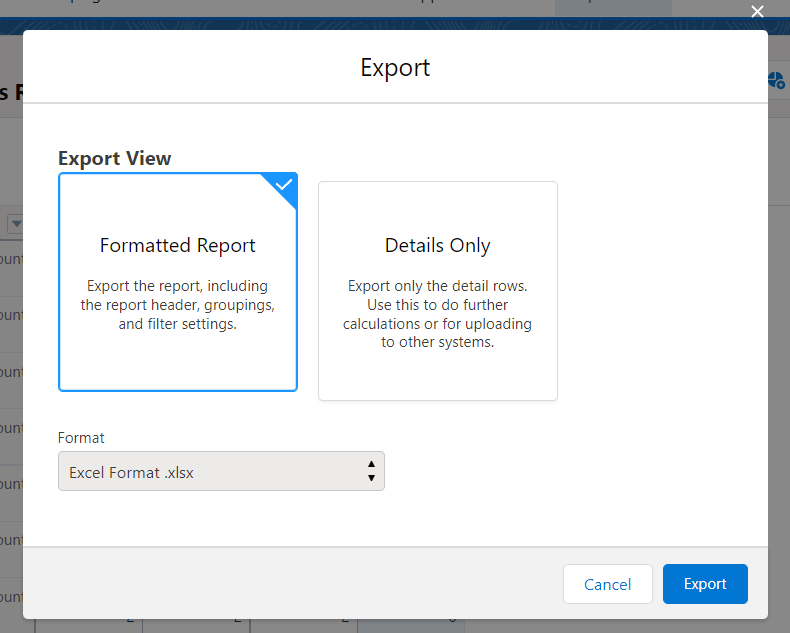
Select the format for exporting the Salesforce report to Excel

  • Formatted Report is readily available for export as an XLSX Excel file
  • Details Only are available for export as XLSX or XLS files, as well as CSV
3 fromat type

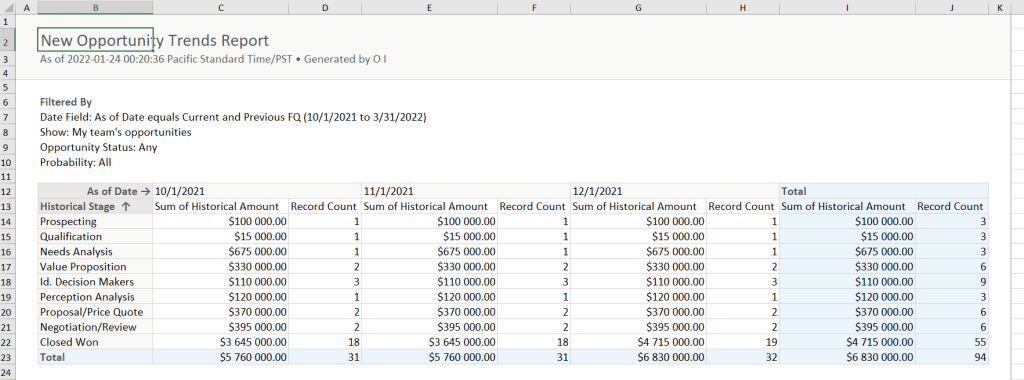
Click Export – The excel file with your Salesforce report will be downloaded to your device.

The Export file generated will be in the raw format, while Printable View will maintain the report format in the Excel file, including:

  • Report name
  • Report generator and timestamp
  • Sorting
  • Report filter
  • Grouping and field count
  • Fields summary
3.1 New Opportunity Trends Report in excel

Salesforce Reports For Excel Export Limitations

  • Up to 5 reports at once.
  • Unlimited rows and columns for Details-only reports in CSV or XLS formats.
  • Maximum 100,000 rows and 100 columns for Details-only in XLSX format or Formatted Reports. 
  • Historical trending reports are unavailable for export.
  • Joined reports can include 2,000 rows and are available for export only as Formatted reports.

What Is A Details-Only Data Export?

This details-only data export will help you export only the data rows with their header.

This is the file format used for extra computing done on Excel or any other spreadsheet program or uploading the file in another program.

The exported data file will be usable for pivot tables, filters, or comparisons with other files.

How to Link Salesforce report to Excel using the Salesforce API

Another solution for exporting Salesforce reports to Excel is the Salesforce REST API. To do this, you’ll have to follow the below-listed steps: 

First, create a Connected App in Salesforce and get an access token 

Using an access token, you can easily send a GET request to the below API URL:

curl “{instance – URL}/services/data/{api_version}/analytics/reports/{report-ID} \

 -H “Authorization: Bearer {access_token}”

Where:

{instance-URL}

is kind of the instance URL, which you got along with the access token, for example, 

https://quantokack.my.salesforce.com/

{api_version}

is the Salesforce API version 

{access_token}

your access token

{report-ID}

is the Salesforce Report Id. If you want to learn the report ID, you need to open the report and check the URL bar. 

This step is more technical as it requires you to work with the Salesforce API documentation and write a script to extract data and map it into your Excel file. 

Conclusion: The above-listed are some of the methods that will help you learn how to export Salesforce reports to excel quickly. Depending upon your expertise and situation, you can go for any method/solution and represent Salesforce reports in Excel format in your management meeting. 

Want to master the world’s leading platform – Salesforce? Enroll in Salesforce developer training and Salesforce admin course offered by QuantoKnack. This live, real-project-based training and certifications will help you thrive in today’s market. 

Don’t miss the opportunity!

READ MORE
TECHAvatar of adminadmin0 Comments
Share article:TwitterFacebookLinkedin
1732 Views
157 Likes

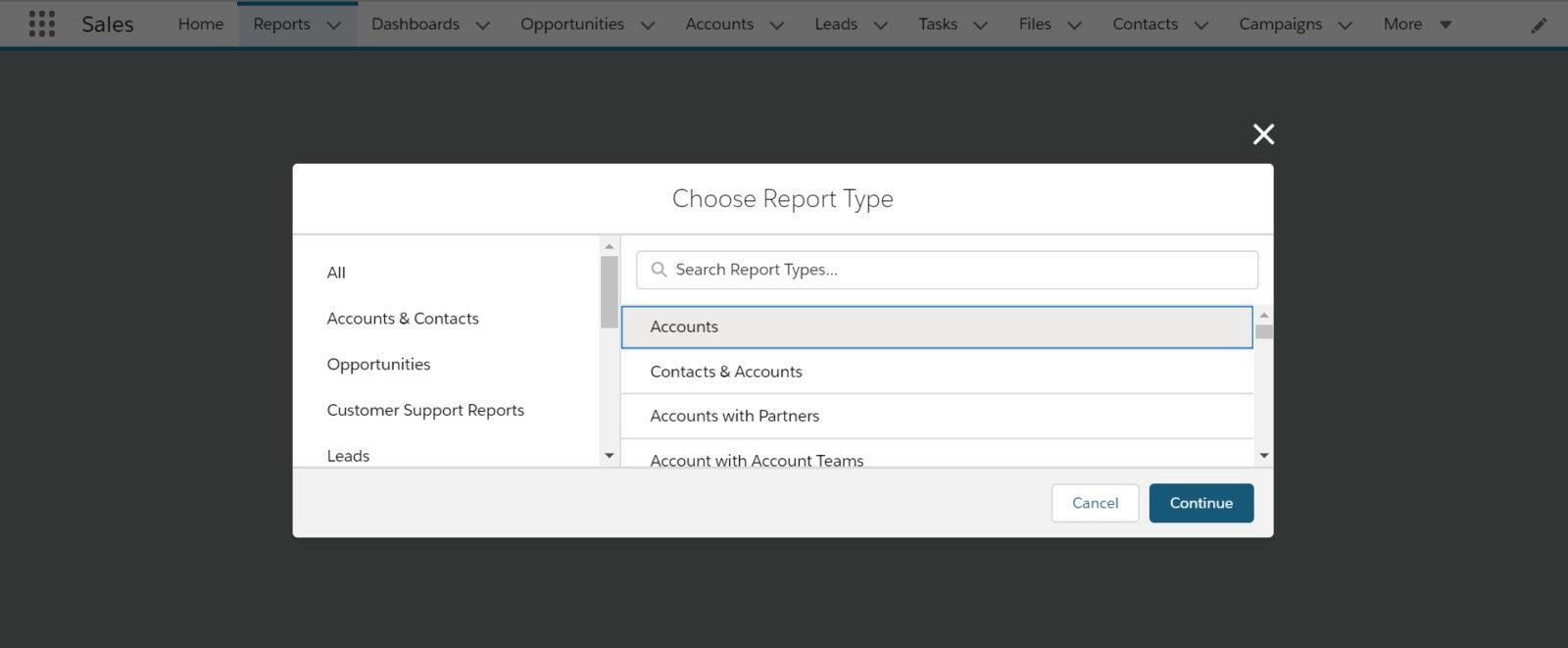
How To Create A Report In Salesforce

As per Forbes, data analytics can bring a lot of benefits to your organization. By leveraging the power of data analytics, you can identify potential risks, improve customer retention rate, and do many more. However, you cannot do data analysis until you generate accurate Salesforce reports. Whether checking your organization’s progress or showcasing results at the board meeting, accurate reporting is critical to your Salesforce success.

But, the reality is that generating Salesforce reports can be pretty tedious, especially if you are relatively new to the platform.

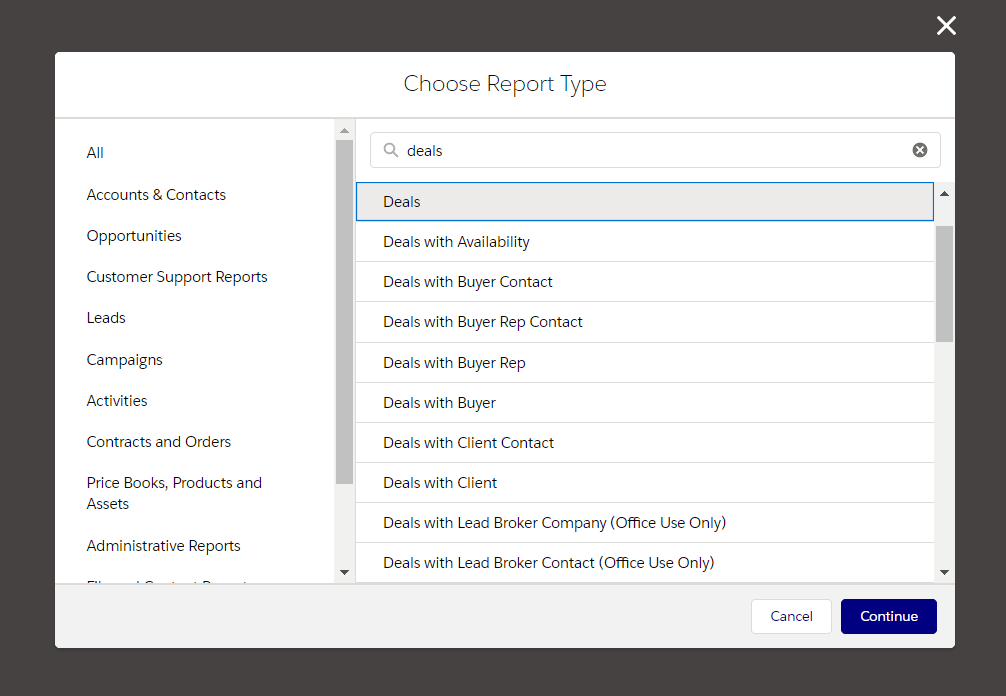
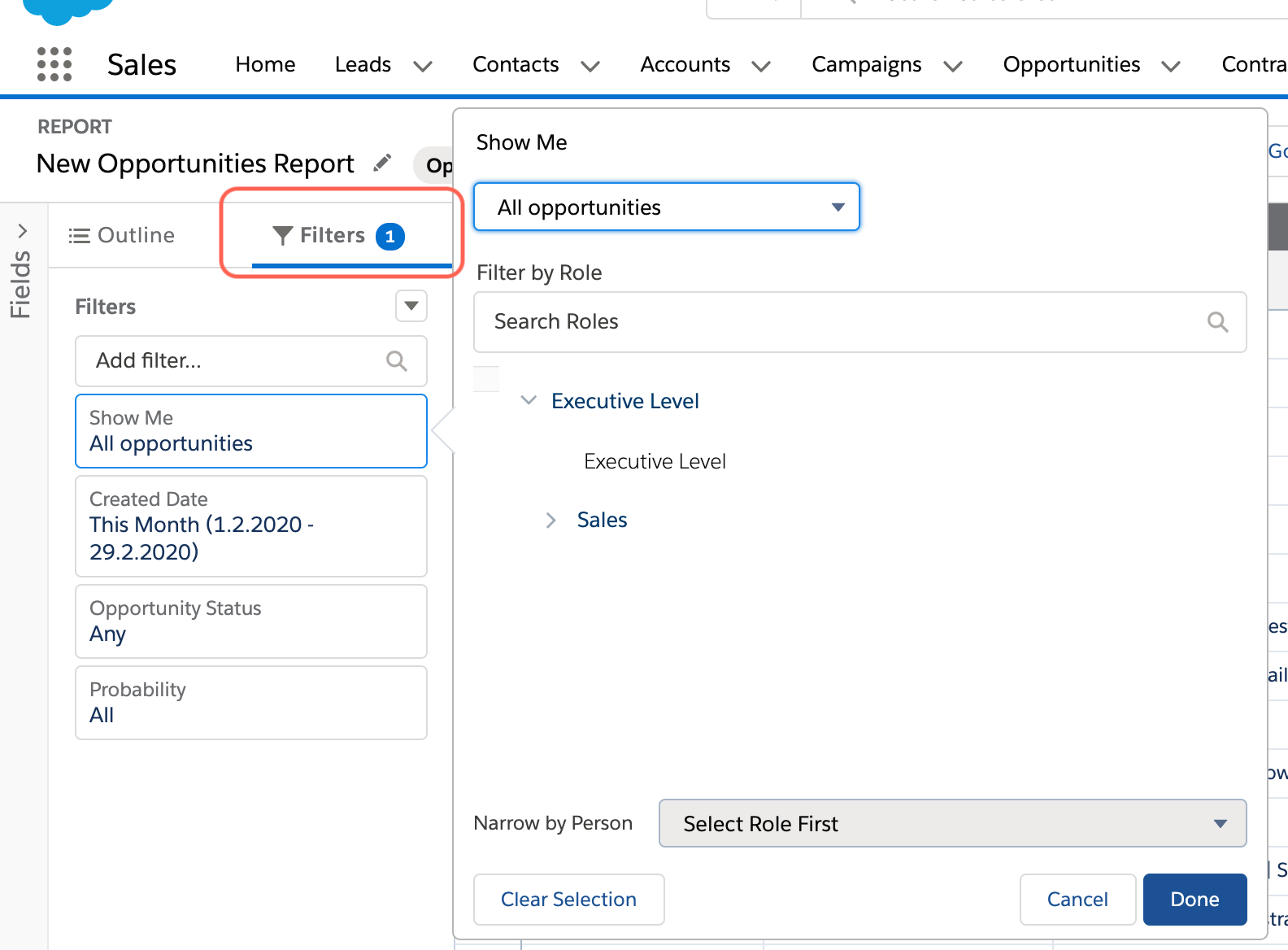
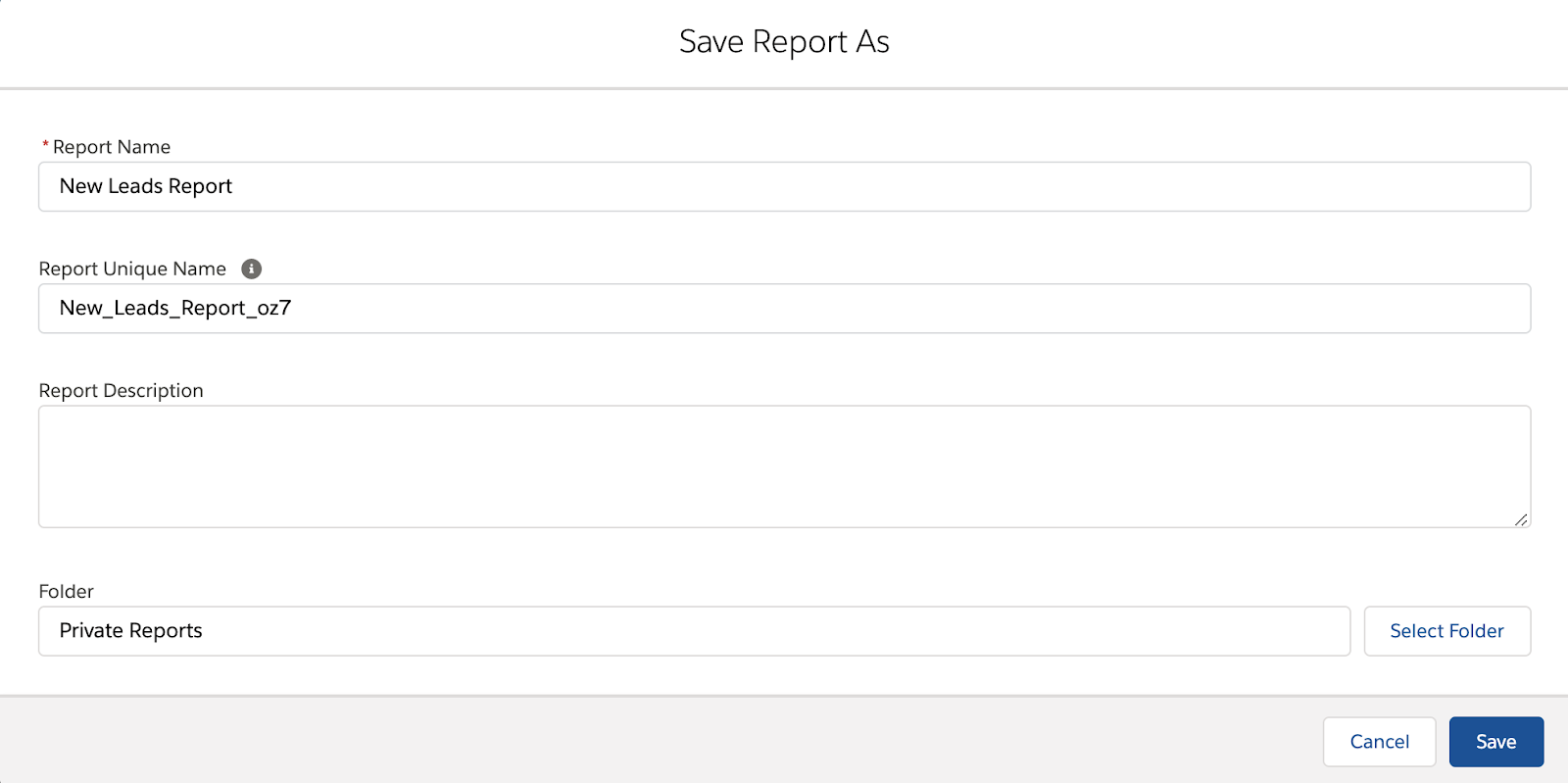
To help you get started, we have created this comprehensive guide on how to create a report in Salesforce. Don’t forget to enroll in QuantoKnack’s Salesforce Admin Course to learn how to create, export, and delete Salesforce reports like a pro.

What Is a Salesforce Report?

A Salesforce report is described as a list of records that contains data in an organized tabular or graphical format. Moreover, Salesforce allows you to create different types of reports to help you analyze and understand your data better. 

Why Should You Master Salesforce Reports?

Accurate reporting has its own place in many business scenarios. Organizations look for it when moving to a CRM system like Salesforce. For example, a small business may need a monthly report to analyze their progress, view new customers/clients, and check the growth of their orders. On the other hand, an enterprise may want to leverage reports to identify which products/services generate the most ROI and which generate the least.

Salesforce makes it much easier for you to report any data related to your customers. However, with so many features and functions, Salesforce admins can feel overloaded with possibilities – making it challenging to decide where to start. Enroll for QuantoKnack’s Salesforce Admin Course and grab the opportunity to learn Salesforce features and functionality as an Admin. 

Types of Salesforce Report

Salesforce reports grow your brand and help you scale. Below are the four basic Salesforce report types you should know. 

Summary – Common & Popular

Salesforce Summary Reports are one of the basic and frequently used types of reports. These Reports are utilized to group rows of data. 

The “Group Field” plays a crucial role in Summary Reports. Grouping is done depending on the value of the selected field. Suppose a property object has a custom field “Status” of picklist type and has two values (Sold, Available). 

Then, a summary report can be generated in two groups by choosing the status field as a grouping field, a ‘Sold’ group, and an ‘Available’ group.

Tabular – Simplest & Fast Export Format

This report suits you if you want to show data without subtotals, calculations, or groupings. It is the simplest Salesforce report type, presenting data in rows and columns. 

Matrix: Most Complicated; Perfect for Large Datasets

Matrix Reports are the most challenging types of reports available on the Salesforce platform. Setting up a matrix report is very time-consuming as well since you have the ability to group data by columns and rows. Like summary and tabular reports, Matrix reports can be utilized with dashboard tools.

The matrix reporting format is a great choice when reviewing data like the number of products sold or revenue totals. Once the report is generated, you can easily skim through the report to get the desired information.

Joined Reports – Comparing Datasets

As the name suggests, Salesforce’s Joined Reports allows you to create two unique reports and “join” the data. The data fetched from each report will be displayed side by side so that you can easily compare the two sets of information.

While many users only generate two reports utilizing the Joined Reports, you can actually add a maximum of five different blocks. These reports can help you gain valuable insights into a specific account.

Joined Reports are the unique type of Salesforce reports that are incompatible with dashboarding tools. This incompatibility is because dashboard components can display information from a single report.

Since many organizations prefer to view data in a visual format, the Joined Reports function is one of the least frequently used types of Salesforce reporting tools.

Component of Salesforce report

Before you start learning how to create a report in Salesforce, it is essential to know some basic components.

Below are the three different components of a Salesforce Report:

Filters

Filters can be utilized to filter the reports to display only the required data. Suppose the requirement is to get a report on sold properties. Then click on Add Filter, select the ‘Status’ field, choose the value ‘Sold’ as shown below, and click on ‘OK.’

Preview

If you chose the four fields: Status, Property Name, Price, and Transaction Type, then the preview for the report is shown below:

Fields

This refers to all the fields of the ‘Property’ object. There are some buttons right to the ‘Fields’ label which are used to group fields. You can additionally search for a specific field in the quick find box. And you can drag and drop the fields to the preview page where you want to report on.

Report Types In Salesforce

Before start creating the report we should know the report types.

Report types are a predetermined amalgamation of related objects and their fields that we can use as starting points when creating new custom reports. In other words, Salesforce report types are containers that include data and fields on which we can create custom reports.

The different report types are available, such as:

  • Standard report types
  • Custom report types

Standard report types

Standard report types are available for designing reports on standard and custom objects and their related objects by default. When creating a new custom field, it is automatically added to standard report types.

Custom report types

Custom report types allow us to build our own report framework in the report wizard; users can create custom reports.

How to Create Reports in Salesforce like a Pro: 6 Simple Steps Guide

Here we have created some simple steps to help you learn how to create a report in Salesforce. Let’s follow it and prepare a valuable report:

Step 1: Create a New Salesforce Report

AXfSwE acamvtjZJPHy80A9LGtf8TN7 bQ0iDn4uIRLcSYy3xqxpo4JnY5scWoGSa4uH05Q8C uffu6Qp4IUzaboOtbyapEu IdaqVmxO9bwpreGrF rbo tx upYLTnu ZlSbX

To find a Salesforce report, you will need to look at your horizontal navigation bar for the “Reports” object.

If you can’t find this tab in the bar:

Look for the objects that are placed in the “More” tab;

Click on “New Report,” and you’ll see the below screen.

PNl0rBoj9Yvr6n11XAGJdC25wsvNUtu1CaFqbfJenWwej 8 GNaFTpYSL6bvbfdUr7NpTN5Ntuxd8VD7ZMJGDSh8vbrcdPCoU pEZUOOZDXdmKpWbRO0KGtAxxhyJox ETeWnZdP

Step 2: Choose a Salesforce Report Type

Pick the Salesforce report type and click the “Continue” button. Remember that the list of reports is quite exhaustive and ranges from various types of “Opportunities,” “Accounts,” to “Deals,” “Cases,” etc. To simplify it, you can start typing some relevant keywords. For instance, if you are looking for a report on your deals, you can click and type “Deals” and get the right outcomes.

Select a Salesforce report type with the help of keywords

Step 3: Filter Your Data

Having a filter is like a blessing if you have extensive data lists. To start choosing the scope of the Salesforce report using the standard Salesforce report filter logic, click the “Filters” panel.

salesforce report filters big screenshot

Below is a quick overview of different filters you can use to define the scope of your Salesforce report:

  • Standard
    • Many objects have standard filters by default. However, some standard filters applied to most objects are Date Field and Show Me.
  • Filter Logic
    • You have to add a condition to let the system know how the fields need to be evaluated. Some filter logic operators consist of And, Or, or Not.
  • Field Filter
    • These filters are specifically for reports, workflow rules, list views, etc. This is helpful for matrix, tabular, or summary reports, where you can easily drag them from the Fields pane to prepare a filter for your report.
  • Cross Filter
    • You can filter a report based on conditions such as With or Without. The system will additionally enable you to add sub-filters.
  • Row Limit
    • You can limit the rows a Salesforce report will return for a tabular report, often utilized as a chart or dashboard table source. 

Just play around with these filters and determine what fields you want to report on.

Let’s say you want to filter reports based on the open deals. Thus, you need to:

  • Find the field called “Status,”
  • Click into the “Status” filter type and determine what status you want to show (e.g., only open deals status, lost ones, won, or all),
  • Click “Apply.”

Step 4: Click the Outline Pane to Display Columns/Fields

The Salesforce Lightning reporting allows you to add or remove columns on your report utilizing a simple drag-and-drop interface. You can find the information you want in the columns on the left side of your screen and then drag the field to the Salesforce report pane on the right.

You can double click or simply drag the field over to the report on the right and to the location you need. For instance, the Deal name is not sufficient in the report. Eventually, you want to add an estimated closed date, so you can just type “Estimated Close Date” in the Columns, and it will fetch your desired outcomes.

Step 5: Group Your Data

If you wish to do the estimated closed date as the grouping, you can type “Estimated Close Date” in the Groups, and your outcomes will be filtered.

When grouping “Deals” by “Estimated Close Date,” furthermore, you can group the data by Day, Calendar Month, Calendar Week, etc.

Step 6: Saving Your Salesforce Report

save salesforce report as

In order to save your Salesforce report, you will be required to follow the below steps:

  • Click “Save & Run”,
  • Fill the “Save Report” details by giving it a “Report Name,” “Report Unique Name,” and “Report Description.”
  • Choose a Folder to save your report. If you want to make it visible only to you, you must choose “Private Reports Folder.” However, if it should be visible for your organization, select “Public Reports Folder.”
  • Click “Save.”

If you want to level up your game, Salesforce allows you to create dashboards. These are some combinations of reports displayed side-by-side using charts, tables, gauges, or metrics. 

Think of reports as the raw data and dashboards as the visually appealing layout that everyone in your company will appreciate.

The Major Difference Between Salesforce Lightning and Classic Report Types

Salesforce Lightning – the upgraded version of Salesforce is a complete overhaul of the user interface within Salesforce, and it starts with cleaner esthetics. 

Salesforce Lightning enhance user adoption as it is much cleaner to look at, making it simpler to use. However, it still maintains many functions of its predecessor. 

Further, it’s just human nature to choose prettier things, and with this, the better something looks and feels, the more likely people will be willing to use it.

The interface overhaul also provided one essential change to Salesforce, which aligns with the way everyday users utilize their technology in today’s age. It is optimized for mobile users, enabling them to interact with Salesforce in their preferred way. Regardless of whether that is on mobile or desktop, at the office, at home, or on the go, it makes user adoption extremely easy.

Make Reports That Matter

Salesforce is a robust platform with a comprehensive suite of reporting tools. The above-listed six steps can help you create better reports and keep your team updated on the organization’s progress. 

Once you learn how to create a report in Salesforce and create the reporting layout that works perfectly for your organization, future reports can be automated, allowing you to access the data you need quickly, on your specified schedule, and with no additional effort.

If you are ready to take your data analytics and Salesforce reporting next level, then enroll in QuantoKnack’s Salesforce developer training or salesforce Admin Course. You will learn a lot of techniques and methods that will make your reporting task much easier.

READ MORE
TECHAvatar of adminadmin0 Comments
Share article:TwitterFacebookLinkedin
1602 Views
162 Likes

How To Merge Accounts In Salesforce

Salesforce admin course 2
How To Merge Accounts In Salesforce 19

At some point, almost every enterprise realizes the terrible truth that they have a tremendous number of duplicate records. This creates many issues for users. 

From faulty reporting to double-work on the same account to multiple representatives working on the same lead, this can be very damaging to sales operations as well as users’ confidence in their system. 

When leadership realizes there is a duplication issue, it’s typically so widespread that it leaves users and managers exasperated.

That’s when it’s time to bring in the Salesforce expert who has already completed the Salesforce admin course to save your day. 

In this article, we’ve created a comprehensive and user-friendly guide on 

  • Why do duplicate accounts appear in your Salesforce database?
  • Useful tips to consider before you start
  • How to Merge accounts in Salesforce Lightning

Let’s begin.

Why do duplicate accounts appear in your Salesforce database?

Duplicate accounts can be disturbing. Not only do they impact efficiency, but they are additionally time-consuming. Between all of the connections in accounts, contacts, and sales reps — there is a lot of work to identify, merge, and double-check to make sure all of the connections are in place as they need to be.

A large piece of the puzzle – dealing with duplicate data comes from preventing it from its source. If you can stop duplicate accounts from being added to the system, you’ll significantly reduce your duplication rates throughout your Salesforce data.

Some of the ways that duplicates are commonly added to Salesforce include:

  • Import lists.
    • Duplicate records are usually created from third-party and import lists.
  • Entry by different reps
    • Different sales representatives may get different accounts at different times. They may assume that they are the first to engage with a particular company and thus, create a new account.
  • Integrations & other apps
    • Integrating third-party apps that add new data and accounts to Salesforce may also result in creating duplicate records.
  • Mistakes
    • By mistake, a team member within your organization creates a duplicate account, not realizing that the original account already exists.
  • Form submissions
    • Someone from an organization may fill out a form that creates a new record in your database while you already had a record for that particular account.
  • Lead conversion.
    • When leads are converted, Salesforce will automatically create an account, contact, and an opportunity. Thus, duplicate accounts get created in this process.
  • Organizations go through mergers and acquisitions.
    • When two organizations merge, or one acquires another, you may have to merge non-duplicate accounts as well.

There are many reasons why duplicate accounts may appear in your Salesforce database. Identifying the root cause of those duplicates and stopping it from happening is the first step that any organization with a duplicate record problem should be considered.

One of the easiest ways to prevent the creation of duplicates is to hire a certified Salesforce Admin who will set up rules in Salesforce. This way, he can keep duplicates from being created depending upon the custom ruleset that you prepare, both from imported accounts as well as from manual entries from your team.

Before we look at how to merge accounts in Salesforce Lightning, it is essential to know some major things. 

Things To Know Before Merging Accounts In Salesforce Lightning

De-duping records can possibly be a burdensome process.  Thus, here is a list of a few things that require your attention before you start to merge accounts in Salesforce. These things are also covered in QuantoKnack’s Salesforce admin course, so you can learn it quickly and get certified.

Account Hierarchy

In Salesforce Classic, the account hierarchy is retained from the primary record, while in Salesforce Lightning Experience, the parent record can be chosen to retain. 

Redundant Relationships

Salesforce will pop up a message saying that you have removed the redundant connections while merging accounts. Chatter feeds will be retained from the Related Contacts list on account records.

Related Items, Chatter Feeds, and Attachments

All duplicate records with activities or campaigns are merged in Salesforce with a few exemptions. Chatter feeds are merged from the main record. Salesforce Files appended in the Chatter feed or Files-related list are kept in the merged account.

Sharing Rules

Sharing rules will be applied to the merged account in the Salesforce Professional, Enterprise, Unlimited, Performance, or Developer version. Further, any manual sharing from the primary record is connected to the consolidated account after the merge.

Relationship Groups

Remember that Salesforce Lightning Experience doesn’t support merging records related to the connected groups.

Divisions

If divisions are empowered, the merged record is doled out to the division from the main record except if you select something else.

How to Merge accounts in Salesforce Lightning

When it comes to duplicate records, there are huge differences between the Salesforce Classic and the Salesforce Lightning Experience. 

In Salesforce Lightning, duplicate alerts are shown on the record detail page of an account and contact. These duplicate records are identified utilizing matching rules applied to individual records or duplicate jobs. On the other hand, in Salesforce Classic, duplicate records are identified via manual searches. 

Standard Account Matching Rule

The standard matching rule identifies duplicate accounts using match keys, matching criteria, and a matching equation. It’s by default activated.

For example, just search “Matching Rules” in the quick search box to see all standard account matching rules using a matching equation, match keys, and matching criteria.

Step by Step Instructions: How to Merge Duplicate Accounts in Salesforce Lightning

A user must know a few things before beginning how to merge accounts in Salesforce. For instance, when a user tries to merge two accounts, they have a relationship with a similar contact.

Here are some steps you need to follow for both Account and Contacts matching and merging in Salesforce Lightning.

Step 1: 

In Salesforce Lightning Experience, you will have to go to a specific account record. If there are any duplicates available, you can just click on “View Duplicates” and see them.

SGQfXdGJcE6Xf4 yCV cTWy ErBzWXt IJmOGaLsNYG uD0xZ37REQ8DRYDNaqPpdxEdwqfLKI7m0JI9EauUagamXVjvOHo lRiF rT1o kFJopnfznDCF SHNma8f6N07KwaC9

However, only the exact same account names are found as potential duplicates in the Lightning Experience.

If you cannot find the duplicates and you need to merge, then switch to Salesforce classic and simply use the Merge Accounts tool.

Duplicate records, with accounts available to merge

Step 2: 

Like Salesforce classic, there are a maximum of three account records that can be merged. Then click on Next.

Step 3: 

Similarly, you can select one account as the primary record and choose the field values you want to keep as it is. Then click Next.

Three potential duplicate accounts, with option to choose field values from each

Step 4: 

Confirm your options here and start merging. And it’s done!

Merge confirmation for person accounts

Merging accounts in both Salesforce Classic and Salesforce Lightning is simple and straightforward but does have some limitations. First, you cannot merge accounts in bulk, as Salesforce has a limitation on merging more than three duplicates 

simultaneously.

Moreover, surfacing and identifying duplicates can be difficult in Salesforce. While the system finds duplicate accounts with similar names, it does not recognize duplicates based on the data contained in the record, which is usually required to surface all duplicates.

Conclusion

Merging records in Salesforce Lightning Experience is available and useful! As a Salesforce Admin, you need to stay on top of potential duplicates to ensure trustworthy and valuable data that reflect your awesome admin skills (or learn all essential skills in the Salesforce admin course offered by QuantoKnack Training.

You can further empower your users to merge themselves. However, they will need the ‘Delete’ permission for the object in question and Edit on related objects, such as Cases and Opportunities.

Do not forget to benefit from the Duplicate Record Set tab and create reports from the items that are fetched from your Duplicate Rules. Keep in mind they are the solid pillar of this functionality, so you want to inspect and adapt them often to keep them relevant and useful.

Learn all the major functionality and many more real-world scenarios in QuantoKnack’s Salesforce admin course and get certified Salesforce admin. We are preparing you for tomorrow!

READ MORE
TECHAvatar of Abhinav KumarAbhinav Kumar0 Comments
Share article:TwitterFacebookLinkedin
1489 Views
64 Likes

Roll-Up Summary Fields in Salesforce for (SUM) Function

Sum -: In Roll -Up Summary we use Sum function to calculate the Summation of the values of a specified field on a child record.

Steps To Create Roll-Up Summary Fields in Salesforce for (SUM) Function

Step 1 Login to your org.

Step 2 Setup > Object Manager.

Capture 1024x618 1

Step 3 Click on Account > field & Relationship > New.

2

Step 4 Select Roll – Up Summary > Next.

3

Step 5 Complete all the Steps and fill the details which are required. 

5 1

Step 6 Next Steps to Define the Summary and provide the function as shown in figure.

6 1

Step 7 Another Steps is to define the Field Security level. Here the permissions are given. 

7 1

Step 8 Next Steps is to Provide the Page Layout Setting. As where the Output of desired function will be shown.

8

Our Roll-Up Summary Field for the Sum function has been established. Now we can get a total Summation of the value present in the Record.

Happy Learning!

READ MORE
  • 1
  • …
  • 6
  • 7
  • 8
  • 9
  • 10
Recent Posts
  • How Salesforce Data Integration Tools Simplify Real-Time Business Connectivity
    In a nutshell, businesses collect operational data to perform...
  • Design, Build, and Optimize Agents with Agentforce 360 Innovations
    In this fast-moving digital world, businesses also want smarter...
  • Salesforce Built-In Payment Processing: How to Handle Everything End-to-End
    In the current digital economy, where online payments have...
  • Explore Top Salesforce Integration Challenges and Ways to Fix Them
    Integrating any system can be a difficult task, as an...
  • Protecting Sensitive Data: A Complete Guide to Encryption in Salesforce
    In the current digital economy, data can easily rank at the top...
logotype

We cater to individuals and corporates and provide IT training and certification programs.

44679 Endicott Drive Suit 300 #1046 Ashburn, VA 20147 United States

Phone: +1-571 989 9489

Email: atul.deo@quantoknack.com

Useful links

About Us

Contact Us

Blog

Courses

  • Live Salesforce Admin Training
  • Business Analyst
  • QA Testing Course
  • Advance JAVA Training
  • SQL Server Training
  • Live Salesforce Developer Training Certification Course
  • Digital Marketing
  • Oracle DBA Training

Subscribe

    Instagram Pinterest Linkedin
    Facebook
    Logo star

     2024 Quantoknack. All Rights Reserved