Become a Instructor

Blogs

logotype
Menu
  • Courses
    • Salesforce Admin
    • Salesforce Developer
    • Advance Java Training
    • Buisness Analyst
    • Digital Marketing
    • Oracle DBA
    • QA Testing Course
    • SQL server Training
  • Register
+1-571 989 9489
logotype
  • Courses
    • Salesforce Admin
    • Salesforce Developer
    • Advance Java Training
    • Buisness Analyst
    • Digital Marketing
    • Oracle DBA
    • QA Testing Course
    • SQL server Training
  • Register
  • +1-571 989 9489

Become a Instructor

Blogs

logotype
Menu
  • Courses
    • Salesforce Admin
    • Salesforce Developer
    • Advance Java Training
    • Buisness Analyst
    • Digital Marketing
    • Oracle DBA
    • QA Testing Course
    • SQL server Training
  • Register
+1-571 989 9489
  • Courses
    • Salesforce Admin
    • Salesforce Developer
    • Advance Java Training
    • Buisness Analyst
    • Digital Marketing
    • Oracle DBA
    • QA Testing Course
    • SQL server Training
  • Register
  • +1-571 989 9489
logotype
logotype
  • Courses
    • Salesforce Admin
    • Salesforce Developer
    • Advance Java Training
    • Buisness Analyst
    • Digital Marketing
    • Oracle DBA
    • QA Testing Course
    • SQL server Training
  • Register
  • +1-571 989 9489
TECH
Home TECH Page 7

Category: TECH

TECHAvatar of adminadmin0 Comments
Share article:TwitterFacebookLinkedin
698 Views
124 Likes

Top 10 Fundamental Salesforce Admin Interview Questions

Salesforce is currently a popular job despite the significant setbacks in the job market. Furthermore, salesforce is expected to create around 3.4 million jobs in the coming years. This is considered higher than the average job growth rate.

Among the most profitable salesforce job roles that can be pursued, the salesforce administrator job is considered to be one of the most important choices for individuals seeking a career in this field. A salesforce administrator’s responsibilities consist of multitasking, which includes a combination of technical and people skills.

According to the U.S. Bureau of Labor Statistics, by 2026, the demand for database administrators, specifically Salesforce administrators, is predicted to increase by 11%. Becoming a Salesforce admin will be a good choice if you want to begin on a career path that offers stability and rapid growth.

This article consists of all the top Salesforce admin Interview questions that usually come up during job interviews for Salesforce Admin job roles.

Let’s dig into some of the interview questions usually asked during Salesforce admin interviews.

Fundamental Salesforce Admin Interview Questions

Question 1 – Explain Cloud Computing and its different forms

Answer – It is considered to be one of the most important admin interview questions in Salesforce. Cloud computing is an on-demand networked system of remote servers that are hosted on the internet that allows users to store, retrieve, manage, and process information remotely by replacing on-site infrastructure efficiently.

Cloud Computing has three main forms:

  • Infrastructure as a Service (IaaS)
  • Software as a service (SaaS)
  • Platform as a service (PaaS)

Question 2 – What do you understand about CRM?

Answer – It is considered to be one of the most important admin interview questions for salesforce. CRM is also known as Customer Relationship Management. It is a set of strategies, practices, and technologies that are utilized by firms for managing and analyzing interactions and data with customers over the period. Moreover, the main aim of CRM is to increase relationships with customers, support retention, and enhance sales growth.

CRM systems collect information from multiple communication channels like the company’s website, phone, email, live chat, marketing materials, and multiple social media platforms.

Question 3 – Explain SaaS, PaaS and IaaS

Answer – SaaS: It is the most common of the three core cloud-based computing services. SaaS offers software available over the internet that allows you to connect users via the web or via an API.

PaaS: PaaS products give firms and developers the ability to create and deploy consumer-facing applications, all hosted in the cloud.

IaaS: IaaS also known as Infrastructure as a service. It is considered to be the first piece of the cloud computing puzzle. It commonly allows users to manage their business resources via the cloud.

Question 4 – Advantages and Disadvantages of SaaS, PaaS, IaaS

Answer – 

Advantages of SaaS

There are multiple advantages of SaaS:

  • Easy set up
  • No local hosting required
  • No time for space invaders
  • Less time-consuming.

Advantages of PaaS

There are multiple advantages of PaaS:

  • More control
  • Instant growth
  • Easy going
  • Instant set-up
  • Create and deploy new applications easily

Advantages of IaaS

There are multiple advantages of IaaS:

  • Cost-effective
  • Multiple people can access the resource
  • Enhanced flexibility
  • Save on resources

Disadvantages of SaaS, PaaS, and IaaS

Disadvantages of SaaS

With advantages, SaaS also has some disadvantages, such as:

  • Hard to customize
  • Lack of control
  • Data portability issues
  • Lack of compatibility

Disadvantages of PaaS

With advantages, PaaS also has some disadvantages, such as:

  • Complex integration
  • Runtime errors
  • Migration issues
  • Lack of control over infrastructure and much more

Disadvantages of IaaS

With advantages, IaaS also has some disadvantages, such as:

  • Potential security risks
  • Huge responsibilities
  • Few integration issues

This is the most commonly asked Salesforce admin interview questions that you should go through.

Question 5 What are the multiple types of report formats in Salesforce?

Answer Salesforce report can be classified into four various types as follows:

  • Tabular Reports – This is the first basic of all report formats and it usually displays the records in a table without a total. Tabular reports are ideal for when you require a simple list or a list of items without a total.
  • Summary reports – The summary report displays a listing of data with groupings and subtotals at the bottom.
  • Matrix reports – Unlike other reports, this one gives you the option to group records both by row and column. Moreover, this report allows us to generate dashboards.
  • Joined Reports – These types of reports allow us to create various views of the data from the various types of reports. Specifically, in a joined report, the data are organized into blocks. Each block is a sub-report containing its columns, own fields, sorting, and filtering. Moreover, to know more about Salesforce admin interview questions then you can join Salesforce admin training at any renowned training institute.

Question 6 – What is Salesforce workflow?

Answer – Workflow is a great way to automate relevant business processes in Salesforce. To do so, you are required to define certain rules and regulations to automate different tasks like sending an email, updating a field, creating a task and outbound message.

Question 7 – What is an object in Salesforce?

Answer – An object is a database table that allows users to store data relevant to the firms in Salesforce. There are two types of objects Standard and Custom. The Salesforce official website provides standard objects, while users create custom objects.

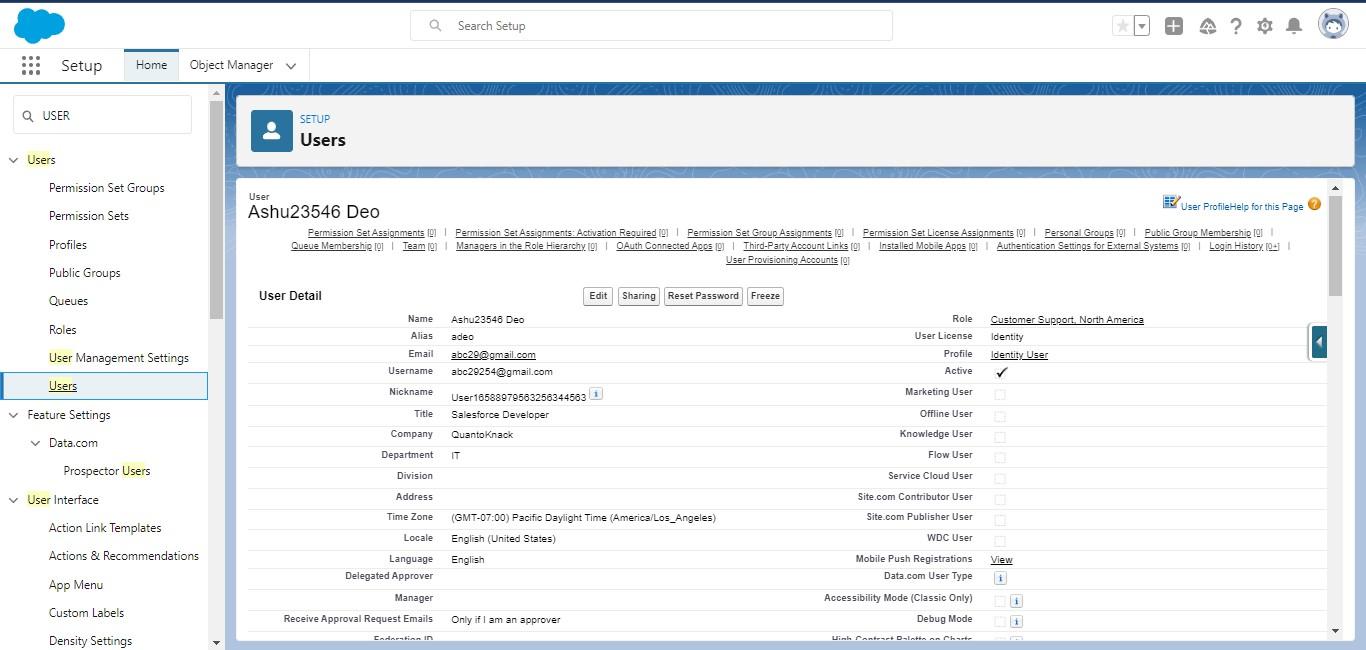
Question 9 – Can you freeze a user on Salesforce? If yes, then can you delete them?

Answer – Salesforce Admins can freeze or deactivate a user by following certain steps:

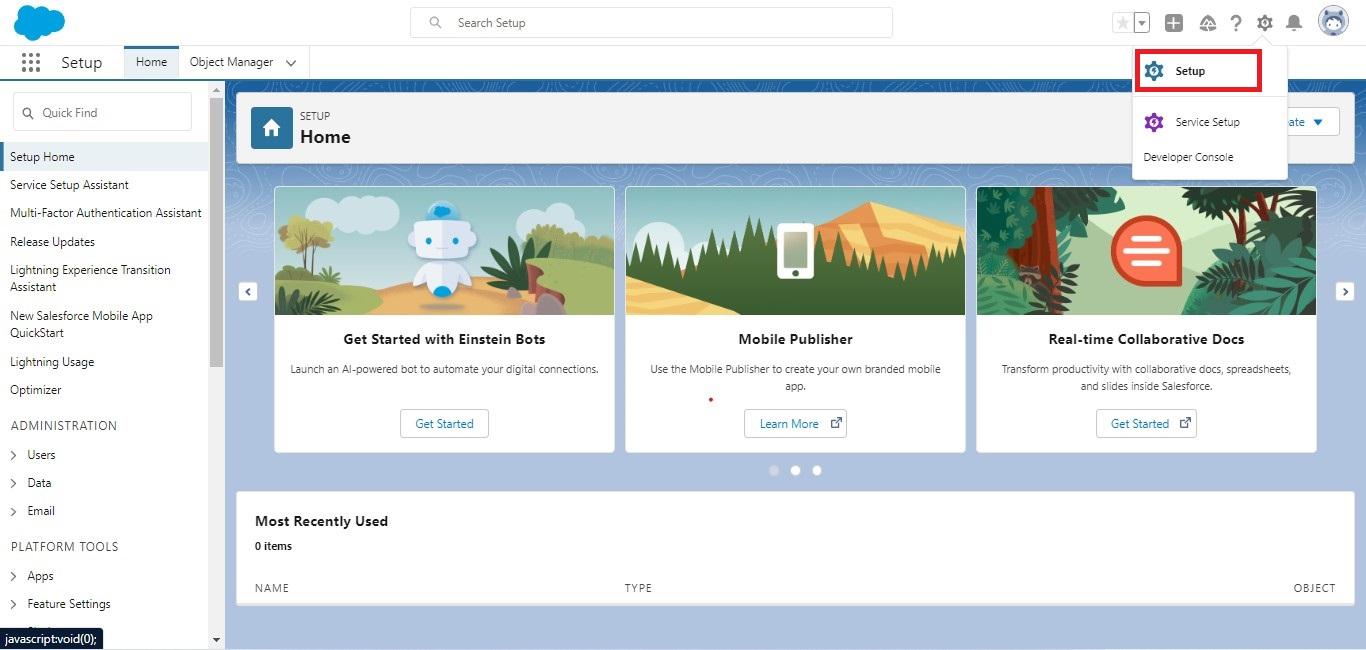
Step 1 – Setup

Step 2 -Administration 

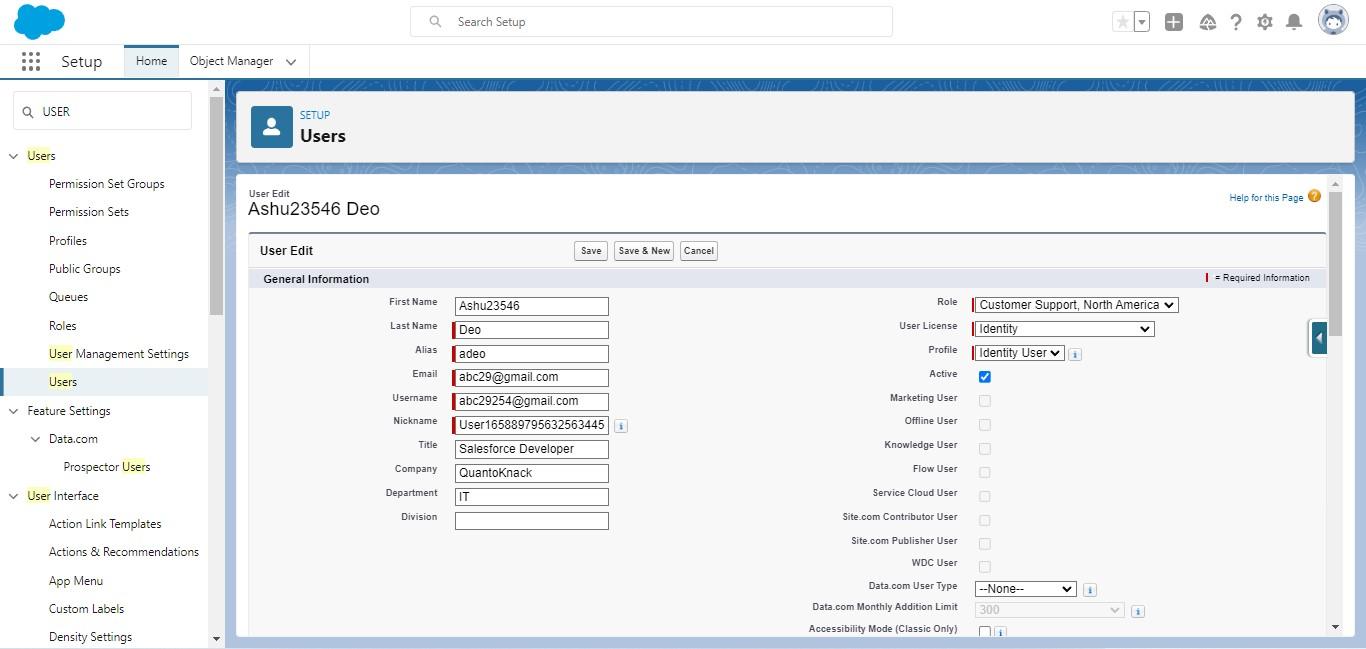
Step 3 -Users

Step 4 -Select the user to Freeze

Step 5 -Click on Freeze button 

As for the second part it’s a tricky part, as users cannot be deleted

Question 10 – What is Salesforce Chatter?

Answer – Chatter is a Salesforce application that makes it hassle-free for users to communicate, collaborate, and share information in real-time. Chatter can be used by individuals of all roles and locations in the firms to connect, engage, and motivate them to work successfully.

The Salesforce administrator certification training course allows you to master Salesforce core administration, which empowers you to implement, configure, and manage Sales and Service Clouds. This course is aligned with the Salesforce administrator certification guide, which helps you understand various Salesforce credentials.In case you are interested in increasing your software development skills further, we recommend you to check Quantoknack Training Salesforce admin courses online. This course can help you gain the right skills and make you ready to grab a better Salesforce admin job role.

READ MORE
TECHAvatar of adminadmin0 Comments
Share article:TwitterFacebookLinkedin
909 Views
124 Likes

Salesforce Admin Certification Cost Analysis Guide

Most of the Salesforce professionals love pursuing certifications. They are a career milestone that demonstrates the individual knows what they are talking about. Salesforce certifications can efficiently be used as leverage when seeking for a more senior position or seeking for a job in another organisation.

Not only do gaining certification need time and energy dedication, but they also come at a monetary cost. So, how much does a Salesforce Certification Cost?

While cost is the first consideration that comes to our mind, how you can get the most out of your investment is necessary to address. This article will cover Salesforce Admin Certification Cost.

Salesforce Certification Cost

There are various salesforce certifications available in the market to pursue. The cost of salesforce certification usually is $200, and for some advanced architects exams cost $400. The Salesforce Certified Technical Architect (CTA) certification is the most expensive exam in Salesforce which costs you $6000. To get more information about salesforce admin training courses are curated by industry professionals to help you pass the salesforce admin training and certification Exam efficiently.

Salesforce has divided most of its certification exam into below categories, such as:

  • Salesforce Developers

Salesforce Developers build custom applications and integrations utilising Apex, Visualforce, and Lightning technologies. Usually the developers write code to create custom business logic, combine salesforce with other systems efficiently. They also work attentively with other stakeholders, like administrators and consultants, to design and execute solutions that meet the business needs. Here is the Salesforce Developer Certification cost you should know;

  • Java Script Developer Cost – 200 USD
  • Salesforce PD1 certification cost – 200 USD
  • PD 2 certification cost – 200 USD
  • Salesforce Designers

Salesforce Designers are responsible for designing and configuring relevant aspects of the Salesforce instance, like data architecture and sharing rules. If you are seeking to focus on Online salesforce admin training for this relevant job role, here are the salesforce courses you will require to undertake.

  • Salesforce UX Designer Certification Cost – 200 USD
  • Salesforce Strategy Designer Certification Cost – 200 USD
  • Salesforce Architect

Salesforce Architects are responsible for designing and supervising the implementation of complex salesforce solutions. They work closely with potential clients to understand their business requirements and design solutions that meet those requirements.

They also offer technical leadership to other stakeholders, like developers and administrators, to ensure the solution is implemented rightly and meets the best practices. Here is the related Salesforce Certification Cost for different courses related to the role.

  • Salesforce Identity and Access Management Architect Certification Cost – 400 USD
  • Salesforce sharing and visibility architect certification Cost – 400 USD
  • Salesforce Development Lifecycle and Deployment Architect certification Cost – 400 USD
  • Salesforce Heroku Architect Certification cost – 400 USD
  • Salesforce Integration Architect Certification Cost – 400 USD
  • Salesforce Data Architect Certification Cost – 400 USD
  • Salesforce Application Architect Certification Cost – 400 USD
  • Salesforce System Architect Certification Cost – 400 USD
  • Salesforce B2C solution Architect Certification Cost – 400 USD
  • Salesforce B2B solution Architect Certification Cost – 400 USD
  • Salesforce Technical Architect Certification Cost – 6000 USD
  • Salesforce Marketers

Salesforce marketers use Salesforce to manage and track sales and marketing activities efficiently. They create and manage campaigns, track leads and opportunities, and analyse marketing performance successfully. The firms also use Salesforce to enhance customer engagement, such as email marketing campaigns and customer surveys.

  • Pardot specialist certification cost – 200 USD
  • Pardot consultant certification cost – 200 USD
  • Marketing Cloud Administrator certification cost – 200 USD
  • Marketing Cloud Email Specialist certification cost – 200 USD
  • Marketing Cloud Consultant certification cost – 200 USD
  • Marketing Cloud Developer certification cost – 200 USD
  • Salesforce Consultants

They work with clients to understand their business requirements and implement new and advanced Salesforce solutions to meet those requirements. They advise clients on improving their Salesforce instance, identifying process improvements, and configuring the system to support their business needs.

Salesforce consultants also offer training and support to users, and if you are seeking to progress up the ladder in this role, here are the certifications for you.

  • Service Cloud Consultant – 200 USD
  • CPQ specialist Certification Cost – 200 USD
  • Sales Cloud Consultant Certification Cost – 200 USD
  • Field Service Consultant Certification Cost – 200 USD
  • Experience Cloud Consultant Certification Cost – 200 USD
  • Tableau CRM & Einstein Discovery Consultant Certification Cost – 200 USD
  • Non-Profit Cloud Consultant Certification Cost – 200 USD
  • Education Cloud consultant Certification Cost – 200 USD
  • Omnistudio Consultant Certification Cost – 200 USD
  • Business Analyst Certification Cost – 200 USD
  • Salesforce Administrators

Salesforce Administrators are responsible for managing and maintaining the Salesforce instance. They build the system, create and manage users, set up security and approach, and maintain data quality. If you are looking to focus on Online salesforce admin training for this relevant job role, here are the salesforce courses you will require to undertake.

  • Administrator Certification Cost – 200 USD
  • Advanced Administrator Certification Cost – 200 USD
  • Platform Developer Certification Cost – 200 USD

Summary

Pursuing any Salesforce Certification Course will add value to validate your expertise and advance your career in the salesforce ecosystem. When you get a certification, you are investing in yourself and displaying to employers and clients that you have the skills and expertise to deliver high-quality solutions on various Salesforce platforms.

In case you are just starting your career or seeking to advance to the next level, earning a Salesforce Admin Training Certification Online is a great move that can open up new opportunities and allow you to achieve your professional goals successfully.

QuantoKnack Training can help you achieve your dream Salesforce job by helping you get the Salesforce Certification efficiently under the supervision of Professionals.

READ MORE
TECHAvatar of adminadmin0 Comments
Share article:TwitterFacebookLinkedin
903 Views
167 Likes

Salesforce Administration Course- A Journey to Certification Success

Salesforce Administration Certification is known as the standard credential for any admin. Passing the Salesforce admin exam will display your knowledge about Salesforce features and best practice configuration.

It is also considered as the foundation level qualification for any Salesforce professional as it covers the core Salesforce CRM platform, counting the Sales and Service Cloud products. While multiple customer relationship management (CRM) tools are accessible, one of them is Salesforce.

Firms that use this platform usually look to hire employees who can leverage it to optimise workflows efficiently. Being a certified Salesforce Administrator can help you enhance your job expectations and enhance your earning potential.

The article will further help you know,

  • What is Salesforce Administrator?
  • Types of Salesforce Administration Certification
  • What are the benefits of Salesforce administration certification?
  • How to get a Salesforce Administration Certification?
  • Salesforce Certification: Is it Worth it?

Let’s begin with understanding What does being a Salesforce Administrator mean,

What is Salesforce Administrator?

A Salesforce Administrator, is a professional who helps a firm maximise its use of the CRM platform efficiently. Salesforce Admins team up with stakeholders to define system needs and design the software for a firm. These professionals may perform different administrative duties or specifically focus on streamlining a firm’s utilisation of the Salesforce platform. Whenever, a person gets certified in Salesforce administrative role, they exhibit their proficiency in:

  • Personalizing Service Cloud and Sales Cloud Applications
  • Building Dashboards
  • Smooth workflows for sales team
  • Producing Performance reports
  • Regenerating user login credentials
  • Maintaining data quality and training users 

Types of Salesforce Administration Certification
There are various sought-after Salesforce Certifications, some of them are:

  • BEGINNER-LEVEL CERTIFICATION
    • Certified Associate
    • Platform Application Builder
    • Platform Developer
    • Certified Administrator
    • Marketing Cloud Administrator
  • INTERMEDIATE-LEVEL CERTIFICATION
    • UX Designer
    • Advanced Administrator
    • Senior Cloud Consultant
    • Sales Cloud Consultant
    • Experience Cloud Consultant
  • ADVANCED-LEVEL CERTIFICATION
    • Identity and Access Management Architect
    • Sharing and Visibility Architect
    • Data Architect
    • Integration Architect
    • Strategy Designer

But selecting a suitable Salesforce Certification Course Online can be domineering.

What are the benefits of Salesforce administration certification?

Salesforce Certification, undoubtedly, is much desirable and in demand. But is it worth it? Why would anyone choose to gain a Salesforce Certification Online which is already from a technical background and has an idea related to the functionality of Salesforce?

Well, to give all the answers, let’s focus on the benefits of Salesforce Certification.

  • Demonstrate your Expertise

Gaining Salesforce Certification, you can prove to potential employers that you understand how to grasp Salesforce’s powerful tools and features to construct great business solutions for their firm. Salesforce certified administrator certification individuals have access to complete content and community resources, like forums, blogs, webcasts to help the firms get them updated with changes and new developments.

  • Network with similar professionals

By becoming Salesforce admin certified, you can join an elite group of professionals who understand and seize Salesforce best practices. This can offer valuable connections for career advancement and professional development opportunities, like participating in online discussions or networking events related to your specific field of expertise.

  • Huge Earning Potential

Organisations know that hiring certified individuals will decrease training costs since they don’t require additional enlistment or training resources. Therefore, they might be willing to pay higher remuneration for these candidates than their non-certified counterparts. Pursuing Salesforce admin Certification classes, you could expect more recognition and more money for your hard work.

  • Offers New Job Opportunities

By becoming a Salesforce administrator Certified professional, you can enhance your visibility in job searches and obtain access to different roles you might not have been able to before such as a Project manager role or a Systems Analyst position efficiently. Multiple organisations usually consider certified candidates when searching for new talent, so having this certification on your CV can make you stand out from other candidates.

How to get a Salesforce Administration Certification?

Here are some step to know to get a Salesforce Administration Certification:

  • Complete the Salesforce Administration Course

QuantoKnack is Salesforce’s free online learning academy. By visiting the website, you can create an account by creating login credentials or by using an existing google account. We have a Salesforce Administration Certification Course Online available for you.

  • Study Guide

After pursuing the Trailhead course, you can use our study guide to review the key concepts and prepare for the Salesforce exam efficiently. The Salesforce Administration study guide also broadcast key details about the Salesforce administrator exam.

  • Use Different Resources

While the course and study guide suitably prepare candidates for Salesforce Certification. Moreover, you can use various additional resources if you require extra review for the exam. Consider registering your name in any course you like under the supervision of experts.

  • Attempt for Salesforce Exam

Once you feel ready to appear for the exam, schedule your invigilate exam online or offline at a test centre. Try practising for your exam by allocating enough time to answer every question.

  • Maintain your certification

After passing the Salesforce administration certification exam, your certification remains valid for a year. You can renew it in the spring by entirely one maintaining module through your trailhead account. Whereas, maintaining your Salesforce certification prevents you from having to retake the entire exam and make certain you have the appropriate credentials for your professional role.

Salesforce Certification: Is it Worth it?

Salesforce is an immeasurable CRM platform that needs a lot of dedication to learn. Multiple users find it easier to pursue formal certification from the provider instead of demanding to learn the platform via scattered online resources. Moreover, being certified via Salesforce offers you with a structured learning environment that you can approach anytime.
Certification courses and exposure are beneficial for increasing your professional career graph. It also increases the promotion aspect. It not only justifies your Curriculum resume but also enhances your credibility.
Let’s Read Why Salesforce Certification is Beneficial in 2025

  • Being professionals, we know that any certification is a proof of your capabilities. It is the same for Salesforce admin certification. Gaining any salesforce certification allows you to have a technical understanding of the field. Your employers or the firm will consider your knowledge and ability based on your certifications. It adds value to your exposure and brings you into the limelight.
  • Gaining the Salesforce credential will enhance your confidence as it is a perfect opportunity to climb the success ladder. It will also allow you to solve CRM issues and communicate efficiently.
  • By pursuing a Salesforce admin course free, you will get exposed to an in-depth understanding of Salesforce Software. This knowledge will enhance your career growth. Sometimes even exposure and an in-depth understanding of the Salesforce products still requires to be accomplished. But by following a proper structured learning program, you can get practical guidance from the experts.
  • One of the most necessary aspects of Salesforce certification is that you will stay up-to-date about current CRM developments.

Conclusion:
Being a Salesforce Certified Candidate is a great way to stand out in the competitive job market and showcase your professional exposure with salesforce products. The Certifications show that you are dedicated to enhance your skill set and committed to best practices for growing customer-centric applications and data solutions.
Certifications also offer credibility when talking to customers and peers about Salesforce, which in turn can lead to career enhancement and development opportunities.
Start your Salesforce journey towards a successful career by knowing yourself with the platform and dedicating yourself to studying for the Salesforce Certification Exam. With the proper approach and effort, you can effortlessly pass the exam and experience the benefits of being a Salesforce Certified Candidate.
Enrol in our Salesforce Training Program with great projects and get 3X certified.

Sign up with Quantoknack Training to start your Salesforce Certification Exam Preparation.

READ MORE
TECHAvatar of adminadmin0 Comments
Share article:TwitterFacebookLinkedin
1447 Views
211 Likes

How To Prepare For A Salesforce Developer Interview

Did you know that in North America, an average of 390 new Salesforce Developer
opportunities are generated each month?

As a Salesforce Developer in Dallas, you’re at a stage in your career where your work and
actions may significantly influence a company’s success. As a result, it’s no surprise that the
recruiting process for developers is frequently extensive and rather aggressive as businesses
compete for the best talent on the market.

Interviews may be challenging, but this does not have to be the case. As with everything,
preparation is key, so as long as you know what to plan before your next Salesforce
developer interview, you can be certain that you are presenting the best version of yourself
to a possible employer.

Here are some key points to keep in mind as you prepare for your next Salesforce developer
interview.

Research the company

We’re quite sure everyone looks at a company’s website before going to an interview, but
that’s not enough these days.

We suggest you check the company’s social channels (Instagram, Twitter, Facebook, etc.) to
get a sense of the company’s culture. You should also look at LinkedIn corporate sites,
hashtags, Google news, and everywhere else that information about a company is
maintained online.

Consider Glassdoor, but as with any review-based platform, be prepared to build your own
impression rather than being deceived by unhappy former workers who may have worked
in entirely other sectors of the organization.

Research the hiring manager

Maybe not as extensively as you stalked the company (or, at the very least, don’t tell the
recruiting manager), but you must go into the interview knowing:

  • The hiring manager’s job, how long they have been with the company, and who is on
  • their team.
  • Where they have previously worked and whether they have worked with anybody
  • you know.
  • Professional organizations that they are a member of or where they may publish
  • work-related information.

Update your portfolio and highlight it during the interview

A Salesforce Developer position is one of the most technical professions available via
Salesforce, and you’ll be required to have a solid understanding of Salesforce’s architecture.
You must be able to execute the work at hand, but employers are more interested in what
you’ve accomplished in the past than what you can accomplish now.

With demand for Salesforce skills increasing, it is your experience as a Salesforce Developer
that distinguishes you as a valuable candidate, and the only way to highlight this is to fill out
your portfolio with all of the projects you’ve worked on, your role in those projects, and
what you learned as a result. Whenever you are asked a technical question, linking it to
something you have worked on in the past is a fantastic way to demonstrate expertise and
experience.

Organize your portfolio so that you can go back and extract which Salesforce version you
worked on, which technologies you used, how long the project lasted, what your learning
outcomes were, and how you would enhance the process if you did it again.

Be Ready For Programming

Though Salesforce developers are not expected to be experts in programming, an ideal
Salesforce developer should be able to design triggers, visualforce pages, and make
configuration modifications. Programming questions such as build a trigger, bulkify a trigger,
develop Lightning Web Components, implement a batch class, and so on might all be part of
the interview.

Salesforce governor restrictions might be a difficult interview subject as well. A question
with numerous answers may lead you to a programmable solution, such as a trigger or Flow,
rather than a solution that can be found in Salesforce’s out-of-the-box capabilities. The
following Programming questions might serve as a good starting point.

  • What programming languages have you worked with?
  • Tell me about your Apex experience.
  • What exactly is a lightning component?
  • What is the Cycle hooks in LWC?
  • What are the different ways to bind data in LWC?
  • How can we pass data from child component to parent component and vice versa?
  • How to generate application level event in Lightning Web Component?
  • What is the Pub -Sub model in LWC?
  • What are the public property in LWC
  • How would you handle unit testing?
  • Please describe your experience using a developer console.
  • On what platform would you build a Salesforce app?
  • What exactly is SOQL?
  • What is the best practice of an apex class?
  • What are the apex design patterns you have used?
  • Differentiate between List and Map?
  • What is Batch class and what are the interfaces available in the Batch class?
  • How do you chain a batch job?
  • When can we use the Future method vs Batch apex?
  • Have you worked on the Streaming API? If yes, explain how it works?
  • Can you tell me about your experience creating Salesforce for mobile apps?
  • What exactly is Development Mode, and when would you use it?
  • Tell me about an instance when you experienced data loss. How did you fix it?


Be a Puzzle Solver

It’s an excellent habit to solve puzzles. Solving puzzles connected to programming will
provide you insight into many other areas. Going through many requirements and solutions
is the greatest technique to becoming a proficient puzzle solver.

It is prudent to choose brief needs and envisage how they may be solved while performing a
requirement analysis. Puzzles can be both technical and non-technical, and they test your
logic and technical knowledge.


Show Your Passion

  • What drives you? Why does Salesforce exist? Interviews are your opportunity to create a
    good first impression. Be prepared to express your enthusiasm for the part – and, most
    importantly, be yourself! Authenticity contributes to developing trust.
    Be Self-Assured: No one understands your history better than you! Spend some time
    ahead of time organizing your thoughts and practicing your answers. Share your
    background and skills casually and genuinely throughout the interview. This will
    improve your speech and show your confidence in your abilities.
  • Share Your Interests: Be open and honest about your likes and dislikes, areas where
    you believe you can contribute value, and long-term aspirations. The Hiring Team
    can assure a good fit when you’re open about who you are.
  • Be Prepared to Explain “Why Salesforce”: What drew you to this role? This will assist
    hiring staff in understanding your beliefs and how you want to contribute to the
    company’s success.

Prepare the Basics

  • Some of these may seem simple, yet they are so crucial that they must be mentioned. It is
    normal to be apprehensive before an interview. Consider this your checklist for calming last-
    minute anxiety.
  • Practice Your Setup: Most sessions will be placed via MS Team, but your recruiting partner will offer specific instructions for your interview. Get help from a friend or family member to confirm that your equipment is operational and that you are comfortable with the settings. Consider using a headset or noise-canceling headphones to ensure your audio is clearly heard.
  • Check for full power and/or that your PC is connected.
  • Be Visible: Always keep your camera turned on unless it causes delays. If this happens, try connecting directly to your router or sitting near your device. Another possibility is to talk about shutting off the camera to build your relationship with your interviewer. Keep in mind that some people, particularly those with hearing issues, may prefer to keep the camera on so they can interpret speech.
  • Join on Time: Just like you would for an on-site interview, arrive early.
  • Be Present: Give the interviewer your undivided attention. Turn off all other gadgets
    to avoid multitasking, such as checking email, phone, and so on.
  • Choose Your Location Deliberately: Portray your personal brand by choosing a quiet corner that allows you to focus, has soft lighting, and minimizes distractions. Your “home office” might be a bedroom, a shared area, or perhaps you have a dedicated office. In any case, interviewers aren’t bothered with the opulence of your surroundings. Simply control the components of your surroundings over which you
    have control.

Conclusion

The need for salesforce developers is growing rapidly. As per IDC, company income from
Salesforce Cloud Services will total $1.2 trillion in the Salesforce economy from 2019 to

This data is sufficient to predict that the recruiter will employ three times as many
Salesforce developers in the future.

Don’t be concerned about the Salesforce Developer interview. You’ve got this. All you have
to do is focus on the questions and not get distracted if you don’t know the answer. It’s all right!

Want to ace your Salesforce developer interview and land your dream job?

Enroll in QuantoKnack’s Salesforce Developer Training course to learn how to use the
Salesforce CRM platform. We provide the finest online training sessions for Salesforce Apex,
triggers, MVC architecture, data validation,  Developer Console, controllers, and much more.

Our Salesforce Developer Training course strives to provide high-quality learning that
combines a foundational understanding of essential ideas with a hands-on approach.
Exposure to real-life use-cases and scenarios will assist learners in scaling up their abilities
and doing real-time projects using best practices.

Register for Our Salesforce Developer training now and pass the Salesforce
Developer Certification. We will assist you in shining throughout the interview process!

READ MORE
TECHAvatar of adminadmin0 Comments
Share article:TwitterFacebookLinkedin
1692 Views
216 Likes

How To Find Duplicate Records In Your Salesforce ORG

For keeping your business running smoothly requires a clean and consistent database. But, several factors can jeopardize the quality of your data.

This blog post will assist you in finding duplicate records in your Salesforce organization. Let’s get started.

What are Duplicate Records?

A duplicate record consists of incorrect information, invalid data, redundant data, or inconsistent data type. These records can impact an organization’s reports, workflow, campaigns, automated processes, etc. CRM implementation efforts, time, and money are all completely useless if the system encounters bad data.

There may be consequences if the duplicates are not resolved. It can not only frustrate and confuse system users, but it can also harm your company’s reputation.

Duplicates can result in 

  • Varied sales reps calling the same prospect or customer 
  • The business appearing unorganized to prospects and customers 
  • Incorrect data reporting 
  • Users losing trust in the system.

These aspects can have a direct impact on a company’s bottom line. You must implement a duplication management approach for your Salesforce instance to avoid future issues.

What is Salesforce Duplicate Management?

Matching Rules and Duplicate Rules comprise the Salesforce Duplicate Management feature.

  • Matching rule: A set of criteria used to detect duplicate records. Salesforce includes three standard rules: business accounts, contacts, leads, and individual accounts.
  • Duplicate rule: Specifies when the matching rule is used and what should happen when a duplicate is discovered using the matching rule.

Duplicate rules can result in one of two outcomes:

  • an alert to the user who is creating a duplicate record; 
  • the blocking of the creation of a duplicate record
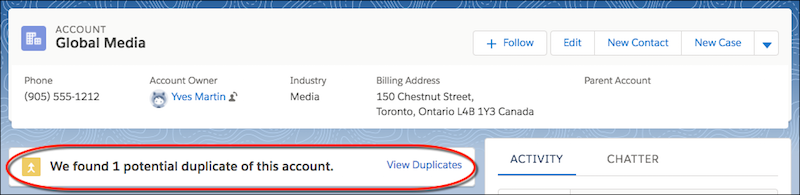
On a record detail page, duplicate alert in a card: We found 1 potential duplicate of this account. (link) View Duplicates

image 3

Salesforce recently improved Duplicate Management with a batch process – mainly, the ability to run the deduplication frequently to detect duplicates in your existing data in bulk. A batch process runs one matching rule simultaneously and is available to Salesforce users on the ‘Performance’ and ‘Unlimited’ editions.

Learn How to find and manage duplicate records in Salesforce

Salesforce identifies and manages duplicates by combining matching and duplicate rules. Duplicate rules and duplicate jobs define matching rules for identifying duplicates. Duplicate sets and reports contain a list of the duplicates discovered.

Required Editions And User Permissions

Lightning Experience and Salesforce Classic are both available (not available in all orgs)

Essentials, Professional, Enterprise, Performance, Unlimited, and Developer Editions are all available.

User Permissions Needed

To see duplicate and matching rules: View Configuration and Setup

To create, edit, delete, activate, and deactivate duplicate and matching rules, follow these steps:

A matching rule compares data and detects duplicates.

A duplicate or matching rule can compare records on the same object, such as leads or objects. A matching rule is an equation that specifies how to compare the fields in two records.

The fields’ criteria determine how widely a match is defined. Indexing and algorithms help to accelerate the matching process. When you activate a matching rule, one or more match keys are applied to existing records. 

The matching rule only searches for duplicates among records with the same match key. If two records do not share match keys, they are not considered duplicates and are not subjected to matching algorithms. This indexing process boosts performance and yields a more accurate set of match candidates.

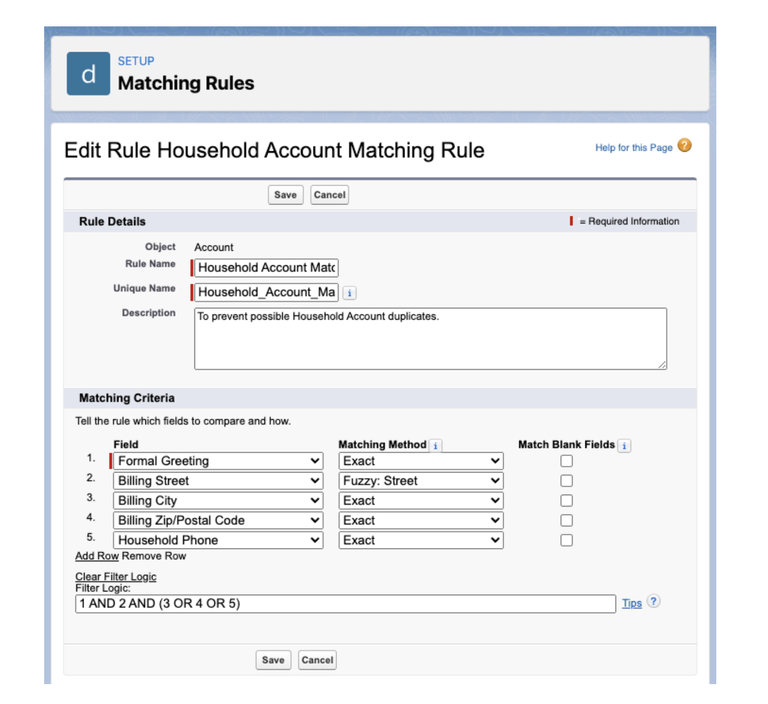
To configure your Matching Rules, follow these steps:

  1. In Salesforce Setup, on the left menu, look for Matching Rules.
  2. Select New Rule to establish a new rule, or Edit to modify an existing rule. To update currently active rules, disable the Duplicate rule and the Matching Rule. Standard rules are not editable.
  3. Select the object for which the matching rule is intended.
  4. Give each rule a name and pick the fields and matching method. Check out the Salesforce support for more information on the matching techniques.
  5. If you have complex logic (for example, a match on Name and Address OR Email), click Add Filter Logic to input it.
  6. Save and enable your rule. The activation may take some time to produce keys for all of the records, based on the amount of data and Salesforce’s existing server load.
  7. That’s all there is to it; you now have a matching rule to utilize in your duplicate rules.
image 1 1

Things to Consider Before Customizing Matching Rules

Considerations for tailoring matching rules

  • A maximum of five matching rules can be activated or deleted simultaneously. 
  • Each item may have up to five active matching rules. 
  • A total of 25 active matching rules are permitted. 
  • A total of 100 matching rules are permitted (both active and inactive). 
  • Each matching rule can only have one lookup relationship field.

Lookup Fields 

The matching rule is ignored if a lookup field’s value is a person account and the matching rule contains a contact lookup field. Except for “Reports To” in the Contact object, all contact lookup fields contain both contacts and person accounts. You can exclude personal accounts by using a lookup filter. Instead of matching on person account data, utilize an account lookup field.

Fields That Become Unavailable 

If an object’s field is no longer available in your organization, matching rules with mappings to that field may be disregarded. Verify all duplicate rule field mappings for an item when the fields in your org change. Customers having a Data.com license, for instance, have access to the Clean Status column. This clean status filed is no longer available if your organization no longer has a Data.com license. This field’s mappings are disregarded by matching rules.

Records in Hierarchies 

You can’t finish merging if the master record is underneath another specified duplicate in a hierarchy. For record hierarchies, change the master or the Parent Account or “Reports To” value on one of the records.

Shield Platform Encryption

Standard matching rules that contain Shield Platform Encryption fields do not identify duplication. On the other hand, custom matching criteria can relate to encrypted fields as long as they are encrypted algorithmically. Probabilistic encryption is not available.

You should update custom matching rules that reference encrypted fields when you rotate your key material. Deactivate and then reactivate the impacted matching rules after rotating your key material. Then, contact Salesforce and request that the background encryption process be initiated. When the background encryption procedure is complete, your matching rules will be able to access the data that has been encrypted using your active key material.

Service safeguards guarantee that loads are distributed evenly across the system. The matching service looks for match candidates until all matches, or up to 200 matches, are found. The Shield Platform Encryption service search has a maximum of 100 possibilities. You may see fewer or no duplicate records if you use encryption.

Duplicate jobs aren’t supported.

A Duplicate Rule or Job Handles Duplicates 

When a sales rep creates, duplicates, or updates a record, a duplicate rule is triggered or when you execute a duplicate task. A duplication rule notifies a sales representative and identifies potential duplicates. Duplicate job results in list duplicates within an organization. They can also be recognized during other procedures, such as importing or using an API.

To configure a Duplicate Rule, please follow these steps:

  1. In Salesforce Setup, on the left menu, look for Duplicate Rules.
  2. Select an item, click New Rule, or update an existing rule. To change a rule, you must first disable it.
  3. Name the rule – If you want many rules, consider using a naming convention to make it easier to discover the rule you need to update.
  4. Bypass sharing rules if necessary – alter Record-Level Security to Bypass sharing rules if you wish to match on all records.
  5. Select what occurs when you click Create and Edit. Choose Block if you wish to avoid duplication. Otherwise, select whether to Alert the user or Report the duplication. If necessary, enter your Alert message.
  1. Determine your matching rules. You may use several matching criteria and even compare records with distinct objects (for example, Contacts with Person Accounts).
  2. If applicable, clearly state your conditions. This is an ideal area to filter out any automated procedures, such as avoiding preventing web-to-lead data by adding a constraint for Lead Source not equal to “Website.”
  3. Save and activate your work.

That’s all there is to it. Now test your new rule and see whether it works properly.

How To Find Duplicate Records In Your Salesforce ORG

Conditions in which Duplicate Rules Do Not Apply

  • Quick Create or Community Self-Registration are used to create records. 
  • Leads are turned to accounts or contacts, although Use Apex Lead Convert is disabled. 
  • The Undelete button restores deleted records. 
  • Lightning Sync is used to add records. 
  • Each record is carefully combined. 
  • A Self-Service user generates records, and the rules contain User object-based criteria. 
  • Duplicate rule conditions have been specified for lookup relationship fields and records, but no value has been stored for these fields. For instance, suppose you have a condition that states that a duplicate rule is executed when a campaign does not contain the word “Salesforce.” If you then add a record with no Campaign field value, the duplicate rule is bypassed.

Conditions Under Which Duplicate Rule Settings Are Disallow 

  • In the following cases, no notification is displayed, and users cannot save entries.
  • The data import tools are used to add records. 
  • A person’s account is transformed into a business account, and the newly generated business account corresponds to an existing business account. 
  • Salesforce APIs are used to add or change records.

Reports and Sets List Duplicates discovered

Duplicate record sets are lists of duplicates discovered when duplicate rules or tasks are executed. Duplicate reports are produced from these groups.

Viewing Duplicates on Reports:

To report on duplicates, you must first establish a new report type and then a report.

  1. In setup, find Report Types.
  2. Create a new Report Type.
  3. Select the duplicate item as the main object (i.e., Leads, Contacts, Your Custom Object) and click on the next.
  4. Relate Duplicate Record Items to the primary object you selected.
  5. Save the report type and start creating reports.

Tips for keeping your Salesforce org clean

  • Consider all of the methods in which customer data enters your CRM system: manual data entry by sales reps, bulk data upload, automated lead sources such as web to lead, and so on, and make sure that you have them all covered to avoid duplicates entering your CRM system.
  • Maintain a necessary field on each Object that holds client data that is important to your company activity, such as a phone number or an email address on Lead. For custom fields, check does not allow duplicates so that Salesforce does not accept duplicity against that field on the Object, and sales reps do not create duplicate records. Have your tech team activate Duplicate Rules and Matching Rules for standard fields to prevent duplicates from forming.
  • If your required field is a picklist field, be sure you activate a restricted picklist for that field since Salesforce enables values other than the field picklist values to get in.
  • Monitor the data your CRM system receives from numerous sources to see if anything unusual is happening with your data so that you can deal with it as soon as possible. Typically, businesses do not recognize this until they have a large amount of dirty data in their CRM systems and attempt to recover from the damage.
  • Clearly identify your lead sources; this will prevent confusion when leads begin to stream in from numerous channels.
  • Instruct your Sales Reps not to save a half-filled form until all relevant client information has been entered.
  • You may even remove the Clone button from the layout if you like. 
  • Cloning records should not be a team-wide practice since it leads to human error in saving cloned data without making essential modifications, resulting in duplicates.
  • Use regular Salesforce Reports to track whether or not duplicates entering your system (if any) are critical to your organization.
  • With huge amounts of data entering your system, some duplicates are sure to enter your database in some form. Utilize a deduplication tool to make your life easier by keeping your Salesforce org free of duplicates.

Conclusion

Cleaning up your Salesforce Org is not a one-person job or a one-time exercise. It requires a team effort and is a constant process in which you work to keep your database clean and faultless, which finally pays off in terms of smooth operations and profits.

Do you want to hone your administrative skills? Enroll in our Salesforce Admin Training. Learn the administrative skills you’ll need to advance your career or reskill in your current job.

With skill-based super badges and role-based Salesforce Certifications, you will get hands-on experience with QuantoKnack’s Salesforce Admin course and Salesforce Developer training and gain a competitive advantage that can lead to new opportunities.
Register now to obtain globally recognized certificates from QuantoKnack!

READ MORE
TECHAvatar of adminadmin0 Comments
Share article:TwitterFacebookLinkedin
1307 Views
197 Likes

How to Secure Your Salesforce Organization

As the costs and risks of data breaches keep rising, cybersecurity should be a major focus for any B2B SaaS organization. As per IBM, the average cost of a data breach is $3.86 million. Organizations cannot afford to neglect security best practices when so much is at risk.

Salesforce is the major center of information for many SaaS firms, so it’s no wonder that organizations are concerned about the security of their Salesforce instance and interfaces. The good news is that Salesforce is a very secure platform.

Salesforce was designed from the ground up to safeguard your data and applications. However, there are several fundamental actions that all businesses must take in order to reduce external risks and breaches caused by human error or malicious intent.

In this blog, we will give you some essential tips and tricks to make your Salesforce organization more secure. Enroll with QuantoKnack’s Salesforce Admin Course, and you will be able to learn many more important aspects of the Salesforce platform.

5 Security Tips for How to Secure Your Salesforce Organization

Without further ado, let’s look at the five simple steps you can take to make your Salesforce org safer and more robust.

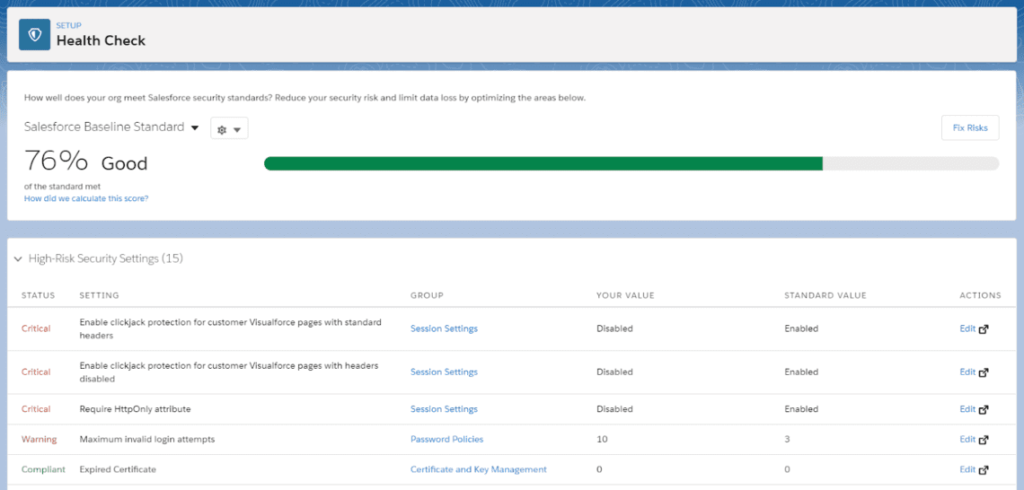
Start With A Salesforce Health Check

Salesforce’s native Health Check is a no-brainer if you need immediate wins. This useful feature compares your organization to Salesforce’s Security Baseline Standard and recommends resolving any vulnerabilities it identifies.

You may also upload your own security baseline standard and perform periodic checks against it. However, keep in mind that Salesforce has had 20 years to create theirs – and it is always being upgraded!

To do a health check on your organization, navigate to Setup > Security > Health Check.

image 1140x546 1

Implement Two-Factor Authentication

Another effective method of data security is two-factor authentication. Every time a person logs in, they must go through two stages of authentication. 

  • Interfaces Logins 
    • Setting up two-factor authentication is a common approach to boost your instance’s security. In Salesforce, two-factor authentication may be used in two ways. The most fundamental method is to activate two-factor authentication for logins. 
  • This provides additional protection by requiring each user to authenticate their identity through an authentication App or text message/call every time they log in to your Org.
  • For two-factor authentication, use the Salesforce Authenticator App.
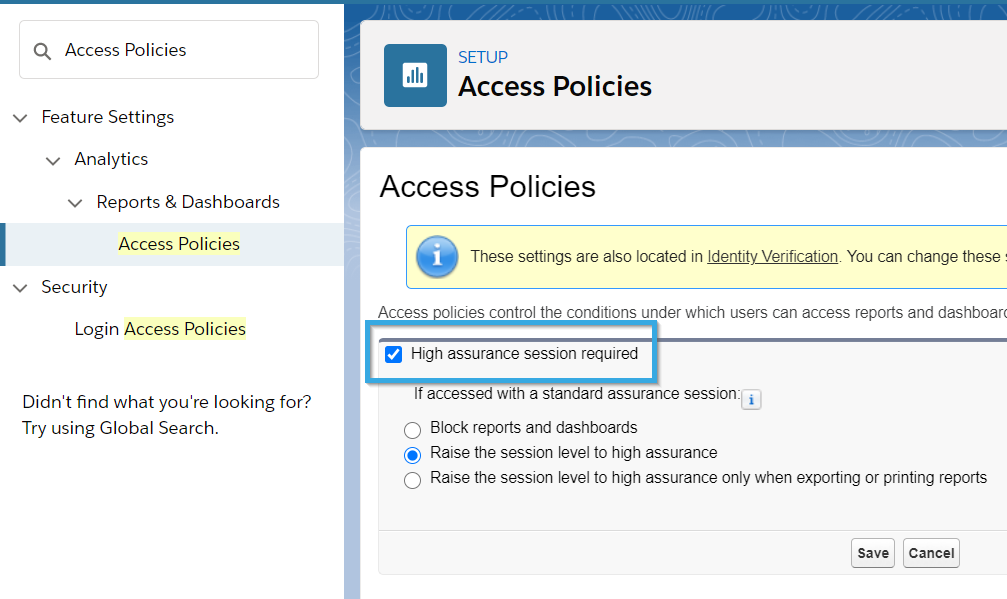
  • Two-Factor Authentication for Reports
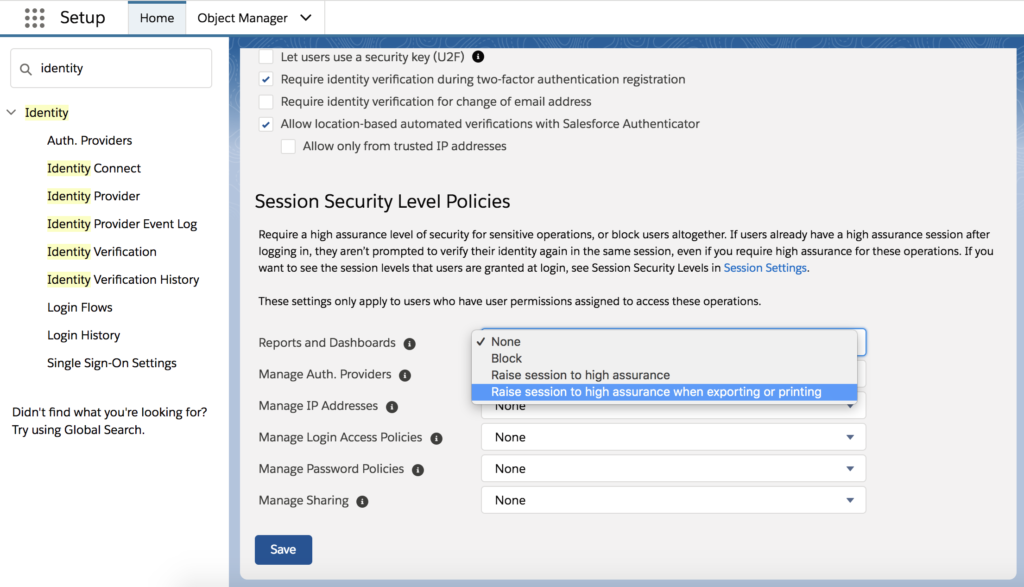
    • Salesforce may also use two-factor authentication to safeguard report access. Users attempting to view reports will be prompted to authenticate their identity using two-factor authentication. To enable two-factor authentication for users viewing reports, the Admin(s) can “Raise the session level to High Assurance” in Setup.
image 1 1

Controlling Report Printing and Exporting Access

image 2 1

Salesforce may also be established to simply ask users to authenticate their identity when exporting or printing reports. To do this, under Setup, enter “Identity Verification” and activate “Raise the Session to High Assurance” under “Security Level Policies,” which will require users to log in when attempting to export data or view particular reports.

Ensure your Org is classified appropriately

Salesforce has advanced from a SaaS contact management solution to a much more powerful PaaS capable of supporting or delivering core business applications. While many businesses already understand how to manage the availability and security of these apps, we’ve seen that they frequently misclassify their Org, resulting in serious oversights. If a Salesforce Org is classified as “Type 1” or “Class A,” it should be regarded as such in terms of business continuity, disaster recovery, enterprise monitoring, security, and compliance.

Evaluate Your Custom Code Against OWASP Top 10

If you implement your own Salesforce code, you risk exposing a security hole that might eventually disclose critical information or allow malicious users to penetrate your system.

If you’re unsure where to begin assessing your code’s risk, check the OWASP Top 10. 

The Open Web Application Security Project is committed to assisting in the creation of safe internet. Their list of top risks is based on real-world observations and is contributed by their large developer and system administrator community. As you integrate custom code into your environment, consider how it interacts with Salesforce and whether it exposes itself to vulnerabilities.

For example, “injection” is number three on the OWASP list of vulnerabilities. As a browser-based application, Salesforce must secure the attack surface from application code to the user interface. Cross-Site Scripting and SOSL/SOQL injection attacks are both OWASP Top 10 code vulnerabilities in the Salesforce environment.

This is an excellent place to start when examining and evaluating every line of code against a comprehensive and up-to-date list of vulnerabilities that may be prohibitive. More information about OWASP is available here.

Set Up Trusted IP Ranges

Employees are increasingly signing into Salesforce from more places than ever before, which might expose them to risks. To address this, configure Trusted IP Ranges, which inform Salesforce which login locations are normal and which are suspect. 

You may instruct Salesforce, for example, to trust your company’s office IP address and other specified workplace locations – and to challenge individuals logging in from any other addresses.

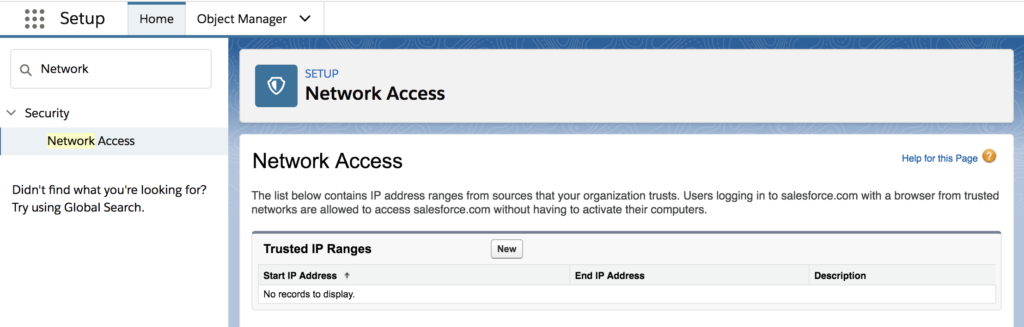
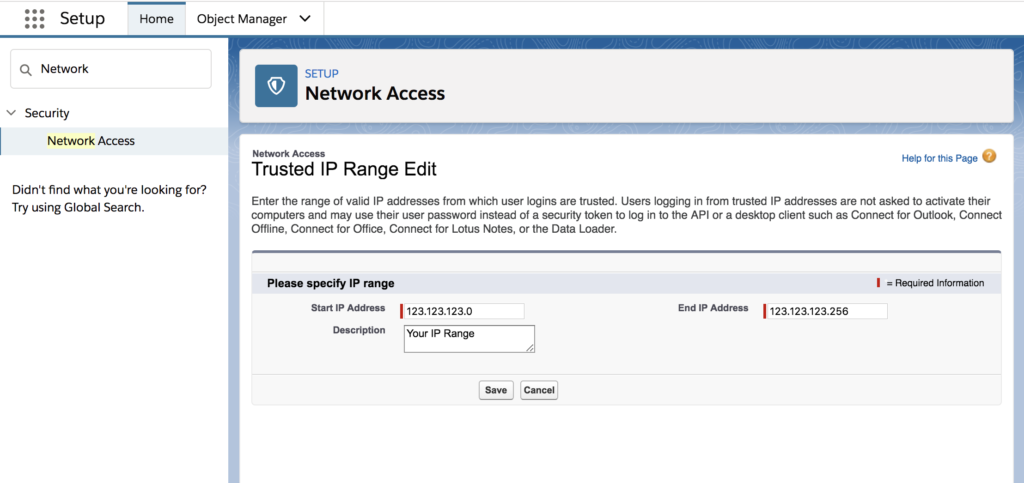
To add trusted IP ranges to your Salesforce security, go to Setup > Security > Network Access and provide a custom range of trusted addresses.

image 3 1

image 4 1

Profile-Based Trusted IP Addresses & Login Hours

You can modify trusted IP ranges depending on user profiles if you don’t need them to apply to your whole organization. For example, suppose you only want support users to be able to log in from your workplace network between the hours of 8 a.m. and 6 p.m., Monday through Friday.

That’s simple! Simply navigate to Setup > Users > Profiles, choose your Support profile, configure your IP ranges and log in hours.

Utilize Shield to maintain platform visibility

Salesforce’s user-friendly development capabilities make it ideal for enabling bespoke apps but make it difficult for compliance teams. Shield, fortunately, can assist you in keeping track of a wide range of data. 

Event Monitoring, for example, allows you to monitor detailed use statistics, while Encryption safeguards data and Field Audit Trail records its condition and value for up to ten years. If you need assistance, a variety of third-party services are available to help you put Shield into action. In addition to analyzing the Salesforce security architecture, it’s vital to properly identify and categorize the data in your Salesforce Org since categorization greatly impacts access restrictions.

Secure your APIs

Salesforce has the interesting advantage of being simple to integrate with other services and apps, allowing you to exchange data and increase functionality. However, not all of the apps you connect to Salesforce are secure, which may lead to a variety of problems, including,

  • Code injections 
  • DDoS assaults 
  • Fraudulent logins 
  • Replay attacks 
  • Unsecured cardholder information, 
  • Exposed data through URI keys.

Because using an unprotected or shady API might result in compliance concerns, data breaches, and hacks, precautions must be taken to use these APIs while being safe. 

You may take the following steps: 

  • Enable whitelisting on the app 
  • Create an integration user 
  • Improve access limits for your integration users 
  • Monitor API access.

Use custom login flow

Salesforce helps safeguard against unauthorized logins while granting authorized access even in odd circumstances. For instance, suppose a user attempts to log in outside of business hours or from a restricted IP address. 

In that case, it may initiate a flow that the user must complete in order to obtain access, such as answering secret questions, for further security. If the login attempt is unexpected, you can add an authentication step with a bespoke login flow.

Utilize App Whitelisting to Prevent Data Leaks to 3rd Party Apps

You may also keep Salesforce secure by setting App Whitelisting for your organization. This prevents users from accidentally providing third-party apps access to your organization’s data. Salesforce admins may use this functionality to control which third-party apps can access the org. This solution is scalable since it may be installed for the entire org for all Salesforce users or for certain users only if necessary.

Enabling App Whitelisting

  • Enroll in QuantoKnack’s Salesforce admin training to learn how to request this option from Salesforce support.
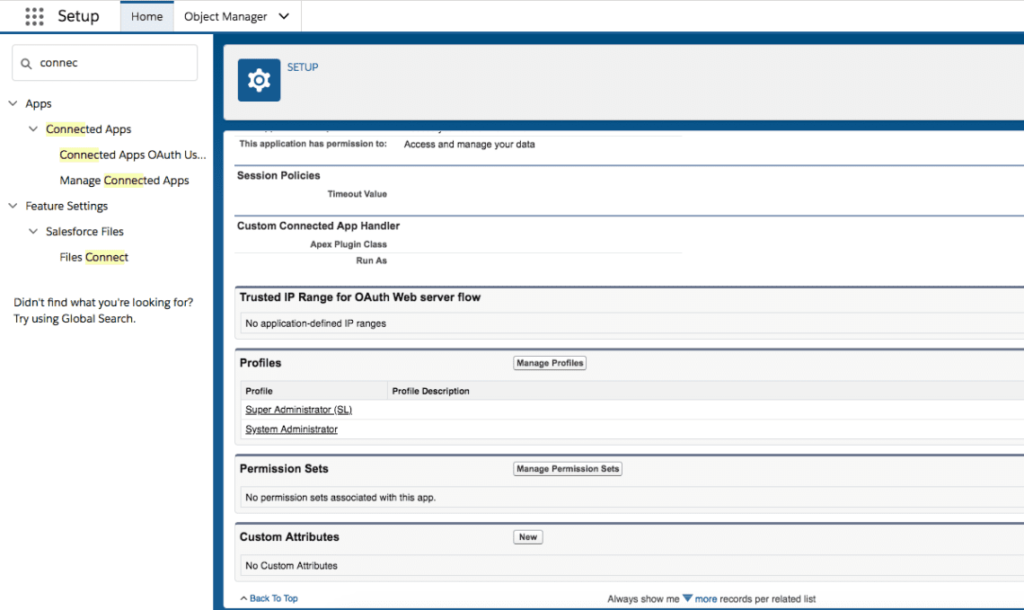
image 5 1140x613 1

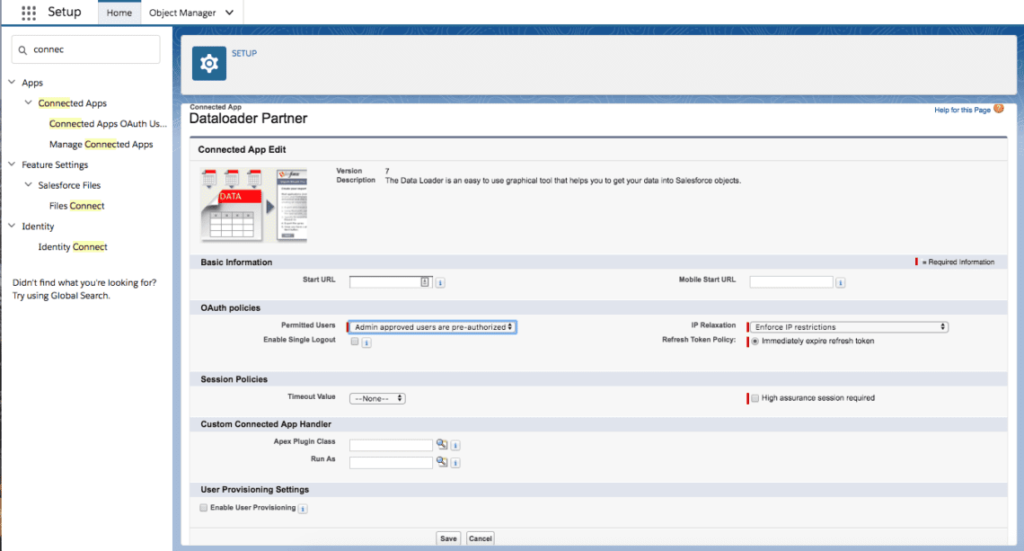
  • After you’ve activated the functionality, navigate to Manage Connected Apps. Then, if you want to whitelist beneath the app, click ‘Edit.’ • Navigate to OAuth policies > Permitted Users. Now, choose the “Admin-approved users are pre-authorized” option.
image 6 1140x679 1

  • Go back to Manage Connected Apps and choose the app you whitelisted. This will take you to the app’s details, where you may configure Permission Sets and Profiles.

Use Clickjack Protection

Clickjacking is the technique of tricking users into clicking on legitimate-looking URLs that execute harmful operations, such as changing your Salesforce data without your permission.

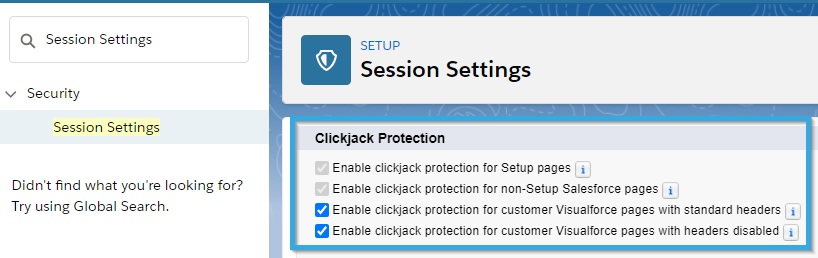
While Salesforce protects against clickjacking by default, you may strengthen these safeguards by checking all checkboxes in the Clickjack Protection section in Setup > Security > Session Settings.

image 7 1

Use Strong Password Policies

Our final simple Salesforce data security victory is to improve your password policy. While you don’t have to make your password requirements overly stringent (people will be unhappy if they have to establish new passwords every few days), you can still improve your security with minor tweaks.

Here are some recommended options (which may be changed in Setup > Security > Password Policies):

  • Password length: 15 characters (the default for Salesforce is 8).
  • Password complexity: alpha, numeric, and special characters must be included.
  • Password Expiration: 90 days
  • Password question: Cannot contain a password (if users set the answer to their security question as their password, anyone could gain access to their account)
  • Passwords should be backed up with MFA if you follow this tutorial, which means that these settings will considerably limit the odds of compromised accounts.

Conclusion 

While Salesforce provides adequate data protection, there is no harm in going the extra mile.

Remember that a developer is only a facilitator for the company. Salesforce administrators, on the other hand, are individuals who are well-versed in business processes and can assist developers in understanding the appropriate solution design.

Salesforce administrators are the foundation of the entire CRM process. They should have greater resources and freedom to realize the CRM function’s potential fully.

Enroll in QuantoKnack’s Salesforce Admin Course and Salesforce Developer Training program now if you want to advance your career or get the most out of the Salesforce platform for your organization. Our Salesforce admin training can help you advance your career in top IT firms across the world.

Allow our industry experts to assist you in mastering the Salesforce platform and preparing you for the future by using real-world projects! You will be working on a project at the end of the Salesforce Admin program, and QuantoKnack will certify you as a ‘Salesforce Administrator’ depending on the project you submit.

Don’t miss the chance this chance! Register with QuantoKnack today to learn from prominent Salesforce experts in live training sessions and become certified as a “Salesforce Admin.”

READ MORE
TECHAvatar of adminadmin0 Comments
Share article:TwitterFacebookLinkedin
1435 Views
204 Likes

How To Setup Visual Studio Code For Salesforce Development

Since the Spring ’18 release, Salesforce has been trying to get users to migrate to Microsoft Visual Studio Code (VS Code) with the retirement of the Force.com IDE Eclipse. So, if you haven’t heard of VS Code yet, now is the time to learn about it.

Visual Studio is a lightweight, user-friendly, and comprehensive IDE with built-in support for Salesforce and Git. It has keyboard shortcuts, debugging assistance, and other capabilities such as syntax highlighting and code completion. All of these things may make your life as a developer a lot simpler.

The best thing is that Salesforce includes its own VS Code extension pack to make the IDE Salesforce compliant. The package contains eight extensions, all of which can be downloaded and installed in your IDE with a single click.

In this tutorial, we’ll look at the capabilities of VS Code, how to set it up, and how to utilize it as a powerful tool for Salesforce development.

Do you want to learn Salesforce concepts firsthand? Enroll in QuantoKnack’s Salesforce admin training in Dallas to gain a wide understanding of customizing & configuring Salesforce on a regular basis, managing users, and searching for methods to get even more out of its features capabilities.

Why Visual Studio Code For Salesforce Development?

VSC(Visual Studio Code ) is one of today’s most well-known editors. It is an open-source editor, which makes it more attractive to developers, has a built-in git client, and is lightweight. This is all we want and need. However, the biggest benefit of VSC over Eclipse (and other editors) is speed.

VSC is easily extensible using extensions. To summarise, it is designed to save you time and make you more effective.

Prerequisites

Before we jump to the installation and configuration section of Visual Studio, it’s essential to understand some perquisites.

Get ready with the following things:

  • Salesforce Developer Account (https://developer.salesforce.com/signup) Download and install Visual Studio Code (.exe)
  • Download & install the CLI (Command Line Interface).
  • Salesforce Add-On Pack (Extension from Visual Studio Code) Install via Visual Studio Code.

Learn To Set Up Visual Studio Code For Salesforce Development

Visual Studio Code is the most recent IDE for Salesforce Development, and in this section, we will help you learn how to set it up for Salesforce Development. So, let’s get started.

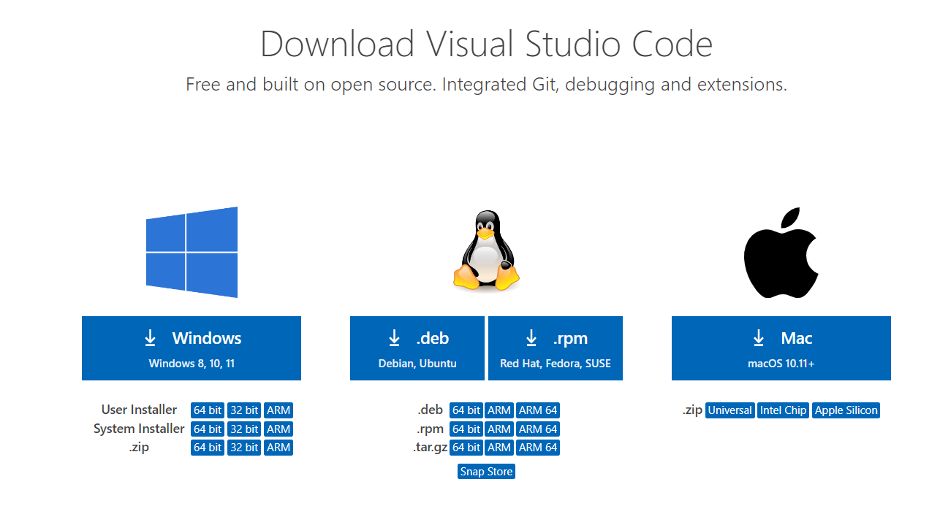
Download Visual Studio Code

The first step in starting with Salesforce development is downloading and installing the VS Code IDE. You may get the most recent version of VS Code here.

How To Setup Visual Studio Code For Salesforce Development 2

Install SFDX Command Line Interface

As previously stated, you must install the Salesforce Extension Pack in order to utilize VS Code for Salesforce development. However, you must first install the Salesforce DX Command-line Interface (SFDX CLI).

SFDX CLI is a highly strong tool that may greatly ease your development experience. You may also use it to establish automation while dealing with your organizations. Bid adieu to the Force.com IDE, and welcome to Visual Studio Code.

It can handle the following vital tasks:

  • It can consolidate and save all of the commands and tools required for Salesforce development in one location.
  • It may be used to sync your organization with the source and vice versa.
  • SFDX CLI also makes it easy to install additional packages.
  • It may be used to manage both organizations and data.
  • It can be used for testing reasons. The best part is that it is open source, which makes it extremely adaptable.
How To Setup Visual Studio Code For Salesforce Development 1 1

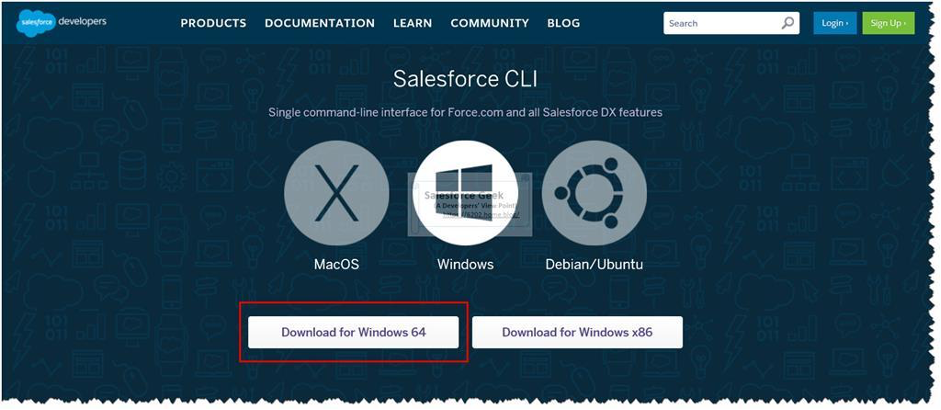
After that, click here to obtain the SFDX CLI for your operating system. Run the sfdx command in your terminal to see if the SFDX CLI is properly installed.

Install Salesforce Extension Pack

Salesforce has released its own extension bundle for developers. When you launch your VSCode IDE, go to the left sidebar menu and select the fourth icon for maintaining extensions. Look for Salesforce Extension Pack and select the top result.

35ed1171 3a7e 4e18 a4d7 95cb59720230

As of currently, the extension pack includes the following extensions, which will be enabled immediately when you install it:

  • Apex
  • Apex Interactive Debugger
  • Apex Replay Debugger
  • Salesforce CLI Integration
  • Aura Components
  • Visualforce
  • Lightning Web Components
  • SOQL
  • SLDS Validator

Create Project

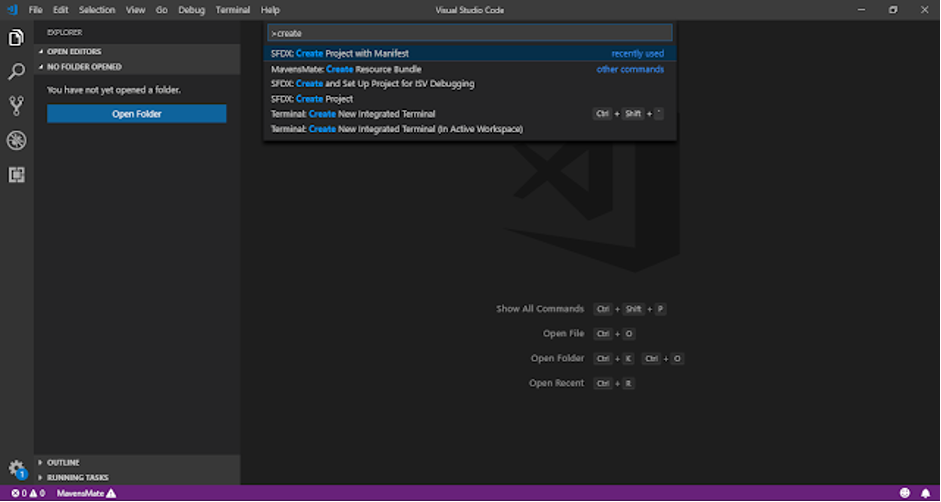
Congratulations! Your software installation is finished up to this point. It is now time to start your first VsCode project. To begin, open the Command Palette or press Ctrl + Shift + P. Then put SFDX: Create Project using Manifest into the search box.

SFDX: Make a Project Using Manifest

Then provide your project name and choose a place to store your project.

You will see an empty folder structure in VsCode until this moment. Let’s examine how we can integrate VsCode with Salesforce.

Connect to your Salesforce Organization

How To Setup Visual Studio Code For Salesforce Development 7 1

Now that our project is complete on the local PC, it is time to link VsCode to Salesforce. Open the Command Palette again, or click Ctrl + Shift + P. This time, you must input or choose “SFDX: Authorize an Organization.”

Then it will ask you to select the environment in which we need to join.

The org alias name must be provided in the final stage. It will then redirect you to your regular browser and prompt you for your org credentials. If you are requested to grant access, click Allow.

Until this moment, your Salesforce org is connected to VsCode. It is now time for development.

Retrieve Component 

How To Setup Visual Studio Code For Salesforce Development 8 1

Do you have to extract all of your Salesforce components into VsCode now?

There are two ways to accomplish this: one uses the manifest file, and the other leverages the org browser. Let’s have a look at both ways.

  • Metadata Retrieval from the Org
    • After successfully configuring your project and connecting it to your org, you will see Visual Studio Code workspace.
    • This allows you to view all of the metadata in your organization. When you hover over a metadata item, a symbol looking like a cloud with an arrow appears to the right of it. You may import the information into your project by clicking this icon.
  • Retrieving Metadata using the manifest package.xml file
    • Before we begin, an addon called “Salesforce Package.xml Generator” will greatly simplify the process of creating these package.xml files.
  • This technique is quite handy if you want to constantly retrieve from your organization into your projects. In some instances, it’s also significantly quicker than the org browser.

To use this technique to retrieve metadata, perform the following steps:

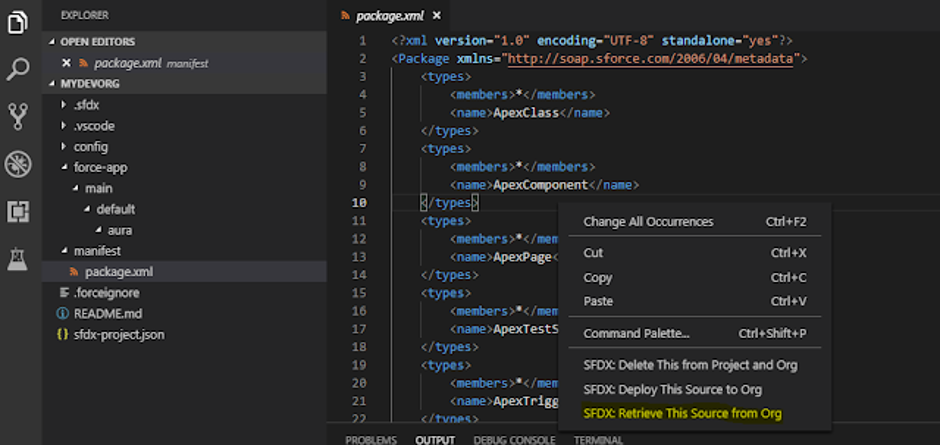
  1. You should find a “manifest” folder in your project. There needs to be a file called “package.xml” in that folder. You may either ignore it or modify the package.xml file to add additional metadata types to retrieve from your organization. In the following step, you will only retrieve data types defined in your package.xml file.
  • In the command palette, execute the command SFDX: Retrieve Source in Manifest from Org. This should import all of the metadata from your organization that you specified in your package.xml file.

Other Useful Things To Set Up

The things mentioned above are the only ones necessary to get started. However, the items listed below will make your life a lot easier.

How to Enable Auto-Complete for Object Fields

  • Run the SFDX: Refresh SObject Definitions command in the command palette to enable autocompletion on your object fields.
  • Do the following if you wish your SObject definitions to update every time you open your VSCode project automatically:
  • Go to Settings (File -> Preferences -> Settings).
  • There is a checkbox for “Enable-object-refresh-on-startup” in the extension settings under “Salesforce Apex Configuration.” When your project is loaded, this automatically updates your organization’s objects.

How to Auto-Deploy to your org to save

If you didn’t already know, it would not automatically deploy to your org whenever you save your code. You must right-click on your project’s file and pick the option to deploy the code to your organization. Follow these steps to enable auto-deployment:

  1. Open VSCode and navigate to File -> Preferences -> Settings.
  2. Select Extensions from the drop-down menu.
  3. Select the Salesforce Feature Previews extension from the list.
  4. Tick the “Push-or-deploy-on-save” box.
  5. If you utilize the auto-deploy on save function, you also need to enable the “Detect Conflicts At Sync” feature preview in settings. By activating this, you will be notified if your save contains any conflicts with other developers’ code before you deploy it to your organization.

That wraps up this tutorial. Give it a shot and let us know in the comments whether you’re able to utilize VS Code for your development activities and if you run into any problems when carrying out the above steps.

Do you want to learn how to configure Salesforce and other processes? Enroll in QuantoKnack’s Salesforce Admin course and Salesforce Developer training. We provide live, instructor-led Salesforce admin training that is designed to lead you through the learning, certification, and job search process of launching a Salesforce career.

Our industry-professional mentors guarantee that you get the required information, hands-on experience, and skill set to jumpstart your Salesforce career.

After completing our Salesforce Admin training or QA training course, you will be able to enter the job market and get significant experience as a working professional in the business.

Register now and go one step closer to your dream Salesforce career!

READ MORE
TECHAvatar of adminadmin0 Comments
Share article:TwitterFacebookLinkedin
1443 Views
177 Likes

How to Automate Your Business Processes with Salesforce

Surviving and prospering in business in today’s competitive environment is a tough challenge. Every business strives to achieve the peak of success. Making income alone is never enough; in addition to earnings, the company works hard to stay current and relevant to current trends. In today’s world, firms must carefully use their resources while receiving proper technical support to maximize their effectiveness.

Technology has revolutionized and impacted every element of our lives, and business is no different. Technology may help firms improve their processes and increase their efficiency. Business process automation can help to reduce overall operating expenses and enhance overall utilization.

CRM solutions are a critical component of corporate automation. IT’s the focus has evolved from catering to internal demands, efficiency, and cost reduction and offering new prospects for business and client management. An advanced CRM software can help you manage all of your data, KPIs, and notes in one location.

Salesforce is the world’s leading CRM platform that offer a variety of tools to help you put your business ideas into reality. There are different Salesforce products available that helps you business in providing an exceptional customer experience with Sales Cloud, improves sales productivity using Sales Cloud, conducts efficient campaigns using Marketing Cloud, and connect your customers and partners using Community Cloud. 

Since all of these solutions are available as cloud-based platforms, you can utilize them as software and also tweak them to meet your specific business requirements.

In this post, we’ll show you how to leverage Salesforce to your business processes and diverse users to make your company more productive. Salesforce can provide your company’s automation or act as a security guard. It may also be the platform that unites all parts of your business under one roof, allowing you to play 360 from the same cloud solution that powers millions of other users worldwide.

Why Your Business Needs Salesforce Automation

Improved Processes

Salesforce Automation enhances numerous business processes and assists firms in gaining a competitive advantage. Salesforce Automation capabilities include Workflow Improvement, Process Builders, Approval Process, and Flow Builder, all of which play an important role in how a business operates. The firm’s size is unimportant; all these operations are required at some level for a business to function properly.

Salesforce Automation may be more expensive, but it allows you to generate more money in the long run while enhancing both customer and staff happiness. It is especially vital if your company is medium to large since the operations are significantly more sophisticated and require automation to run smoothly. With the help of additional Salesforce Automation solutions, you can accelerate your business while keeping your customers satisfied.

Data-Based Decisions

Data is driving the world and will become increasingly more important in the future. Salesforce Automation is data-driven and operates depending on user behavior, and data gathered in the past. Salesforce Automation reduces the risks associated with every industry it uses. Salesforce Automation can help you make the most of your marketing and business process investments.

Making data-driven decisions is essential for everyone who wants to operate a successful marketing and sales department. Salesforce Automation guarantees that you can make the best decision by giving you all of the facts in one location. From then, you may do whatever seems right to you. Salesforce’s Marketing Cloud and Sales Cloud are both excellent tools, but what sets them apart is Salesforce Automation.

Improved Customer Satisfaction

Salesforce has been recognized across the world for enhancing customer retention, and it is genuinely instrumental in improving customer happiness. Salesforce Automation makes operations quicker and more precise. Compared to people, the systems are self-learning and continue improving with additional data and time. The most crucial item to enhance is the customer experience, and Salesforce has invested heavily in this area.

360 View of customers

Whether it’s lead generation, presales, or post-sales, having a clear overview of the customer’s data is vital if you want to handle things more effectively. Salesforce allows this through automation and artificial intelligence and has created capabilities directly into Marketing Cloud, Sales Cloud, and Service Cloud to obtain a comprehensive picture of the user. Using Salesforce services ensures that you are always one step ahead of the competition when it comes to offering the greatest client experience.

However, consumer 360-degree views are useful for more than just boosting customer experience. Every time, it aids in different internal processes and the development of a better strategy and knowledge of the user base. Personalization is the key to success in this competitive world, and clients expect everything to be tailored to their own needs. The only way to do so is to have a 360-degree picture of their requirements and needs, which Salesforce can provide.

Generating Relevant Leads

Salesforce provides more for marketing teams via the Marketing Cloud and goes even further with its intelligent automation. Because of its data-driven methodology, Salesforce Marketing Automation assures optimal practices in lead creation. The Marketing department will be able to use data from different sources, which was not feasible with previous systems.

Sales teams benefit from the use of Salesforce Sales Cloud as well. They may access comprehensive data that is publicly available immediately on their dashboards. Furthermore, management is simplified using Salesforce services. The marketing and sales teams may communicate in real-time. Companies will be able to create more relevant leads with ease, thanks to the clever Salesforce AI.

Salesforce Automation Tools for Your business processes 

Salesforce automation technologies significantly improve efficiency by automating administrative operations that sales reps and management must undertake manually. Join QuantoKnack’s Salesforce Admin Training In Dallas to hone your skills in Salesforce administration-related tasks. Our live, instructor-led training programs will teach you how to manage and create apps for CRM systems throughout the world, as well as how to improve company operations.

Workflow, Process Builder, Approvals Process, and Flow Builder are some of the automation tools available from Salesforce to help you automate repetitive business processes in your organization.

Each tool has its own distinct capabilities. The kind of business process dictates the automation approach to use.

Workflow Rules

Salesforce can perform things like sending an email, generating tasks, or updating fields. Workflows are one of the best ways to automate business operations in Salesforce. They allow you to establish a rule-based on specific criteria.

These activities might be either ‘Time-Dependent Actions’ that occur at a specific time or ‘Immediate Actions’ that occur immediately. In the event of Time-Dependent Action, parameters are re-evaluated prior to action, and if the parameters are determined to be erroneous, the Time-Dependent Action is not done. The following actions may be performed using the workflow:

  • Field Update
  • Email Alert
  • Send Outbound Messages
  • Create Task

Approval Process

Salesforce’s Approval Process streamlines the necessary procedures to authorize a record and decides approval at each level. It specifies what happens when a record is submitted for review, when it is approved by an approver or by all approvers, and when an approver rejects a record. 

The Approval procedure allows you to conduct actions such as Field Update, Email Alert, Create Task, and Outbound Message.

When invoked from Process Builder, a Flow, or APEX, the approval process can begin when a user submits a record for review. When a user requests permission, initial application operations occur, and the record is locked so other users cannot edit it when the approval is pending. If the request is rejected by the approver, the final rejection actions are executed, and the approval status is changed to deny.

Process Builder

Many aspects of your business processes, such as sending emails, changing information, and allocating tasks, are routine. These processes may be automatically designed using Salesforce Process Builder, which gives a graphical depiction as it is built up using its “point-and-click” capabilities. Here are some examples of how Process Builder might be useful:

  • Creating a published or written content record 
  • Appreciating teams like congratulating them on a big deal
  • Schedule follow-up tasks that are important to your department.

The associated actions are mentioned below:

  • Record modifying
    • The tool can assist you in updating several records that are somehow connected to the record that started the process. You can either manually insert records or use records from a linked record to do so.
  • Creating records
    • This action allows you to create new records and provide different field values to them.
  • Chatter posting
    • The feature allows you to post on Salesforce Chatter to share any data with any user.
  • Quick action
    • If you also have global actions or objects in Salesforce, you may utilize “Quick Action” in any record.
  • Activating the flow
    • You may activate the flow from your process to automate certain processes.
  • Invoking a different process
    • This operation will really activate another process.
  • Invoking/triggering Apex code
    • Within Salesforce, you may call or trigger Apex code that you have already created.
  • Automatically submitting the record for approval
    • Only the first record that was used to initiate the procedure can be submitted.

Salesforce Flow

Salesforce Flow is a solution that employs automation to assist businesses in creating, running, and maintaining business processes.

The most significant aspect of Salesforce Flow to remember is its capacity to improve the accuracy and efficiency of business operations. Workflows that are disjointed or inefficient might be damaging to your company’s business strategy. Furthermore, time spent on repetitive manual work such as reporting and monitoring activities might be transferred to topics requiring human judgment.

Ways to Automate Your Business Processes with Salesforce

Declarative modifications and custom programming are the two main approaches to integrating your business into Salesforce. Let’s take a look at both of them in the below section.

Declarative Customizations

Many of Salesforce’s support, sales, marketing, and engagement functionalities are available right now. These declarative capabilities, in other words, are available without the need to write a single line of code and are often set up by your organization’s Salesforce admins or other appropriate sales/service/marketing experts. The following is a rundown of some of the most prevalent declarative features:

  • Workflow rules allow you to conduct an action/value change when particular conditions are satisfied, such as when a new lead is formed.
  • Validation rules let you check your data before adding or modifying it, for example, supplying an email address before generating a lead.
  • Security and sharing allow you to select who sees what and create access privileges for everyone, such as permitting a manager to see his or her subordinates’ work and data.
  • Opportunity and related features comprise opportunity splits and revenue estimates, which aid in deploying the sales cloud. Opportunity splits allow you to divide a deal’s contribution across numerous users, while predictions allow you to anticipate incoming revenue in the quarter.
  • Campaign and related capabilities contribute to marketing cloud deployment by sending bulk marketing emails.
  • Case and associated features, such as case teams and case queues, contribute to service cloud deployment. Case teams enable a group of service representatives to collaborate on a case. Case queues allow you to allocate a case to many individuals, with the case finally going to whoever is available.

Custom Programming

Salesforce is designed at the API level. This implies that all of the exceptional capabilities may be extended and/or upgraded in ways that are exclusive to your business. We generally want Salesforce experts who can write in Apex, Visualforce, and Lightning for this. The following are the primary functionalities provided with Salesforce custom programming:

  • Visualforce pages allow you to develop VF pages to design custom forms, display PDF documents, etc. They are developed with server-side architecture in mind.
  • Apex code is utilized to drive logic in Visualforce pages and Lightning components and for data synchronizing interactions with external systems.
  • Lightning components enable you to utilize Lightning to develop a mobile-first responsive design for numerous UI elements such as forms and tables. They are quicker than Visualforce pages since they are built on client-side architecture.

Conclusion

Businesses nowadays are large and amazingly complicated; however, that doesn’t mean their processes have to be a mystery. From single-employee startups to massive organizations, the right business process automation software can help guarantee that every process goes smoothly.

The Salesforce Platform deploys cutting-edge technology where it is most required by businesses while simultaneously improving the systems that fuel corporate performance.

If you want to automate your business processes, you will need to understand Salesforce and its offering deeper. 

At QuantoKnack, we offer Salesforce certification courses that cover basics to advanced Salesforce concepts to help you qualify for various certifications while imparting real-time knowledge that will help you prepare for a full-fledged demanding career.

Get Hands-on Experience in CRM, SF Objects, Workflow Automation, Data Access & Modeling. Earn The Salesforce Admin training and Salesforce Developer training Certificate & Elevate Your Career or enhance your business. Once you complete this training program, you’ll get an opportunity to enter the job market and open up invaluable opportunities as a working professional in the industry.

Register yourself today for QuantoKnack’s Salesforce admin training Certification Program to master the concepts of Salesforce Admin while focusing on Sales & Service Cloud, Apex Programming, Salesforce Lightning, and much more.

READ MORE
TECHAvatar of adminadmin0 Comments
Share article:TwitterFacebookLinkedin
1362 Views
198 Likes

How to Create New Users in Salesforce

In this Salesforce admin article, we will learn what a user is and how to Create a New User in Salesforce.

Moreover, you can learn to successfully manage your cloud-based Salesforce apps with QuantoKnack’s Salesforce admin course. Get the fundamental information you need to get up to speed, perform well, and make the most of Salesforce. Register now for Salesforce admin training!

What exactly is a User?

Every user in Salesforce will have a user account by default. A user is someone who has access to Salesforce and can utilize the application. The user account identifies the person, and the profile settings define its capabilities.

  • Every Salesforce user account will also have a username.
  • Every user account must have an email address and a license. The Salesforce license determines the number of user licenses that we utilize.
  • Profile and Function

The company must acquire the appropriate number of licenses and allocate them to each user based on the number of users.

Important Points

  • To create the new user, you must log in with the “SYSTEM ADMINISTRATOR” account.
  • The user account’s username is UNIQUE throughout the Salesforce organization.
  • Only users with the SYSTEM ADMINISTRATION profile may establish and manage user accounts in an organization, such as assigning user licenses, resetting passwords, and giving rights to access certain data in Salesforce.
  • By choosing “Add Multiple User,” you may create “Multiple Users” at the same time, and you can add approximately ten users at a time in your Salesforce org.

Creating Users  in Salesforce Organization

Creating a new user might be difficult if you don’t know how, but after you understand the procedures, you’ll realize how simple it can be. To assist you, we have produced this simple step-by-step instruction.

Step 1

Click the gear icon and then the Setup option.

DdorgZ0bqGZMV G9W Sky5WDZH57fX0LwqenR8lu JjsbuPvTwOzYAWR7K3sIvV2ed4LxiUkesuTqwOmHynCejqzWnYWN9qD0vj6m3g6d7KwUyXXyBXafFM8eKPqVhRCsZ582GmQVvMq C7jan6Vkg

Step 2

Type “User” into the search box and then choose “User” from the bottom of the recommendation menu.

MaYYK mLDHx8TWHCeVwUTBuTYgtpFVlfy3MJyErLDJHvncEweVfGu tkz7sxr32h7kyMbVZEf4i551TwaoZRaoHCpsEZ

Step 3

On the user page, several user lists are displayed. Now click the New User button if you wish to create a new user.

aKCZLOvx800yzpKRv5xQVJID eeIT0aWOCdnz696VjhPwfn9Nnn93mmP5oXFzL9qj08Wz0avI4gybCpQ3IPcD5v2Y2jr3zTJyQ 30AKs0G3JiOM2KS3saKuF1Fz lSjsm4nrWAWIZvSbT2QDiyOGA

Step 4

Fill in general information about users such as First Name, Last Name, Alias, Username, Email, Nickname, User License, Role, Profile, and so on.

  • Alias: It automatically takes the first letter of the first name and the first 4 letters of the last name. However, you may modify it to meet your needs.
  • Username: It must be “Unique” within the Salesforce organization. It automatically uses the Email Id you provide in the Email Field.
  • Nickname: It produces one Id for Nickname automatically. However, you can add a Nickname if necessary.
  • Role: You may assign a role to a user based on their needs.
  • License: Choose a license for the user based on their needs.
  • Profile: Choose a necessary profile for the user. 
vbY cmFnImrl4esx3I 9krflqiw6fw5EbyPYesU1iX1OrnGJ76anZmhgY0RTrsUQ0CvRXC zDYEpOZcYeTq YHg3OV944dHgBamvCDsEdqOf sQspHF8TviVFEce44z8h4EFrfa7oD11nMnEEK Cw

You may fill in other information such as Title, Department, Company, Division, Phone, Mobile, and so on. 

You may additionally enable specific checkboxes in the user window based on your requirements or to provide the user further access.

Step 5

You may also include a mailing address in your user window. Now choose the Generate Password and Notify User Immediately checkboxes.

  • Now press the “Save” button.
  • Please remember the fields with a red asterisk (*) are required. As a result, you may fill or manage as needed.

Step 6

You may reset your user password by clicking on the “Reset Password” option. An email will be sent to the user email ID you gave when establishing the user, and the user can reset the password as he wishes using this email.

Your new user is now created.

If you want to learn more about similar Salesforce Admin-related functions and tasks, then register yourself for QuantoKnack’s Salesforce admin training program. 

QuantoKnack can help you become a Salesforce specialist. In this online Salesforce training course, you will learn Salesforce Administration, App Builder, and SFDC abilities. Our Salesforce admin training will prepare you to pass the Salesforce Certified Administrator (ADM 201) and Certified Platform App Builder tests (DEV 402).

Do you know Salesforce consultants are also in demand? Want to be the one? Read our comprehensive guide on “How to become a salesforce consultant.” It covers everything you need to become a Salesforce developer. 

Enroll now to get a competitive advantage that will lead to new career opportunities!

READ MORE
TECHAvatar of adminadmin0 Comments
Share article:TwitterFacebookLinkedin
1496 Views
174 Likes

How To Define Validation Rules In Salesforce

With so many changes made to Salesforce records on a regular basis by employees, it may be challenging to keep track of the quality of the input data. Salesforce uses Validation Rules to protect users from making mistakes (such as entering phone numbers in the wrong format), establishing verification boundaries, and standardizing data requirements in general.

In this article, you will learn more about:

  • What is a validation rule?
  • What are validation rules used for?
  • When to Use Validation Rules in Salesforce?
  • Cases When Validation Rules Are Skipped
  • How to define a validation rule?

If you want to get a deeper understanding of Salesforce or upskill yourself, register for QuantoKnack’s Salesforce Admin Training In Dallas program. Our live, instructor-led Salesforce certificate courses will help you enhance your knowledge and give wings to your dream job. 

What is a Validation Rule?

In Salesforce, validation rules are rules that comprise formula expressions that validate our data and return a value of “True” or “False.” These validation rules ensure that any record created or updated meets the defined business rules. If not, developers/administrators can show the appropriate error message. 

Want to do even more or learn how to become a Salesforce Administrator? Register for QuantoKnack’s Salesforce admin training program to get hands-on experience with all aspects of Salesforce.

Validation rule constitutes of:

  • Object: That’s where the rule will run field checks, such as Contact, Account, Opportunity, Custom Object, and so on.
  • Formula — a formula for assessing business rules. If the formula statement is True, a validation error is thrown; otherwise, the validation is considered successful.
  • Error message — This error message appears when a user doesn’t really meet the validation rule’s requirements.
  • Location — This allows the administrator/developer to specify where the validation error should be displayed. Standard page layouts will enable the user to display the error at the top of the page or beneath the selected field.
  • Validation rules are called whenever a record is generated or updated, whether manually or through an API.

What are Validation Rules Used for?

A validation rule’s primary purpose is to ensure that the data entered, updated, or removed by the user on a record meets the defined standards before saving it. In the event that it does not, the validation rule displays an error message with a brief explanation of what was entered incorrectly, preventing the user from saving the changes with invalid data. Such rules allow you to avoid incorrect values and unnecessary confusion.

Setting up various validation rules to evaluate data entry in one or more fields may take significant time and effort. Choose QuantoKnack’s Salesforce admin course and Salesforce developer training program to learn and ensure you have the necessary skills and knowledge.

Features of Validation Rules

Here are a few key points and characteristics of validation rules.

  • When you try to save or update a record, the validation rule will fire.
  • A rule usually includes a formula or expression that evaluates data from one or more fields. Based on the validation rule, values will be returned as True or False.
  • If a validation rule discovers an incorrect record, it will display an error message to notify you that the data you entered was incorrect in some way. The error message will appear at the top of the page or beneath the field itself.

When to Use Validation Rules in Salesforce?

When you want to ensure that users are entering correct data, you can use validation rules in Salesforce. For example, suppose you want to ensure that a user only enters numbers between 1 and 10,000 in a specific field.

  • You want to avoid having duplicate records. If you don’t wish to have two contracts with the same name or two leads with the same email address, for example.
  • You don’t want users saving records except if they meet specific criteria. 
  • You want to ensure that data is entered in a specific field before users can save a record, for instance, if you don’t want people to save an opportunity unless they provide information about what the leader wants. For example, if your company has sales targets for each region, those targets cannot be saved unless a value is entered into the target amount field for that region. Before users save records, you should ensure that data is entered in a specific format. For example, if you need phone numbers that are more than ten digits long but less than 15 digits long, you can use this method (since some phone numbers may have an area code).

Cases When Validation Rules Are Skipped

It should be noted that validation rules are not always applicable. As a result, if the verification must be performed across multiple records or on multiple objects, validation rules will not suffice (generally, Apex triggers could solve such cases).

Furthermore, validation rules are subject to constraints. Here are a few examples of when Salesforce ignores validation rules:

  • If validation rules are in place for activities and activity is formed during the lead conversion process, the lead will convert, but no task will be created.
  • Similarly, the validation rules will only be applied during lead conversion if lead conversion validation and triggers are enabled in Lead Settings.
  • Campaign hierarchies will also disregard validation rules.
  • The validation rule will not work when using the Mass Transfer tool to change the owner of multiple records. The rule, however, will continue to work if the owner is changed only on one record individually (without using the Mass Transfer).

How to define a validation rule?

Browse the specified object to create a new validation rule. For example, go to the Accounts object if you want to validate the AccountID. Navigate to the selected object’s management settings and then to “Validation Rules.” Now, select “New.” The properties of the validation rules must then be set in the following step. This includes the items listed below. If you want to learn more about “how to create a validation rule” with step-by-step instructions, then read our article here. 

  • Rule Name
    • The validation rule’s name should be unique. Salesforce permits a rule name of up to 40 characters. There must be no special characters or blank spaces.
  • Active
    • This property indicates whether or not this validation rule is enabled. If we want it to be enabled after creation, we should set this field to “Yes.” Sometimes, we would like to create a rule but don’t want to activate it immediately. Then we simply set it to no.
  • Description
    • That’ll be the validation rule’s description. This is not visible to users and is used only for internal purposes. Salesforce permits 255 characters for the validation rule description.
  • Error Condition Formula
    • This is the expression or formula that will validate the field.
  • Error Message
    • An error message will be displayed if the validation rule fails.
  • Error Location
    • This field specifies where the error message will be presented on the page. 

If you really want the error message to be displayed, choose the option field, then the specific field, just beside the field. If this field is deleted later, Salesforce will default present the error message at the top of the page.

Managing the Validation Rules

Once a validation rule is defined, there may be circumstances in which we must manage the newly created rule. We may need to update it, or it may be necessary to delete it entirely.

  • In either case, navigate to the object associated with the validation rule.
  • Navigate to the management properties page, followed by the validation rule page. This page will display all of the rules that have been created.
  • Browse to the appropriate rule and then click the edit button next to it.
  • After that, the rule fields can be edited and saved. If the validation rule is no longer needed, it can be removed from the same page.
  • If the validation rule has been created but is not active, click the edit button and set the active option to Yes. This will activate the validation rule.

Cloning a validation rule

Salesforce enables you to clone an existing validation rule and apply it to another entity or object.

  • To clone an object, navigate its management settings and the validation rules page. The rules that must be duplicated should be listed here.
  • Now, select the validation rule that will be cloned and then click “Clone.”
  • Create a new rule that is based on the existing one. The new rule can be defined similarly to how it was discussed in the previous section.
  • Enter the field values and then click “Save.” The new rule has now been successfully cloned to the old one.

Conclusion

Salesforce validation rules are critical and include formula fields, lookup filters, and record types. You can also configure page layouts and track field history. They can even be personalized and used to import data. Even members of the sales, service and operations teams will be able to do a better job if they use these validation rules to validate the data.

Salesforce validation rules allow you to ensure the accuracy of your data as it is entered.

Before saving a record to Salesforce, validation rules analyze the information that is entered into the record to ensure that it meets the standards defined by your business. This means you can avoid having users enter incorrect data into your Salesforce org in the first place.

Everyone can learn in-demand skills and succeed in the Salesforce Ecosystem.  

QuantoKnack empowers everyone to develop their Salesforce admin career and developer career. Take a Salesforce admin training on QuantoKnack from Salesforce-certified experts and learn the fundamental Salesforce skills required to launch a new Salesforce career.

READ MORE
  • 1
  • …
  • 5
  • 6
  • 7
  • 8
  • 9
  • 10
Recent Posts
  • How Salesforce Data Integration Tools Simplify Real-Time Business Connectivity
    In a nutshell, businesses collect operational data to perform...
  • Design, Build, and Optimize Agents with Agentforce 360 Innovations
    In this fast-moving digital world, businesses also want smarter...
  • Salesforce Built-In Payment Processing: How to Handle Everything End-to-End
    In the current digital economy, where online payments have...
  • Explore Top Salesforce Integration Challenges and Ways to Fix Them
    Integrating any system can be a difficult task, as an...
  • Protecting Sensitive Data: A Complete Guide to Encryption in Salesforce
    In the current digital economy, data can easily rank at the top...
logotype

We cater to individuals and corporates and provide IT training and certification programs.

44679 Endicott Drive Suit 300 #1046 Ashburn, VA 20147 United States

Phone: +1-571 989 9489

Email: atul.deo@quantoknack.com

Useful links

About Us

Contact Us

Blog

Courses

  • Live Salesforce Admin Training
  • Business Analyst
  • QA Testing Course
  • Advance JAVA Training
  • SQL Server Training
  • Live Salesforce Developer Training Certification Course
  • Digital Marketing
  • Oracle DBA Training

Subscribe

    Instagram Pinterest Linkedin
    Facebook
    Logo star

     2024 Quantoknack. All Rights Reserved